Like a tune-up before a long shot, resetting your air rifle scope is essential for accuracy. Start by securing the mounts firmly, checking the rail alignment, and confirming the rifle’s zero at a stable rest.
Next, boresight the scope and fire a tight group to assess your initial impact. Adjust windage and elevation in small clicks until the point of impact matches the reticle.
Keep in mind that pellet weight and recoil can shift your impact point. Because of this, you’ll want to verify one more detail to ensure consistent accuracy before taking your shot.
Key Takeaways
- Set the rifle on a stable rest, fire a careful group, and note where shots hit relative to aim.
- Loosen turret caps if needed, then adjust elevation and windage to move the reticle to the impact point.
- Recheck with another group and make small turret changes until the point of aim matches point of impact.
- Ensure the scope is mounted squarely, with even ring gaps, compatible rails, and no pinched tube.
- Verify the new zero after any pellet, power, or recoil change, then record settings and secure the caps.
Reset Your Air Rifle Scope Zero
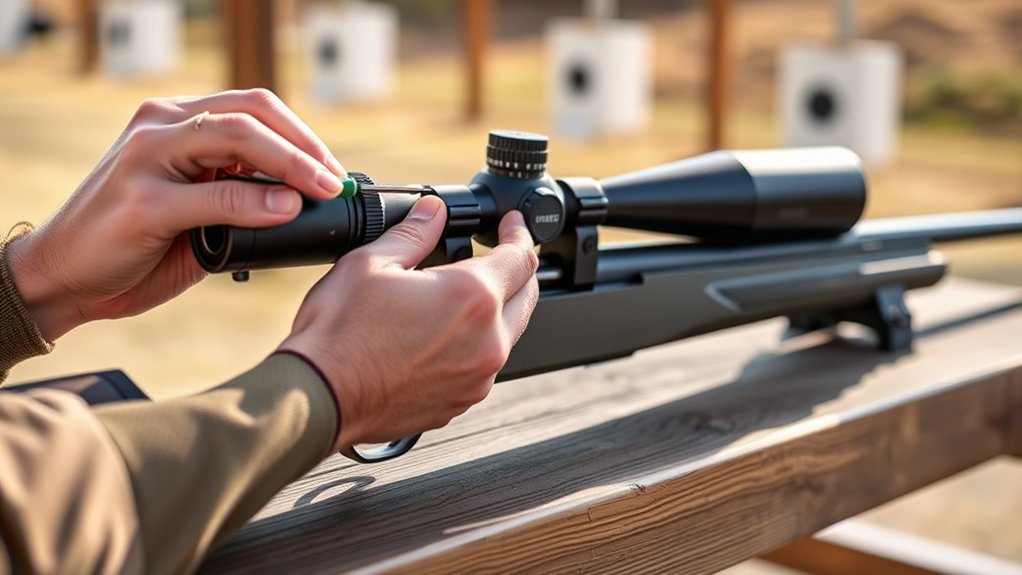
Before you adjust anything else, you need to reset your air rifle scope to a known zero so every click on the turrets has a reliable reference. Set the rifle on a stable rest, fire a careful group at your chosen distance, and note the impact point.
Then loosen the turret caps if needed, and rotate the elevation and windage indicators to match that point of impact without moving the reticle off target. This lets you reset optics while preserving your shooting data.
Recheck the group, then fine-tune and adjust turrets in small increments until the reticle and impacts coincide. Confirm the new zero with another group, record the click values, and return the caps to secure the settings.
Check Your Mounts And Rail Alignment
Next, inspect your mounts and rail alignment to make sure the scope can hold zero. Check that both rings sit squarely on the rail and that each screw engages evenly.
Verify rail compatibility before tightening, since mismatched interfaces can tilt the optic or damage the finish. Use mounting safety practices: support the rifle, keep the screws clean, and tighten them in a balanced pattern to the manufacturer’s torque.
Confirm the scope tube isn’t pinched and that there’s equal gap at each ring.
| Check | Result |
|---|---|
| Front ring | Aligned |
| Rear ring | Aligned |
| Rail contact | Full |
| Screw tension | Even |
| Tube clearance | Uniform |
Recheck alignment after a few turns, then mark the screws if needed.
Why Recoil And Pellet Weight Change Zero
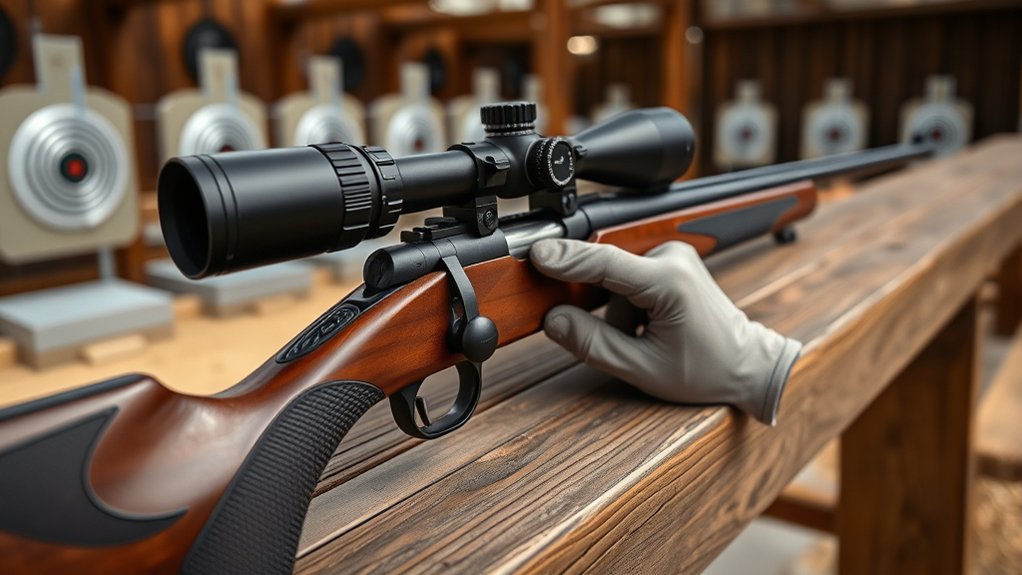
Even with the scope mounted squarely, an air rifle can still shift point of impact because its recoil cycle is different from a firearm’s and because pellet mass changes the way the rifle vibrates. You need to understand that the piston or spring moves forward, then the rifle settles, so the scope sees motion in two directions.
If that recoil consistency varies, your zero won’t stay fixed. Pellet dynamics matter too: heavier pellets stay in the barrel longer, letting the rifle’s vibration pattern change before the pellet exits. Lighter pellets leave sooner and may print elsewhere.
Test one pellet weight at a time, and verify zero after any change in ammo or power setting. Small differences in timing can move groups several clicks.
Boresight Your Air Rifle Scope
Start by boresighting your air rifle scope so the reticle aligns roughly with the bore before you fire. Set the rifle steady, center the bore on a clear target, then adjust the scope until the point of aim matches that reference.
This initial setup won’t replace live zeroing, but it’ll reduce shot error and speed up your final adjustments.
Initial Boresight Setup
Before you zero in at the range, boresight your air rifle scope so the reticle sits close to the pellet path at a short distance. Mount the rifle solidly, align the scope, and adjust windage and elevation in small clicks.
Use discussion ideas about Subtopic to confirm your setup, then note unrelated two word pairs only as reminders, not targets. Keep the bore and optic centered on a fixed point, and tighten rings evenly.
| Step | Action |
|---|---|
| 1 | Secure the rifle |
| 2 | Level the scope |
| 3 | Center the reticle |
| 4 | Make fine clicks |
| 5 | Lock hardware |
This initial boresight setup reduces correction later and gives you a precise starting point for range work.
Verify Point Of Aim
At the range or on a safe, stable rest, verify point of aim by aiming at a single, clearly defined target and checking where the reticle centers on that point. You should keep the rifle unloaded, align your cheek weld consistently, and confirm that the scope picture stays fixed while you adjust your position.
If the reticle drifts off target, inspect for mounting mistakes, loose rings, or improper eye relief before changing turret settings. Fire a three-shot group only after the reticle is centered, then compare impact to aim.
Small offsets can indicate calibration errors in the scope or setup, not just shooter input. Make one correction at a time, then recheck point of aim until the reticle and target align precisely.
Sight In Your Air Rifle Scope
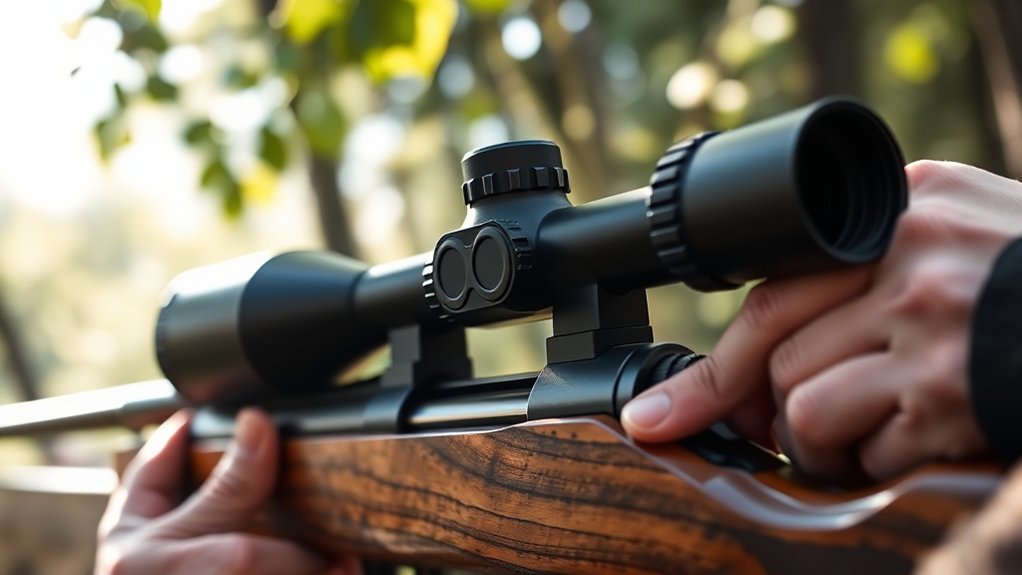
Set your zeroing distance before firing, and confirm it matches your pellet velocity and intended use. Fire a tight group from a stable rest, then check the point of impact against the point of aim.
Adjust the scope in small increments, and repeat the group test until your shots consistently land at zero.
Zeroing Distance Setup
Where should you zero your air rifle scope? Start by choosing a distance that matches your rifle’s power and your intended use. For most spring-piston and PCP air rifles, 25 yards gives a practical baseline, while 10 to 15 yards suits short-range field shooting.
Set your lucky targets at the exact range you’ll measure, and keep the target centered at your shooting stance height to avoid angle error. Use a stable bench, align the rifle level, and focus on a clean sight picture.
Fire from the same position each time so your zeroing distance stays consistent. If you shoot mostly at one range, zero there. If you need versatility, select the distance where your pellet’s trajectory stays flattest across typical shots.
Group Adjustment Checks
Now check your groups to sight in the air rifle scope. Fire a controlled 3- to 5-shot group from a solid rest, then measure the center-to-center spread. If impact drifts, dial the turrets in small, repeatable increments and keep your aiming point unchanged.
- Confirm the group’s horizontal and vertical offset.
- Adjust the windage and elevation knobs only after each group.
- Recheck parallax; resetting parallax sharpens focus and reduces aiming error.
- If your zero still shifts, inspect the mounting and try adjusting reticle alignment.
Repeat this cycle until consecutive groups land at the same point. Record each correction so you can track how the scope responds and avoid over-adjusting.
Dial In Windage And Elevation
With your scope mechanically centered and the rifle secured, begin dialing in windage and elevation by making small, deliberate adjustments toward your point of impact. Use windage basics to move the reticle left or right, and apply elevation principles to correct vertical error.
Fire a confirmed three- to five-shot group at your chosen zero distance, then measure the group center relative to point of aim. Turn the appropriate turret in the direction that moves impact to center.
Count clicks carefully, using the scope’s click value to calculate correction. Refire after each adjustment to verify movement. Keep the rifle stable, maintain the same ammunition, and note every change.
Stop when the group centers consistently, then make a final confirmation group before recording your zero.
Frequently Asked Questions
How Often Should I Reset My Air Rifle Scope?
You usually shouldn’t reset your air rifle scope often; only when point-of-impact shifts, after transport, or mounting changes.
Reset frequency depends on recoil and use, while scope durability determines how long zero holds reliably.
Can Weather Affect My Air Rifle Scope Zero?
Yes, weather can shift your zero; temperature, humidity, and pressure change point of impact. You should verify zero after weather effects and perform durability checks on mounts, rings, and turrets before shooting.
What Tools Do I Need for Scope Adjustment?
You’ll need a screwdriver set, torque driver, Allen keys, bubble levels, and a bore sighter for scope mounting. For zero maintenance, keep lens cloth, marker, and a target notebook handy.
Should I Recheck Zero After Changing Pellets?
Yes, you should recheck zero after changing pellets; it’s like tuning a compass after a storm. Different weights alter recoil impact and pellet drift, so confirm point of impact, adjust your scope, and verify consistency.
How Do I Know if My Scope Is Damaged?
You’ll know your scope’s damaged if it won’t hold zero, tracks inconsistently, shows blurred optics, or has loosened mounts. Check scope maintenance and pellet compatibility first; then inspect for dents, moisture, and internal shifting.
Conclusion
By resetting your air rifle scope with steady groups and careful turret adjustments, you bring the reticle and pellet impact back into alignment. Check your mounts, account for recoil and pellet weight, then boresight and sight in with patience. Each click is a small correction, but together they sharpen your zero like tuning a compass before a long journey.
Confirm the final group, lock the caps, and trust your setup to point true. Following these steps ensures your accuracy and reliability, making the process of how to reset air rifle scope straightforward and effective.