If you’re choosing between a straight and angled spotting scope, the better option depends on how you use the spotting scope.
A straight scope lets you find targets fast and keeps your eye aligned with the barrel, which helps in active field use.
An angled scope is easier on your neck during long sessions and works better when you’re sharing a view or glassing at mixed elevations.
The tradeoff isn’t simple, and the details matter.
Key Takeaways
- Neither is universally better; straight scopes favor fast target acquisition, while angled scopes favor comfort during long sessions.
- Choose straight if you need quick scanning, rapid transitions, and easy tracking of moving subjects.
- Choose angled if you want reduced neck strain, seated viewing, or easier use on varied terrain.
- Straight scopes often feel more intuitive for quick setup and eye-level observation.
- Test both in your typical field positions, because ergonomics and tripod reach matter more than image quality.
What Is a Straight Spotting Scope?

A straight spotting scope is a spotting scope with an eyepiece aligned directly in line with the objective lens, so you look through it along a straight optical path. You point the tube at the target, then view through the same axis, which can make acquisition fast and intuitive.
For you, that alignment often improves hand-eye coordination when you’re scanning distant birds, wildlife, or range markers. In birding ergonomics, a straight body can feel efficient when you’re viewing from a standing position or tracking moving subjects.
It also pairs well with telescope accessories such as digiscoping adapters, because the rigid, linear geometry simplifies setup and alignment. Compared with other designs, a straight scope can support rapid target finding, but it may demand more neck movement when you observe from a lower tripod height.
You’ll usually value it most when speed, direct sighting, and simple optical geometry matter.
What Is an Angled Spotting Scope?
An angled spotting scope places the eyepiece at a fixed incline, usually around 45 degrees, so you can look through it without keeping the tripod at eye level. You’ll find this layout is especially useful for seated viewing, shared use, and high-angle observation, while straight models can feel quicker for fast target acquisition.
Its key design features include the angled prism housing, adjustable focus controls, and an eyepiece position that reduces neck strain during extended sessions.
Eyepiece Angle Basics
An angled spotting scope places the eyepiece at roughly a 45-degree angle to the barrel, so you look downward into the optic rather than straight through it. That eyepiece angle changes how you align your head, body, and tripod, and it often improves viewing ergonomics because you don’t need to hunch as much.
Compared with a straight model, it can feel more natural when you adjust focus or switch targets with fine precision.
- The angled layout reduces neck strain during extended observation.
- The optical path stays efficient, so image quality depends more on lens design than on the bend.
- The angled housing can make minor height adjustments easier when you share the scope or compare settings.
You’ll usually notice the difference most during careful, sustained viewing.
Common Viewing Positions
When you use an angled spotting scope, you’ll usually view from a standing, seated, or kneeling position. Each setup changes how easily you can keep the eyepiece aligned with your eye.
You’ll notice angled viewing often supports better birding ergonomics during long sessions, especially if you alternate positions.
| Position | Effect |
|---|---|
| Standing | Fast setup, but you may need to raise your head more. |
| Seated | Most stable for prolonged observation and reduced neck strain. |
| Kneeling | Useful for low targets, though it can feel less balanced. |
| Mixed | Lets you adapt to terrain without losing sightline control. |
Compared with a straight scope, this layout helps you observe from more natural body angles, which can improve comfort without demanding constant posture correction.
It also reduces unnecessary handling, which can indirectly support scope durability over time.
Key Design Features
An angled spotting scope uses an eyepiece set at about 45 degrees to the optical tube, so you look downward into the eyepiece rather than straight back through it. That geometry changes how you mount, aim, and share the scope, and it drives key design considerations.
You’ll usually get easier viewing from seated positions, especially when you scan high targets or observe for long periods.
- The angled body reduces neck strain, but it can slow target acquisition compared with straight tubes.
- The eyepiece angle improves tripod clearance and lets you adjust height with less leg extension.
- Rotating collars and waterproof housings support flexible use, yet they add weight and complexity.
You should weigh these ergonomic tradeoffs against your viewing environment, not just magnification or objective size.
Straight Or Angled: What’s Different?
A straight spotting scope keeps the eyepiece in line with the objective, so you look directly through the tube, while an angled model bends the optical path to place the eyepiece at a set offset. That viewing angle changes how you position your neck, tripod, and body, and it affects how easily you can track targets at different elevations or share the scope with others.
You’ll usually prefer straight designs for fast, direct sightlines and angled designs for longer sessions, steep viewing angles, or more flexible group use.
Viewing Angle Differences
At first glance, the key difference between straight and angled spotting scopes is the line of sight: a straight scope keeps the eyepiece in direct alignment with the objective lens, while an angled scope bends that viewing path, typically at 45 or 60 degrees. You’ll notice this changes how you position your head, shoulders, and tripod, and it directly affects viewing angle and ergonomic comfort.
- A straight model gives you a direct, linear sightline with minimal optical offset.
- An angled model lets you tilt the eyepiece while keeping the target in frame.
- The geometry alters how you track subjects without shifting the entire setup.
This difference isn’t about image quality; it’s about how the scope meets your eye and how efficiently you maintain alignment.
Best Use Cases
That ergonomic difference matters most when you decide where and how you’ll use the scope. If you’re glassing from a car window, seawall, or tall tripod, a straight scope lets you acquire targets fast and track moving birds with minimal repositioning.
You’ll also like it for target transitions in open country, where quick alignment beats comfort. Angled models excel when you share a tripod, work at varying heights, or spend long sessions scanning ridgelines; you can keep a relaxed neck and maintain stable posture.
For Birding ergonomics, the angled design often reduces fatigue during prolonged observation. Telescope mounting also matters: angled scopes give you more flexibility with leg extension and eyepiece access, while straight scopes simplify centering when the tripod setup stays fixed and the sightline changes often.
Best Uses for Straight Spotting Scopes
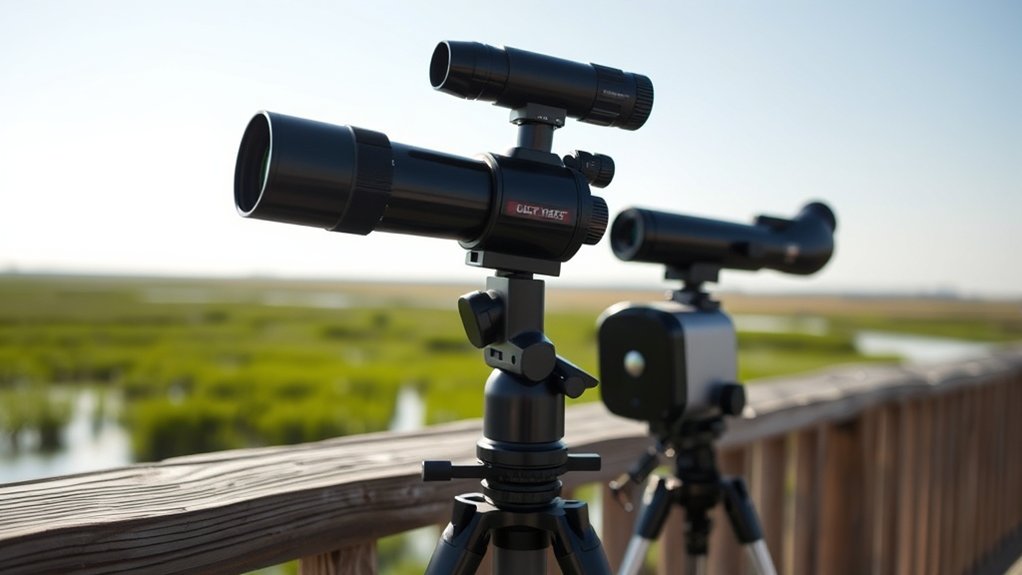
Straight spotting scopes work best when you want a fast, intuitive line of sight from tripod to target, especially for target shooting, birding, and any situation where you’re viewing subjects at or near your eye level. You’ll mount it, center it, and track movement with minimal reframing, which makes it ideal for techniques comparison and portability practicality in the field.
Straight spotting scopes give you a fast, intuitive view for target shooting, birding, and eye-level observation.
- Range work: You can spot bullet holes, verify group size, and make quick corrections without changing your body position.
- Birding at eye level: You’ll scan fences, shorelines, and feeders efficiently because the eyepiece aligns naturally with your stance.
- Mobile observation: You can pack and deploy it quickly, and the straight-through tube keeps setup simple when you value fast transitions over complex angles.
Compared with angled models, straight scopes reduce handling steps and deliver a direct viewing path, so you’ll spend less time adjusting and more time observing.
Best Uses for Angled Spotting Scopes
Angled spotting scopes shine when you need long viewing sessions, shared use, or frequent height changes, because the 45-degree eyepiece lets you keep a more relaxed posture while still maintaining precise alignment. You’ll notice the biggest advantage when you scan from tripods set at variable heights, especially on slopes, docks, or uneven ground.
The angled body also improves birding ergonomics, since you can keep your neck neutral while tracking targets near treetops, mudflats, or distant ridgelines. For group observation, you can hand off the scope without constantly resetting the tripod, which makes teaching and comparison viewing easier.
Compared with straight models, angled designs usually offer better field versatility for mixed terrain and extended glassing. They also pair well with taller observers or changing positions, because you can fine-tune the angle instead of forcing your body into alignment. If you prioritize comfort and adaptability, angled scopes fit your workflow well.
Straight Vs Angled for Birding?

For birding, you’ll usually choose based on how you plan to track and observe birds in the field: a straight spotting scope is faster for quickly locating birds because you can point the barrel directly at your target, while an angled scope is easier on your neck during long sessions and when you’re watching birds at different elevations.
If you move constantly, straight models feel intuitive; if you scan marshes or treetops, angled models improve birding ergonomics and reduce awkward posture.
- Target acquisition: Straight scopes let you follow fast, low-flying birds with less refocusing.
- Viewing comfort: Angled scopes support longer sessions and sharing through a tripod.
- Field portability: Straight scopes often pack and deploy faster, while angled scopes can ride lower in a bag.
You should match the body angle to your terrain, since the right choice depends more on observation style than image quality.
Straight Vs Angled for Target Shooting?
When you switch from birding to target shooting, the choice shifts from mobility and comfort to sight picture and repeatable alignment. You’ll often find a straight scope gives you the fastest line from target to eyepiece, which helps when you’re calling shots or checking multiple lanes in rapid sequence.
That direct axis can feel more intuitive during prone work, benchrest sessions, and wind-reading at distance. An angled scope, however, lets you keep the tripod lower while maintaining a comfortable head position, which can reduce neck strain during long relays and support cleaner observation notes.
In strategy planning, straight models favor quick scan patterns, while angled models support sustained sessions with less posture fatigue. For equipment maintenance, both designs need equal care, but angled bodies may invite slightly more dust in the eyepiece area if you store them open.
Your shooting tempo and firing position will shape which optical geometry serves you best.
How To Choose Between Straight And Angled
To choose between straight and angled spotting scopes, start by matching the optic to your viewing angle, tripod height, and how long you plan to observe. You’ll usually favor straight models for quick target acquisition, especially when you can keep the eyepiece at shoulder level. Choose angled models when you need to share the scope, scan uphill, or maintain a relaxed neck position during extended sessions.
- Evaluate setup geometry: If you must raise the tripod high, an angled body keeps the eyepiece reachable and often improves tripod stability.
- Consider outdoor lighting: Straight scopes can reduce strain in bright, direct light, while angled eyepieces help you shield glare more easily.
- Match use case: For fast tracking and moving between positions, straight works better. For long glassing sessions, angled usually offers superior comfort and less fatigue.
Test both in your typical field position before buying.
Frequently Asked Questions
Which Spotting Scope Is Easier to Share With Multiple Users?
You’ll usually share an angled spotting scope more easily, since users can stand at different heights and still view comfortably. Its sharing versatility and user ergonomics beat a straight scope, though straight models align faster for single users.
Does Angled Viewing Reduce Neck Strain During Long Sessions?
Yes, angled viewing usually reduces neck strain during long sessions, since you can keep a more natural posture. You’ll notice better angled comfort than with straight scopes, especially when you’re sharing the eyepiece.
Which Design Is More Compact for Travel and Storage?
You’ll find straight scopes usually offer a more compact design, making packing easier. Their inline body saves space and improves travel convenience, while angled models need slightly more room because of the bent eyepiece housing.
Are Straight or Angled Scopes Better in Bad Weather?
Angled scopes usually handle bad weather better because you can keep a lower, more sheltered stance; however, straight advantage helps you track quickly in wind. You’ll still face weather impact, so prioritize sealed optics.
Which Spotting Scope Type Is Faster to Set Up?
Straight scopes usually set up faster: you align them with your eye in one motion, while angled scopes need more adjustment.
You’ll get quick setup, though angled models often reward you with better ergonomic viewing.
Conclusion
You might expect the “better” spotting scope to be the one that looks most ergonomic, yet the real answer is less glamorous: it depends on how you work.
If you’re scanning fast-moving birds or shifting positions often, a straight scope gives you quicker, more direct target acquisition.
If you’re glassing for hours, an angled scope quietly wins by saving your neck.
So, test both, because the best choice is the one that makes your longest sessions feel shortest. In the end, choosing the better spotting scope depends on your specific needs and usage style.