Only a fraction of spotting scopes can deliver usable detail beyond 40x magnification, so when searching for the most powerful spotting scope, “more power” isn’t the whole story.
When you compare models, you’ll see that objective size, ED glass, coatings, and tripod stability often matter more than headline zoom numbers.
If you want the strongest practical option, you need to balance light, sharpness, and handling in a way that isn’t obvious at first.
Key Takeaways
- The most powerful spotting scope is not just the highest zoom; it’s the one with the clearest, brightest usable image.
- In practice, 15–45x and 20–60x scopes are most useful; above 60x often becomes shaky, dim, and less sharp.
- Larger objective lenses, like 80mm or 100mm, gather more light and improve detail, especially at higher magnification.
- Premium glass and coatings matter because they preserve contrast, reduce glare, and control chromatic aberration.
- A rigid tripod and stable mount are essential, because high magnification magnifies vibration, wind, and tracking errors.
What Makes a Spotting Scope Powerful
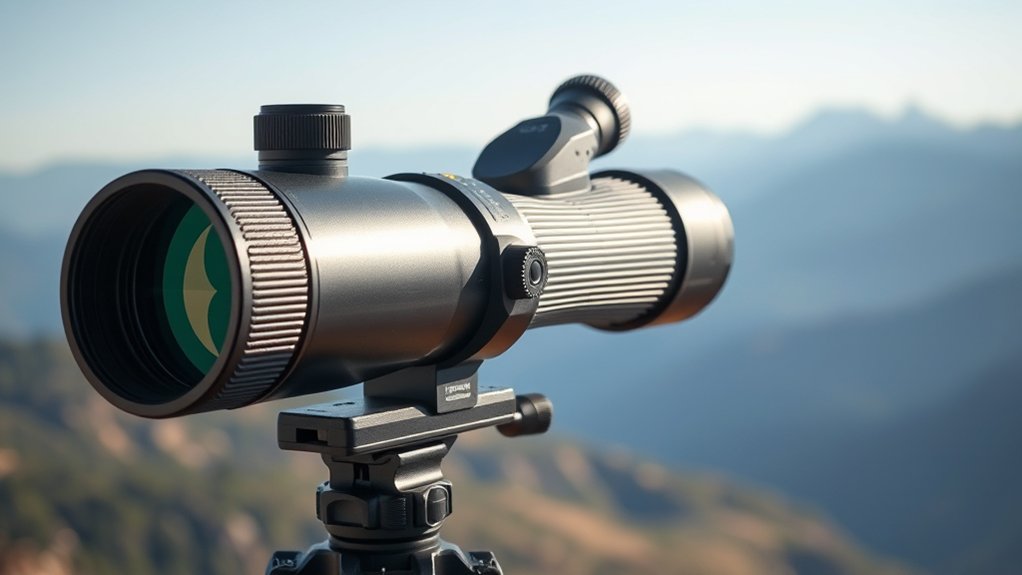
A spotting scope feels powerful when it combines high magnification, strong light transmission, and crisp edge-to-edge resolution without sacrificing stability. You should judge power by optical performance, not just numbers on the barrel.
A larger objective lens can gather more light, but you still need coatings that preserve contrast and color fidelity. Superior distortion control keeps straight lines true and prevents image bending near the edges, which matters when you inspect fine detail.
A rigid chassis also helps because wind resistance reduces vibration and keeps the view steady in exposed conditions. Eyepiece design, lens alignment, and precise focusing all contribute to usable power.
If the scope shakes, dims, or softens at the perimeter, you lose practical reach. You want a system that delivers a bright, stable, and accurate image so distant targets stay identifiable under real-world conditions, not just in ideal specifications.
Magnification vs. Real-World Clarity
High magnification does not automatically mean better clarity, because every increase in zoom magnifies optical flaws, atmospheric haze, and hand or tripod vibration along with the target. You may see a larger image, but you don’t always gain usable detail.
At some point, image resolution becomes limited by the scope’s optics and the observing conditions, not by the dial on the eyepiece. You should think in terms of magnification tradeoffs: a moderate setting often gives you a steadier, brighter, and sharper view than maximum power.
If you push too far, fine textures can blur, contrast can drop, and the image can look soft even when the subject is close. For real-world use, choose the lowest magnification that still lets you identify the detail you need.
That approach usually delivers more practical clarity than chasing the highest number on the barrel.
Why Objective Lens Size Matters
Objective lens size largely determines how much light your spotting scope can gather, which directly affects image brightness, contrast, and usable detail. When you choose a larger objective, you usually get a brighter view at dawn, dusk, or under heavy cloud cover, because the wider front element admits more light to the optical system.
That extra light also helps you resolve fine edges and subtle color separation, especially when atmospheric conditions reduce visibility. You should balance these objective considerations against portability, since bigger lenses add bulk, increase overall length, and often demand sturdier support.
They can also raise manufacturing cost and make hand carrying less practical. If you plan to observe from a fixed position, a larger objective can be worthwhile. If you move often, you may prefer a smaller lens and accept reduced low-light performance.
In short, objective size sets the optical ceiling.
Which Zoom Range Works Best?
Which zoom range works best depends on how you plan to use the spotting scope, because magnification trades field of view, brightness, and image stability for reach. If you watch birds, 15-45x often balances detail and usability. For long-range target work, 20-60x gives you more reach, but you’ll face high power tradeoffs sooner.
Above 60x, magnification limits become obvious: shimmer, vibration, and narrow framing can reduce practical detail.
| Zoom Range | Best Use | Notes |
|---|---|---|
| 15-30x | Scanning | Wide view, easier tracking |
| 15-45x | General use | Versatile, moderate detail |
| 20-60x | Long-range viewing | More reach, tighter field |
| 25-75x | Specialized use | Demands stable setup |
| 30x+ | Extreme detail | Clear only in ideal conditions |
Choose the lowest zoom that shows enough detail. You’ll usually get a sharper, more usable image than chasing maximum power.
How Glass and Coatings Improve Image Quality
How do glass quality and coatings affect what you see through a spotting scope? You get sharper detail when the objective and eyepiece use high-grade glass with low dispersion, because chromatic aberration drops and fine edges stay clean at high magnification.
Better polish and tighter tolerances also reduce scatter, so contrast improves and dark textures remain separated from background tones. Glass coatings matter just as much: anti-reflective layers cut surface glare, increase light transmission, and help you keep a brighter image in dim conditions.
Multi-coated optics usually preserve more contrast across the field, while phase-corrected and dielectric coatings can improve color fidelity and reduce internal reflections. You may notice slight image warmth in some systems, which comes from coating design and glass formulation, but that’s often a tradeoff for a more natural, less harsh view.
In practice, quality optics let you resolve more detail with less eye strain.
Top Spotting Scope Brands for High Power
When you compare premium high-power spotting scope brands, you’ll see that the top models emphasize optical resolution, edge-to-edge sharpness, and stable image performance at long range. You should focus on brands that pair high magnification with quality zoom mechanisms, precise focus control, and effective lens coatings. These features matter because they help you maintain usable detail as power increases.
Premium High-Power Brands
Premium high-power spotting scope brands earn their reputation by combining optical resolution, mechanical stability, and usable magnification at the top end of the zoom range. You’ll notice names like Swarovski, Kowa, Zeiss, and Leica because they control color fidelity, edge sharpness, and focus precision under demanding field use.
When you compare options, weigh budget tradeoffs against build quality, since premium models often use tighter tolerances, stronger housings, and better waterproof durability. You should also inspect eyepiece interfaces, tripod collar rigidity, and internal baffling, because these affect image steadiness and contrast more than marketing claims.
In practice, the best brand for you delivers consistent clarity in bright or low light, resists alignment drift, and maintains performance after long-term outdoor exposure.
Best Magnification Features
For high-power spotting scopes, the magnification system matters as much as the glass itself, because you need usable detail without sacrificing brightness, contrast, or image stability. You should favor zoom ranges like 20-60x or 25-75x, since they give you flexibility for scanning and fine observation.
Top brands engineer smooth, precise zoom rings, so you can adjust power without image jump or backlash. You’ll also want a larger exit pupil at lower settings and strong lens coatings to preserve contrast at higher magnification.
Don’t trust magnification myths that equate more power with better performance; above the scope’s optical limit, detail drops fast. Look for rigid internal mechanics, ED glass, and consistent edge sharpness, because these features determine whether high power remains truly usable in the field.
Best Spotting Scopes for Birding, Hunting, and Shooting
The best spotting scopes for birding, hunting, and shooting balance magnification, optical clarity, light transmission, and field durability for their intended use. For birding, you’ll benefit from a wide field of view, fast focus control, and birding ergonomics that reduce fatigue during long observation sessions.
For hunting, prioritize rugged sealing, muted finishes, and hunting camouflage that helps you remain visually unobtrusive in varied terrain. For target shooting, choose models with precise reticles, sharp edge-to-edge resolution, and repeatable focus that lets you read impacts at distance.
You should also compare objective size, glass quality, and coating performance, since these factors affect image brightness and contrast in low light. Angled bodies usually improve comfort for elevated viewing, while straight bodies can speed target acquisition. Select the scope that matches your primary task, because a specialized optical design usually performs better than a general-purpose compromise.
How Tripods Improve Spotting Scope Stability
Even the sharpest spotting scope can’t deliver a steady image if your support system flexes or vibrates, so a tripod becomes the foundation for usable high-magnification viewing. You reduce image shake by spreading the load across three rigid legs, which lowers oscillation from wind, terrain, and hand pressure.
When you adjust leg angle and center column height, you improve tripod stability and keep the optical axis aligned with the target. A properly sized head also helps you fine-tune mount balance, so the scope doesn’t tip forward or drift during panning.
With better balance, you can track birds, impacts, or distant terrain without constant refocusing. You also minimize fatigue because you’re not fighting the optic’s weight. For high power observation, that mechanical control matters more than raw magnification, since even slight movement can blur detail and reduce contrast.
Key Features to Compare Before Buying
What should you compare first when narrowing down a spotting scope? Start with magnification range and objective lens diameter, because they set image scale and brightness. You’ll want enough power for detail, but not so much that the view becomes dim or shaky.
Compare magnification range and objective lens diameter first—they determine image scale, brightness, and usable detail.
Check lens coatings next; fully multi-coated optics usually improve contrast, reduce glare, and help in low light. Then compare prism and glass quality, since ED or fluorite elements can control chromatic aberration better than standard glass.
Evaluate field of view, eye relief, and focus speed, because they affect how easily you track targets. Also review weather sealing and nitrogen purging if you plan to use the scope outdoors.
An ultra wide apparent field can make scanning easier, while a straight or angled body changes handling and tripod use. Finally, weigh weight, build materials, and warranty so you can judge durability against portability.
Which Spotting Scope Is Most Powerful for You?
You’ll get the most powerful spotting scope for your needs by balancing magnification against image clarity, since higher zoom can reduce sharpness and brightness. A larger objective lens can improve light transmission and detail resolution, but it also increases size and weight.
You should also account for field of view, because a narrower view makes target acquisition harder even when magnification is high.
Magnification Versus Image Clarity
Higher magnification does not always mean a more powerful spotting scope, because optical quality determines how much usable detail you can actually see. When you increase power, you narrow the field of view and magnify shake, atmospheric distortion, and small optical errors.
That’s one of the main high power tradeoffs: you may gain size, but lose image fidelity if the scope can’t resolve fine contrast cleanly. You should compare how the scope performs at its useful upper range, not just the label on the barrel.
A lower-magnification scope with sharp edges, strong contrast, and minimal color fringing can reveal more real detail than a softer high-power model. For your use, prioritize the clearest image at practical magnification, since clarity turns magnification into usable observation.
Objective Lens Size
An objective lens gathers light, and that directly affects how much detail you can see through a spotting scope, especially in low light or at longer distances. You’ll usually see 60mm, 80mm, or 100mm objectives; larger diameters improve brightness and reduce image noise, but they also add weight and bulk.
For high power vs low light, a bigger lens helps preserve usable contrast when you increase magnification. Balance eyepiece compatibility vs mounted stability, because a heavy body can strain a tripod while certain eyepieces may demand extra support.
- Bright dawn ridge line
- Shadowed treeline at dusk
- Crisp rock texture
- Heavy tripod on packed soil
- Wide front glass catching light
Field Of View
Field of view determines how much of the scene you can see at a given magnification, and it often matters as much as raw power when you’re judging a spotting scope. You should compare angular FOV and linear FOV, since both affect target acquisition and tracking.
At long distance, a narrower view can make finding subjects harder, even if the scope offers higher effective magnification. Wider FOV helps you scan faster, especially when wind or heat shimmer shifts the target.
Also weigh distance weight, because heavier optics can reduce steadiness and limit practical use. Check eye relief and edge sharpness, since usable field can shrink if image quality drops near the perimeter. Good color accuracy also improves subject separation and reduces eye strain.
Frequently Asked Questions
Can Spotting Scopes Be Used for Stargazing?
Yes, you can use a spotting scope for stargazing if you have good spotting scope compatibility and low night sky brightness. You’ll see the Moon, planets, and bright clusters, though wide-field views are limited.
Do Angled and Straight Scopes Affect Comfort Differently?
Yes, they do: angled comfort suits you for prolonged viewing, especially at high mounts, while straight comfort feels more natural for quick, level targets.
You’ll adjust neck position, tripod height, and target access accordingly.
Are Waterproof Spotting Scopes Always Better?
No, you shouldn’t assume waterproof means better; like a storm-proof shell, it protects gear, not image quality.
You’ll still weigh waterproof limitations, price vs. optics, and sealing against weight, brightness, and serviceability.
How Much Does Eye Relief Matter in Powerful Scopes?
Eye relief matters a lot in powerful scopes because you’ll need stable viewing and less vignetting. Good eye relief improves magnification comfort, lets you maintain a full field of view, and reduces eye strain during extended use.
Can Phone Adapters Work With High-Power Spotting Scopes?
Yes, you can use phone adapters with high-power spotting scopes, but you’ll need a rigid mount, precise alignment, and good eye relief. Two word ideas matter: stability, compatibility, and vignette control under magnification.
Conclusion
You’ll find that the “most powerful” spotting scope is like a lantern in a storm: raw brightness alone won’t guide you unless the lens, coatings, and mount work together.
You get the best results when you choose a large objective, ED or fluorite glass, and a stable tripod. Then use practical magnification instead of chasing numbers.
In the end, you’re buying clear, steady detail, not just higher zoom. This is what truly defines the most powerful spotting scope.