To keep a rifle scope from fogging up, you need to control moisture, temperature shifts, and surface contamination before they start working against you. Managing these factors early on will help maintain clear vision during use.
You’ll get better results by keeping the optic dry, using proper desiccants and lens caps, and applying an anti-fog treatment that won’t harm coated glass.
The real issue isn’t just condensation; it’s how quickly it builds under field conditions, and that’s where the next step matters most.
Key Takeaways
- Keep the scope, rifle, and case completely dry before storage and transport.
- Use desiccant packets and dry, weather-resistant lens caps to limit moisture exposure.
- Let the scope acclimate to outdoor temperature before shooting to reduce condensation.
- Apply a scope-safe anti-fog product in a thin, even layer and reapply after cleaning.
- Clean lenses gently with microfiber and lens-safe tools, and avoid breathing directly onto the glass.
Understand Why Scopes Fog Up
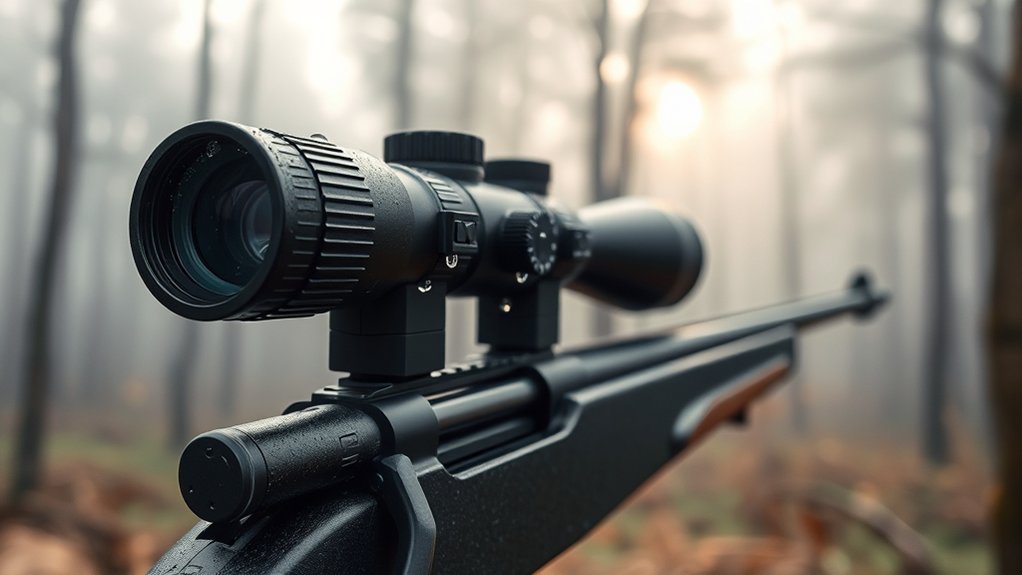
Fog forms on a rifle scope when humid air meets a cooler lens surface, causing water vapor to condense into tiny droplets. You see this when your scope’s temperature drops below the surrounding air’s dew point, especially in humid environments.
The lens coating and housing don’t prevent condensation; they only affect how much light passes through the refractive optics. When moisture scatters incoming light, image contrast falls and the reticle can appear blurred.
Rapid temperature changes make the problem worse, because the glass cools faster than the air around it. You can also get fogging from your breath, rain, or moving between climate-controlled and outdoor conditions.
Understanding this thermal mismatch helps you predict when condensation will form and why visibility degrades.
Keep Your Rifle Scope Dry Before You Go
Before you head out, make sure your scope, rifle, and soft case are completely dry, because any trapped moisture can condense as soon as temperatures change. Wipe every exterior surface with a lint-free cloth, then inspect the turret caps, objective bell, and eyepiece for hidden droplets.
If you stored the optic after rain or high humidity, let it air-dry indoors before packing it. Keep desiccant packets in the case to reduce residual moisture during transport. Check that lens caps fit tightly, but don’t seal in dampness.
Dry gear also helps preserve zero, so your windage adjustments stay consistent when you arrive. During safety training, you should treat moisture control as part of routine equipment inspection, not an afterthought. Dry optics perform more predictably and demand less correction in the field.
Use Anti-Fog Products on Lenses

You should choose an anti-fog spray that’s explicitly rated safe for coated scope lenses, since harsh solvents can damage optical finishes. Apply it in a thin, even film to minimize streaking and maintain optical clarity without altering image quality.
Reapply after cleaning, because wiping removes the protective layer and reduces fog resistance.
Choose Scope-Safe Sprays
A scope-safe anti-fog spray can reduce condensation by leaving a thin hydrophilic film on the lens surface, which helps moisture spread evenly instead of forming light-scattering droplets. You should choose formulas explicitly labeled for optical coatings, because aggressive solvents can damage lens treatments and undermine scope effectiveness.
Check the ingredient list for ammonia, alcohol overload, or abrasive additives, and avoid products marketed for household glass unless the maker confirms compatibility. Apply a maintenance mindset: verify that the spray suits multi-coated optics, your turret housing, and any rubberized seals.
You also want residue-free performance, since oily films can attract dust and reduce contrast. Before field use, test the product on an inconspicuous edge, then confirm that clarity stays stable under humidity changes, recoil, and temperature swings.
Apply Thin Even Coats
Apply the anti-fog product in a thin, even film across the lens, because excess coating can streak, pool at the edges, and reduce image clarity. You should use only enough material to create a uniform lens coating that breaks surface tension without leaving visible residue.
Work the product over the outer surface with gentle, consistent motions, and keep pressure light so you don’t disturb optical alignment or smear the glass. Focus on full coverage, not thickness, because fog control depends on an even molecular layer, not a heavy deposit.
If you see glints, smudges, or wet patches, you’ve applied too much. A properly distributed film should look nearly invisible and preserve contrast, sharpness, and target definition in variable temperature and humidity conditions.
Reapply After Cleaning
After every cleaning, renew the anti-fog layer so the lens keeps its moisture barrier and doesn’t lose protection as the coating is removed by wiping or solvent use. You should reapply after cleaning because residue-free glass accepts the treatment more uniformly, and uniform coverage improves optical consistency.
Use a microfiber swab, apply a measured amount, and let it cure before exposure to humidity.
| Step | Action |
|---|---|
| Clean | Remove oils and debris |
| Reapply | Restore anti-fog film |
| Verify | Check for streaks or gaps |
This sequence supports fog prevention strategies by maintaining a stable surface energy on the lens. If you skip reapplication, condensation can nucleate faster on exposed areas, reducing clarity exactly when you need the scope most.
Prevent Fogging in Cold Weather
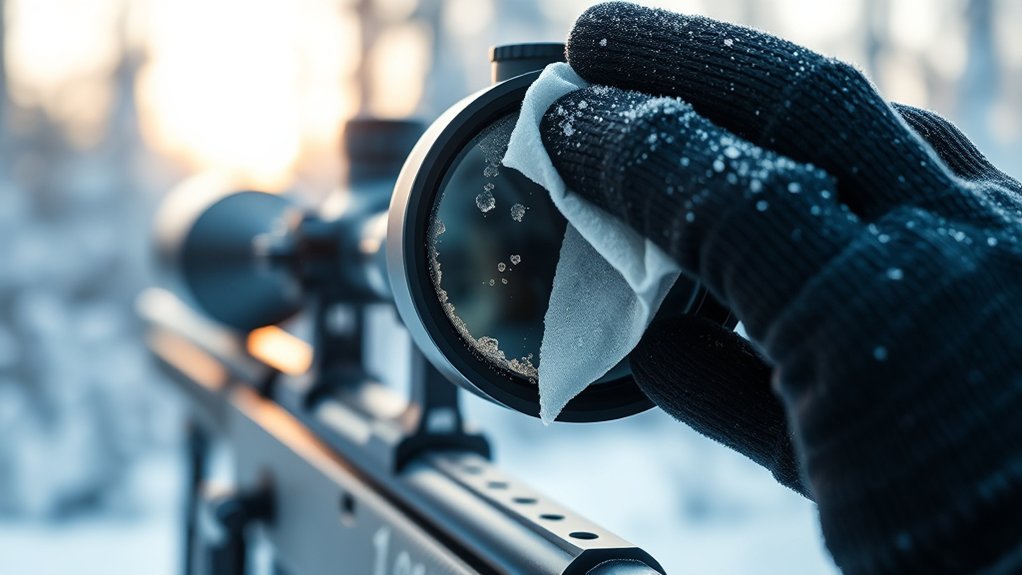
In cold weather, your scope fogs when warm, humid air meets a lens that’s below the air’s dew point, so the fastest way to prevent it is to keep the optic closer to ambient temperature and limit moisture exposure. Before use, let the rifle and scope acclimate outdoors; don’t warm them indoors and then expose them suddenly.
Keep lens caps on until you’re ready to shoot, and avoid breathing directly onto glass during setup. Use a dry, sealed case with desiccant for transport, and inspect O-rings, turret seals, and eyepiece threads for leaks.
Budget hints matter here: a simple neoprene cover can outperform cheap gimmicks. For ethics discussion, don’t use heat sources that can damage coatings or warp seals; controlled temperature management is the correct method.
Handle Humidity and Sudden Temperature Changes
You should seal the scope and its access points against moisture to limit humid air intrusion. Let the optic equalize gradually with ambient temperature instead of moving it directly between extreme conditions. This reduces condensation on internal and external surfaces.
When you’re not using it, store it in a dry case with desiccant to keep relative humidity low.
Seal Against Moisture
Moisture control starts with a tight, intact seal, because humid air and rapid temperature shifts can force condensation inside the scope body. You should inspect moisture seals at the turret caps, objective bell, and eyepiece threads, then replace any cracked O-rings immediately.
Keep anti fog coatings clean, since residue can trap moisture and reduce optical clarity.
| Checkpoint | Target | Action |
|---|---|---|
| O-rings | Flexible | Replace if nicked |
| Lens edges | Dry | Wipe with lint-free cloth |
| Caps | Fully seated | Tighten to spec |
If you store the scope in a sealed case with desiccant, you’ll limit vapor ingress and preserve internal pressure balance. Don’t overtighten fittings; you can distort seals and create microleaks.
Equalize Temperature Gradually
When temperature changes fast, condensation forms on the coldest surfaces first, so let the scope acclimate before exposing it to humid air or moving it from a cold vehicle into a warm environment. You reduce fogging by managing the thermal gradient instead of forcing immediate use.
Hold the rifle in a sheltered area until the optic approaches ambient conditions, and avoid wiping lenses while moisture is still forming; that can spread condensate and residue. During field maintenance, monitor the housing with your hand: if it still feels markedly colder than the surroundings, it needs more time.
This temperature management step is simple, but it prevents internal and external fog from interfering with image clarity and keeps the optic ready for accurate observation.
Store In Dry Cases
A dry storage case helps stabilize a rifle scope between outings by limiting exposure to humid air and abrupt temperature shifts. You should choose a rigid case with an intact gasket seal and add desiccant packs to support humidity control.
Keep the scope uncapped only after it reaches ambient temperature, then place it in dry storage immediately. Avoid leaving the case on concrete, in a vehicle, or near exterior walls, where condensation risk rises.
Check desiccants regularly and replace or recharge them when saturation appears. If your case uses foam, ensure it’s dry before storage, because damp foam can trap moisture against the optic.
This routine reduces internal fogging, protects lens coatings, and keeps thermal transitions predictable.
Protect Your Scope With Lens Covers
How do you stop condensation from settling on your optic in the first place? You shield the lenses with fitted covers, because they limit moisture exchange and reduce thermal shock. In scope maintenance, this is a simple control step that supports fog prevention without adding complexity.
Keep the front and rear caps closed whenever you’re not actively aiming, especially in humid air or rapid temperature changes.
- Use snug, weather-resistant covers.
- Check that caps seal evenly.
- Open only when you’re ready to shoot.
- Reclose them immediately after use.
You’ll also reduce dust exposure and preserve optical clarity. If your cover fits poorly, replace it; gaps let damp air reach the glass and weaken the protection you need.
Clean Rifle Scope Lenses the Right Way
You should clean rifle scope lenses with only gentle, low-pressure motions to avoid scratching the optic coatings. Use proper cleaning tools, such as a lens brush, microfiber cloth, and lens-safe cleaner, because abrasive materials can damage the surface.
If you remove dust first and wipe in controlled passes, you’ll reduce residue without degrading optical clarity.
Gentle Lens Cleaning
Before wiping a rifle scope, clear away loose grit with a blower or a soft, clean brush so you don’t drag abrasive particles across the lens coatings. For gentle lens care, use light, controlled pressure and short strokes; hard rubbing can leave micro-scratches and reduce contrast.
Keep your cleaning practices disciplined:
- Inspect the glass under angled light for residue.
- Apply only minimal cleaning motion to the affected area.
- Wipe from center outward to limit streaking.
- Stop once the surface looks clear and uniform.
You’re aiming for optical preservation, not polishing. Excess contact raises contamination risk and can force moisture into edge seals. If fogging persists, let the scope stabilize in ambient air before touching the lens again.
Proper Cleaning Tools
What tools actually protect a rifle scope’s lenses? Use a clean microfiber cloth, a soft lens brush, and a blower bulb. These tools remove dust without grinding grit into the coatings.
You should keep lens tissue and a dedicated optical cleaning solution in your kit for stubborn residue, but apply liquid sparingly to the cloth, not the glass. Avoid paper towels, shirt fabric, and household cleaners; they can scratch coatings and reduce clarity.
During lens maintenance, brush loose particles first, then wipe in straight, controlled passes. This sequence limits abrasion and supports fog prevention by preserving the anti-reflective layer.
Store your tools in a sealed pouch so they stay uncontaminated. Consistent, careful selection of cleaning tools keeps your scope’s optics clear and serviceable.
Stop Fogging During Rain and Snow
Rain and snow create a fast path to lens fogging by driving moisture into the scope body and forcing warm, humid air to condense on the glass. You can reduce this risk with disciplined fog prevention and rain protection practices.
- Keep lens caps closed until you’re on target.
- Wipe external moisture with a dry microfiber cloth.
- Limit exposure by moving the rifle under cover when you’re not actively aiming.
- After use, let the scope dry at room temperature before storage.
Don’t trap wet air inside a case, and don’t breathe directly onto the objective lens. If precipitation is persistent, pause, dry the optic, and resume only when visibility stabilizes. Consistent handling keeps the image clear.
Choose a Fog-Resistant Rifle Scope
A fog-resistant rifle scope starts with sealed construction and quality glass. You should prioritize nitrogen or argon purging, O-ring seals, and multi-coated lenses, because these features reduce fogging causes by limiting internal moisture and thermal distortion. Compare specifications carefully; not every model marketed by anti fog brands delivers the same seal integrity or coating performance.
| Feature | Why it matters | Your outcome |
|---|---|---|
| Purged tube | Blocks internal moisture | Stable clarity |
| Sealed turrets | Limits air exchange | Less condensation |
| Lens coating | Improves surface behavior | Sharper image |
You’ll also want reputable warranties and verified waterproof ratings. If the scope’s design matches your environment, you’ll gain consistent optical performance and fewer humidity-related failures in the field.
Clear a Fogged Scope Quickly
When your scope fogs up, act fast: move it to a warmer, drier environment and let the lens equalize before you wipe anything. You should then isolate the fogging causes: temperature shock, humidity, or a compromised seal.
When your scope fogs up, move it to a warmer, drier place and let the lens equalize first.
Use a clean microfiber cloth only after condensation breaks. If external moisture remains, apply gentle airflow, not heat, to avoid coating damage.
For rapid recovery, follow this sequence:
- Cap the objective and eyepiece.
- Raise ambient temperature slowly.
- Inspect O-rings and turret seals.
- Verify anti fog testing results before reuse.
If fog returns, your optic likely has internal moisture, and you’ll need service or replacement. Quick correction prevents abrasion, preserves clarity, and limits further contamination.
Frequently Asked Questions
Can Fogging Permanently Damage My Rifle Scope?
Usually no. Fogging causes temporary condensation, not permanent damage. If you let moisture linger, it can attack seals, promote internal corrosion, and degrade lens coatings over time. You should dry it quickly and store it sealed.
Do Scope Caps Reduce Fogging Effectively?
Yes, scope caps can reduce fogging, but they’re no silver bullet. You’ll block moisture and temperature shock, yet anti fog coatings work better. Use both; they’ll keep your optic clearer under changing conditions.
Is It Safe to Use Household Anti-Fog Sprays?
Usually, you shouldn’t use household anti-fog sprays; they can damage coatings. You’ll get better results with safe storage and proper lens cleaning.
If you try one, verify it’s optics-compatible first and test sparingly.
Can I Use a Hair Dryer to Clear Lens Fog?
Yes, you can use a hair dryer, but treat it like a scalpel, not a torch. You’ll speed evaporation without harming lens coatings if you keep heat low, move continuously, and respect fog science.
Are Expensive Scopes Less Likely to Fog?
Yes, expensive scopes usually offer better fog resistance because you’re getting sealed tubes, purged internals, and superior coatings.
However, you’ll still fog them if you expose them to rapid temperature changes or moisture.
Conclusion
Fogging usually starts when warm, moist air meets a cold optic, so treat your scope like a sealed instrument, not a casual accessory. I once saw a hunter lose a clean shot because he left his caps off in a damp truck bed; the lens clouded in minutes.
Keep your scope dry, capped, and acclimated. Use desiccant and anti-fog coatings, and clean it correctly.
That discipline turns condensation from a constant threat into a controlled variable, helping you effectively keep your rifle scope from fogging up.