You’ll find that the crossbow was first invented in ancient Greece around the 5th century BCE, representing a major leap in ranged weaponry technology.
The Greeks developed early models like the gastraphetes, which laid the foundation for improvements in power and accuracy.
Later, ancient Chinese innovators refined trigger mechanisms and materials, transforming it into a robust military tool.
Crossbows evolved considerably across cultures, influencing warfare and weapon design profoundly.
There’s much more to uncover about its impact and development.
Key Takeaways
- The crossbow was first invented in ancient Greece around the 5th century BCE.
- Early Greek designs such as the gastraphetes represent the first crossbow-type weapons.
- The Romans later adapted and reinforced crossbow frames for greater durability.
- Ancient Chinese civilizations refined crossbow mechanisms and materials for enhanced power and accuracy.
- Crossbows evolved significantly by medieval times but originated from these early ancient innovations.
When and Where Was the Crossbow First Invented?

Where exactly was the crossbow first invented, and when did this significant advancement in weaponry occur? The ancient origins of the crossbow trace back to ancient Greece around the 5th century BCE, marking a pivotal moment in weapon evolution. This innovation represented a departure from traditional bows, offering greater power and ease of use.
You’d notice that the crossbow’s design allowed for mechanical assistance in drawing the string, enabling users with less physical strength to achieve effective range and impact. This advancement influenced military tactics and weapon development profoundly.
Understanding these precise origins helps you appreciate how the crossbow bridged early archery with more complex projectile technology, setting a foundation for subsequent innovations in warfare across various cultures.
How Did Ancient Chinese Innovations Shape the Crossbow?
While the earliest crossbows appeared in ancient Greece, it was the innovations from ancient China that greatly refined and expanded the weapon’s capabilities. Chinese engineering introduced advanced trigger mechanisms and composite materials, enhancing durability and power. These improvements transformed the crossbow from a simple ranged weapon into a sophisticated tool integral to ancient weaponry.
You’ll find that Chinese military strategy heavily relied on mass deployment of crossbows, maximizing battlefield effectiveness. The crossbow evolution in China also included standardization and mass production techniques, allowing for consistent performance and easier maintenance. By examining these developments, you can see how Chinese innovation not only improved functionality but also shaped tactical doctrines.
This influence firmly established the crossbow as a cornerstone of military technology in ancient China.
Crossbow Use in Ancient Greek and Roman Warfare
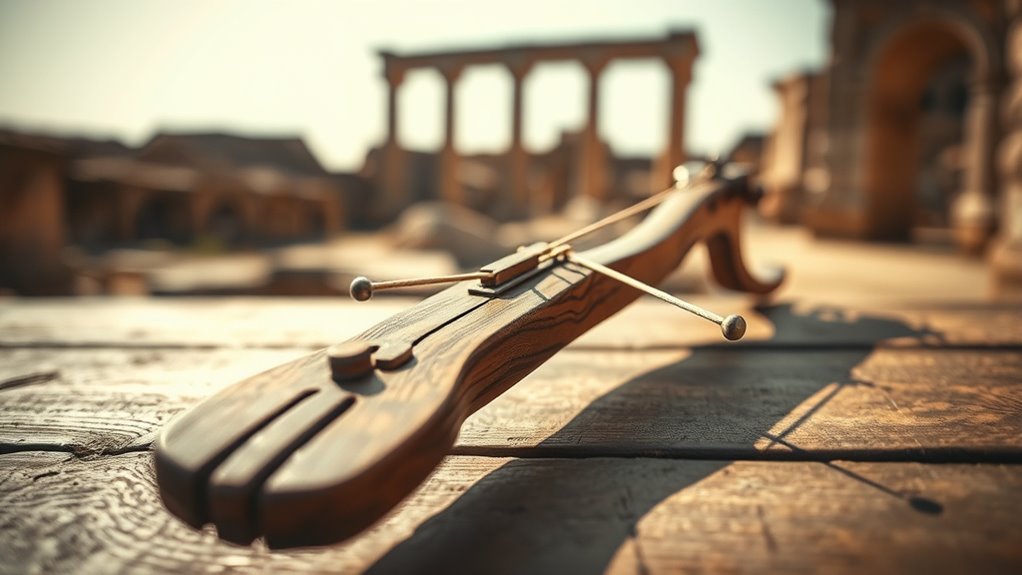
You’ll find that early Greek crossbow designs, like the gastraphetes, laid important groundwork for ranged weaponry. The Romans later adapted these concepts, integrating crossbows into their military strategies to enhance infantry capabilities.
Understanding the tactical advantages and limitations they faced helps clarify why crossbows had a specific role in ancient warfare.
Early Greek Crossbow Designs
Although the precise origins of the crossbow remain debated, early Greek designs demonstrate a clear understanding of mechanical principles that enhanced projectile force and accuracy. You’ll find these early designs pivotal in the weapon evolution timeline, reflecting innovations that influenced later developments.
The Greeks experimented with tension mechanisms and trigger systems, improving consistency and power.
Key features include:
- Use of composite materials for increased limb flexibility
- Introduction of a windlass for tensioning the bowstring
- Development of a simple yet effective trigger release
- Compact design allowing easier handling compared to traditional bows
Roman Military Integration
As the Greek innovations in crossbow technology matured, the Romans recognized the potential of these weapons for their military strategies and began integrating them into their arsenals. You’ll see that Roman tactics adapted to leverage the evolving crossbow’s capabilities, emphasizing ranged precision and fortification defense.
This integration marked a critical phase in crossbow evolution, blending Greek design with Roman engineering.
| Aspect | Roman Adaptation |
|---|---|
| Weapon Design | Reinforced frames for durability |
| Deployment | Infantry support and siege defense |
| Tactical Role | Supplement to traditional missile troops |
| Manufacturing | Standardized production for consistency |
Understanding these elements helps you grasp how the Romans optimized crossbows to enhance battlefield effectiveness without supplanting established combat methods.
Tactical Advantages and Limitations
While crossbows offered notable benefits in ancient Greek and Roman warfare, their tactical advantages came with distinct limitations that commanders had to weigh carefully. You’d find the range accuracy of crossbows superior to traditional bows, enabling more precise, effective strikes from a distance. Their stealth advantages allowed soldiers to engage enemies quietly, essential for ambushes.
However, the slower reload time reduced the rate of fire, limiting sustained offensive capability. Additionally, the crossbow’s heavier build affected mobility and rapid repositioning on the battlefield.
- Enhanced range accuracy improved targeted attacks
- Stealth advantages facilitated silent operations
- Slow reload time hindered continuous firing
- Bulkiness compromised soldier mobility
Understanding these factors helps you appreciate why crossbows were both valued and cautiously deployed in ancient military tactics.
Why Did the Crossbow Gain Popularity in Medieval Europe?

Because the crossbow required less training and physical strength than traditional longbows, it quickly became a favored weapon among medieval European armies. You’d find it increasingly popular during a period marked by evolving medieval warfare tactics, where rapid deployment of effective ranged weapons was essential.
Unlike longbows, which demanded years of practice, crossbows allowed less-experienced soldiers to contribute effectively. This shift aligned with broader social changes, including the rise of professional armies and the declining dominance of the knightly class.
As infantry forces grew in significance, the crossbow’s ease of use and lethal power provided a tactical advantage in sieges and open battles alike. Consequently, its adoption reflected not only technological innovation but also transformations in military organization and social hierarchy.
Materials and Design of Early Crossbows
Though the crossbow’s effectiveness stemmed largely from its mechanical design, the choice of materials played a crucial role in its performance and durability. Understanding the ancient materials used helps you appreciate the design evolution that made early crossbows reliable weapons.
You’d note the following key components:
- Prod (bow): Typically made from flexible woods like yew or composite materials combining horn, sinew, and wood for enhanced elasticity.
- Stock: Crafted from hardwoods such as oak or walnut, providing structural strength and stability.
- String: Often made from twisted animal sinew or hemp, balancing tensile strength and flexibility.
- Trigger mechanism: Early designs used simple metal or wooden levers, evolving towards more complex steel components for improved precision.
How the Crossbow Changed Military Tactics Over Time
As you examine the evolution of military tactics, the crossbow emerges as a transformative weapon that reshaped battlefield strategies. Its introduction allowed soldiers with relatively limited training to deliver precise, powerful shots, altering traditional reliance on skilled archers. Crossbow tactics enabled forces to engage enemies effectively from defensive positions, reducing vulnerability during reloading phases through coordinated volleys.
This shift contributed to changes in troop formations and siege warfare, emphasizing ranged combat and protective structures. Over time, the crossbow influenced military evolution by bridging the gap between simple projectile weapons and more complex firearms, prompting adaptations in armor and battlefield mobility.
Understanding these tactical developments highlights the crossbow’s critical role in the progression of warfare, demonstrating how technology can drive strategic innovation and reshape combat dynamics.
When Did the Crossbow Reach Its Peak Usage in History?
The widespread adoption of the crossbow fundamentally altered how armies engaged in combat, but pinpointing when it reached its peak usage requires examining historical contexts and military needs. You’ll find that crossbow warfare peaked during the medieval period, especially between the 12th and 15th centuries.
This era saw significant reliance on crossbows due to their ease of use and penetrating power. Key factors contributing to peak usage include widespread deployment in European battles and sieges, integration into both infantry and specialized crossbowmen units, and technological improvements enhancing range and power.
Legal and cultural acceptance, despite initial resistance from knightly classes, also played a crucial role. Understanding these factors helps clarify why the crossbow became a dominant weapon before firearms ultimately supplanted it.
Differences Between Early and Modern Crossbows
When comparing early and modern crossbows, you’ll notice distinct differences in materials, mechanics, and design that reflect advancements in technology and changing combat requirements. Ancient mechanisms relied heavily on wood, horn, and sinew, limiting durability and power. In contrast, modern crossbows utilize advanced materials like carbon fiber, aluminum, and composite polymers, enhancing strength and reducing weight.
Early designs featured simple trigger systems and manual spanning methods, while contemporary models incorporate precise, mechanical cocking devices and safety features. The shift from handcrafted limbs to engineered, laminated products improves energy storage and shot consistency. These changes not only increase accuracy and range but also improve user ergonomics and reliability.
Understanding these contrasts highlights how evolving materials and engineering have transformed the crossbow from a rudimentary weapon into a sophisticated tool.
How Crossbows Shaped Later Projectile Weapons
You’ll notice that the mechanical innovations of crossbows directly influenced the development of later projectile weapons, especially early firearms. Their design introduced new ways to store and release energy efficiently, shaping tactical approaches on the battlefield.
Understanding these connections helps clarify how crossbows contributed to advancements in weaponry and combat strategy.
Mechanism Innovations
Although crossbows originated centuries ago, their mechanical innovations have had a lasting impact on the design of later projectile weapons. You’ll notice that these mechanical advancements contributed greatly to the design evolution of weaponry by introducing reliable, repeatable firing mechanisms and enhanced power delivery.
The crossbow’s trigger mechanism, for example, allowed for controlled release of stored energy, influencing future designs.
Key innovations include:
- Use of a mechanical trigger to improve firing accuracy
- Integration of a stock to stabilize aim
- Development of a spanning device to manage draw weight
- Adoption of composite materials for enhanced durability
These features collectively informed the engineering principles behind subsequent projectile weapons, emphasizing efficiency, power, and user control. Understanding these innovations helps you appreciate the crossbow’s foundational role in projectile weapon design evolution.
Influence on Firearms
The mechanical innovations of the crossbow laid the groundwork for many principles later adopted in firearm development. As you study the crossbow evolution, you’ll notice how its trigger mechanism inspired early firing systems, while its stock design influenced firearm ergonomics.
This shift marks a clear technological lineage, showing how mechanical energy storage evolved into chemical energy propulsion in firearms. Understanding these connections is essential for grasping firearms development’s historical context.
| Crossbow Feature | Influence on Firearms |
|---|---|
| Trigger Mechanism | Early firing mechanisms |
| Stock Design | Ergonomic firearm stocks |
| Energy Storage System | Shift to gunpowder use |
Tactical Advantages
Because crossbows combined mechanical power with ease of use, they offered tactical advantages that markedly influenced the design of later projectile weapons. When you analyze their impact, you see how tactical efficiency and battlefield adaptability became priorities in weapon development. Crossbows enabled soldiers to deliver powerful shots without extensive training, increasing unit effectiveness.
Their compact form allowed for deployment in varied terrains and combat scenarios.
Key tactical advantages include:
- Reduced training time for effective use, enhancing troop readiness
- Consistent power output regardless of user strength, improving accuracy
- Ability to maintain a ready-to-fire position, increasing response speed
- Versatility in different combat environments, boosting battlefield adaptability
These factors shaped subsequent projectile weapons, emphasizing ease of use and reliable performance under diverse conditions.
Why the Crossbow Is a Symbol of Innovation in Warfare
When you consider the evolution of military technology, the crossbow stands out as a groundbreaking advancement that reshaped combat strategies. Its introduction marked a pivotal moment in warfare evolution by combining mechanical innovation with practical battlefield application. Crossbow technology allowed soldiers to deliver powerful, accurate shots with less physical strength and training compared to traditional bows.
This democratized ranged combat, enabling a wider pool of combatants to engage effectively. Additionally, the crossbow’s design incorporated a trigger mechanism, which was a significant leap in weapon engineering. By changing how armies approached offense and defense, the crossbow symbolized the shift toward mechanized weaponry and strategic complexity.
Understanding its role helps you appreciate how innovation drives changes in warfare tactics and military effectiveness.
Frequently Asked Questions
What Safety Precautions Are Needed When Using a Crossbow?
You should always follow crossbow safety by checking the bow for damage, keeping your fingers clear of the string path, never dry firing, and ensuring your target area is safe.
These user precautions minimize accidents effectively.
How Accurate Is a Crossbow Compared to a Traditional Bow?
You’ll find crossbow accuracy generally surpasses a traditional bow’s due to its mechanical trigger and stable shooting platform, though traditional bows offer greater skill-dependent precision.
This makes crossbows more consistent for beginners and traditional bows more adjustable for experts.
Can Crossbows Be Legally Owned and Used Today?
Sure, you can own crossbows, but crossbow regulations and ownership restrictions vary widely. You’ll need to research local laws carefully to guarantee compliance, as some places limit possession or use, especially for hunting or public safety reasons.
Be sure to check specific rules in your area before purchasing or using a crossbow. This ensures you stay within legal boundaries and avoid potential penalties.
What Maintenance Does a Crossbow Require for Longevity?
You’ll need regular string maintenance, including waxing to prevent fraying and timely string replacement when wear appears.
Additionally, keep bolts tight, lubricate rails, and inspect parts systematically for ideal crossbow longevity and performance.
Are Crossbows Used in Modern Hunting or Sport Competitions?
You’re stepping into a modern Robin Hood’s world—crossbow technology is advanced, blending tradition with innovation.
However, you’ll need to navigate strict hunting regulations that vary by region, ensuring your use aligns with legal and ethical standards.
Conclusion
You might find it fascinating that the crossbow, first invented in ancient China around the 5th century BCE, coincidentally emerged in different cultures like Greece and Rome with distinct designs. This overlap highlights how the need for efficient projectile weapons independently drove innovation.
Understanding these parallel developments helps you appreciate the crossbow not just as a historical weapon, but as a pivotal technology that influenced warfare and weaponry evolution across civilizations.
In conclusion, knowing when the crossbow was invented provides valuable insight into its role in shaping military history worldwide.