To hold an AR-15 effectively, wrap your middle finger firmly around the pistol grip with your thumb resting along the side.
Your support hand should grip the handguard high and forward to control recoil.
Keep your feet shoulder-width apart, lean slightly forward, and align your shoulders square to the target.
Rest your trigger finger straight along the frame until ready to fire.
This foundation guarantees stability and precision.
Further guidance will help you master varied shooting positions and refine your technique.
Key Takeaways
- Firmly wrap your middle finger around the pistol grip with thumb resting along the side for stable control.
- Position your support hand high and forward on the handguard to reduce muzzle rise and recoil.
- Stand with feet shoulder-width apart, dominant foot slightly back, and lean slightly forward for balance and stability.
- Maintain a straight posture with shoulders squared, knees slightly bent, and weight evenly distributed.
- Keep your index finger straight along the receiver until ready to fire, then use the pad of the finger on the trigger.
How to Grip an AR-15 for Stability and Control
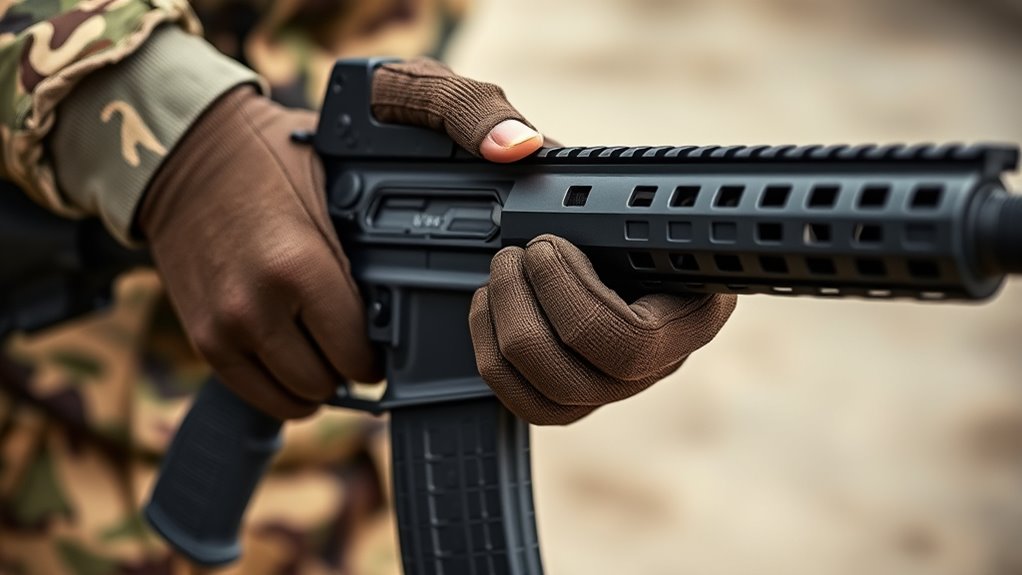
Mastering your grip on an AR-15 is essential for maintaining stability and control during operation. Begin by placing your firing hand firmly around the pistol grip, guaranteeing your middle finger wraps completely around it while your thumb rests comfortably along the side. Proper hand positioning reduces recoil impact and enhances accuracy.
Apply consistent, moderate grip pressure; gripping too tightly can cause fatigue and disrupt your aim, while too loose a hold limits control. Your index finger should rest naturally on the trigger, ready to engage without unnecessary tension. Maintain a straight wrist alignment to maximize stability and reduce fatigue.
How to Place Your Support Hand for Better Control
You need to position your support hand firmly on the handguard, ensuring your fingers wrap securely around it for maximum stability. Focus on maintaining a consistent grip that minimizes movement and enhances control during recoil.
This precise placement will improve your accuracy and overall handling of the AR-15.
Optimal Support Hand Placement
Although it might seem straightforward, placing your support hand correctly on the AR 15 greatly enhances stability and recoil management. Mastering support hand techniques involves precise hand positioning strategies that provide better control during firing. You want your support hand high and forward on the handguard to reduce muzzle rise and increase accuracy.
Here’s what to focus on:
- Position your palm firmly against the handguard’s side or bottom for a solid purchase.
- Spread your fingers comfortably to maximize contact and control without tension.
- Avoid gripping too tightly; maintain a firm but relaxed hold to reduce fatigue and improve follow-up shots.
Grip Techniques for Stability
Building on proper hand placement, your grip technique directly impacts stability and control when handling the AR 15. Different grip styles modify stability factors like recoil management and barrel alignment.
Position your support hand high on the handguard for ideal leverage, ensuring firm yet relaxed pressure to maintain control without fatigue.
| Grip Style | Stability Factor | Key Technique |
|---|---|---|
| Thumb-Forward | Enhanced recoil control | Wrap thumb forward along rail |
| C-Clamp | Improved barrel control | Firm grip with fingers below |
| Palm-Support | Reduced muzzle rise | Palm presses handguard base |
| Two-Finger Support | Quick target reacquire | Index and middle finger support |
| Full-Hand Grip | Maximum stability | Entire hand wraps handguard |
Master these grip styles to refine your AR 15 handling precision.
Set Your Shooting Stance for Accuracy and Comfort
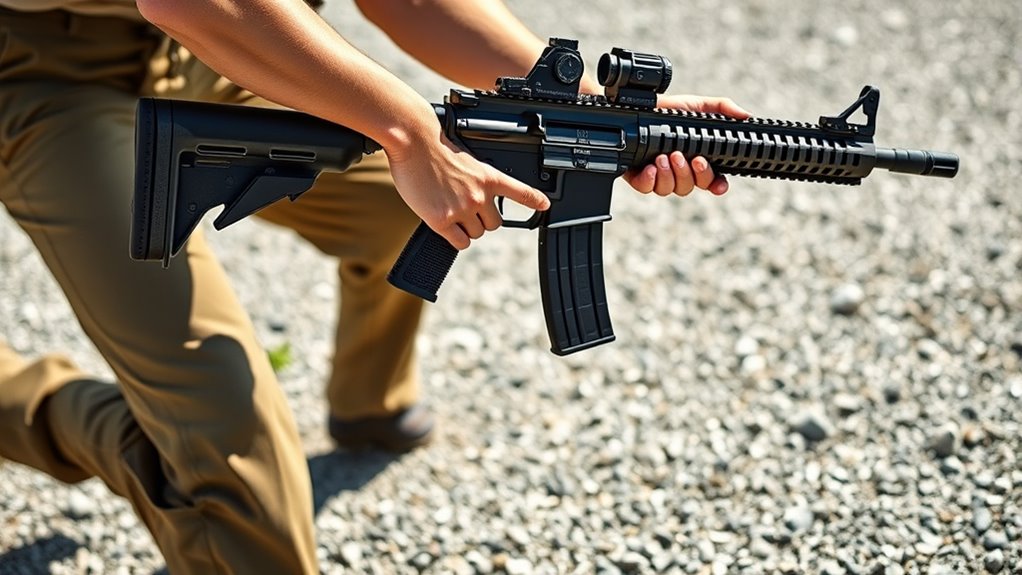
To set your shooting stance, position your feet shoulder-width apart with your weight evenly distributed for stability. Align your body so it faces the target squarely, maintaining a slight forward lean to control recoil.
These adjustments will enhance both your accuracy and comfort while firing.
Foot Placement Techniques
When setting your shooting stance, your foot placement plays an essential role in maintaining balance and ensuring consistent accuracy. Proper foot placement creates a stable base, allowing you to absorb recoil and make precise shots.
Focus on these key points for effective stance adjustments:
- Position your feet shoulder-width apart to maximize stability.
- Angle your support foot slightly forward, roughly 30 degrees, to enhance lateral balance.
- Keep your dominant foot comfortably back to provide a strong anchor and improved control.
Always make small stance adjustments based on your comfort and shooting environment. Avoid overly rigid or overly relaxed foot positions, as both can compromise stability.
Consistently practicing proper foot placement will build muscle memory, improving your accuracy and comfort when holding your AR 15.
Body Alignment Tips
Although proper foot placement sets the foundation, aligning your body correctly is essential for maximizing accuracy and comfort while holding your AR 15. Focus on maintaining a straight, relaxed posture with your shoulders squared toward the target. Use body positioning that distributes your weight evenly between both feet, preventing unnecessary fatigue.
Employ alignment techniques such as slightly bending your knees and leaning slightly forward at the hips, which enhances stability and recoil control. Keep your head upright and aligned with your spine, avoiding excessive tilting. This precise alignment reduces muscle strain and improves sight picture consistency.
Consistently apply these body positioning and alignment techniques during practice to build muscle memory, ensuring your stance supports quick, accurate follow-up shots under various conditions.
Position Your Shoulders and Cheek for Proper Sight Alignment
Proper sight alignment begins with positioning your shoulders and cheek firmly yet comfortably against the rifle. To establish a consistent cheek weld and maintain proper shoulder alignment, follow these steps:
- Verify your dominant shoulder is squarely and firmly pressed into the stock to absorb recoil effectively.
- Place your cheek firmly against the stock’s comb, creating a repeatable cheek weld that aligns your eye directly with the sights.
- Adjust your head position slightly to avoid strain, maintaining a natural line of sight down the barrel.
This precise positioning guarantees that the sights line up correctly with your eye, promoting accuracy and control. Avoid shifting your shoulders or cheek during aiming, as this disrupts sight alignment and can reduce your shooting effectiveness.
Consistency in this setup is key for reliable performance.
Manage Your Trigger Finger for Safety and Precision
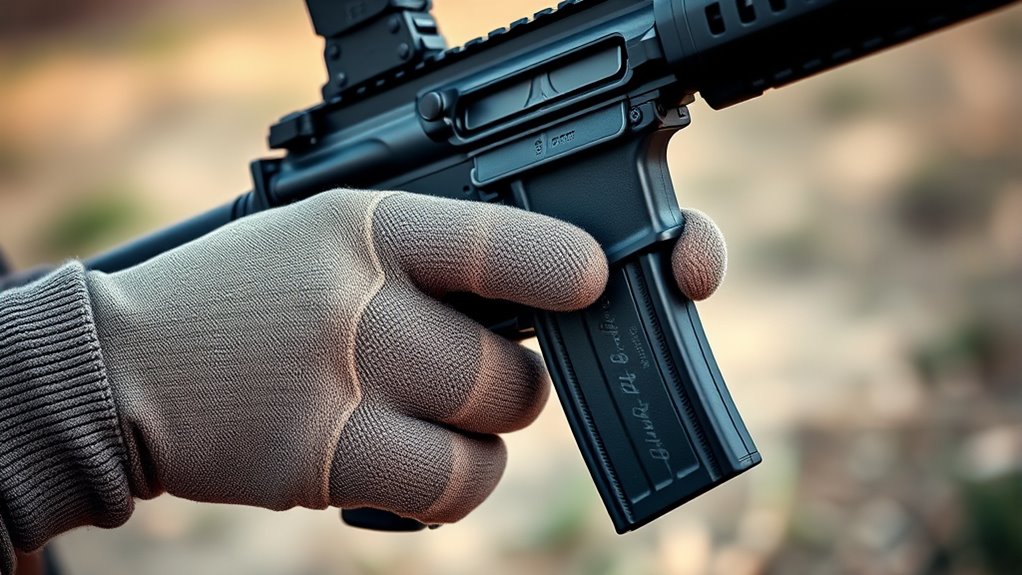
A controlled trigger finger position is essential for both safety and shooting accuracy. Always practice strict trigger discipline by keeping your finger indexed straight along the receiver’s frame until you’re ready to fire. This prevents accidental discharges and guarantees you only pull the trigger intentionally.
When you do engage the trigger, focus on precise finger placement: use the pad of your index finger, not the joint, to apply smooth, consistent pressure. This technique minimizes movement and improves shot control. Avoid placing your finger inside the trigger guard prematurely; it compromises safety and readiness.
Maintaining proper finger placement also reduces fatigue during extended shooting sessions. By mastering trigger discipline and deliberate finger positioning, you enhance both your safety and precision with the AR-15.
Adjust Your AR-15 Hold for Standing, Kneeling, and Prone Shots
When you switch between standing, kneeling, and prone positions, you need to adjust your AR-15 hold to maintain stability and control. For standing shots, grip the rifle firmly with your support hand forward on the handguard and keep your stance balanced to absorb recoil.
Adjust your AR-15 hold for stability when switching between standing, kneeling, and prone shooting positions.
During kneeling shots, place your support elbow on your knee to create a solid shooting platform and reduce sway. In prone shots, rest your support arm on the ground or use a sling to stabilize the rifle, minimizing movement and enhancing accuracy.
- For standing shots, focus on a strong, controlled grip and a stable stance.
- During kneeling shots, utilize your knee to support your elbow.
- In prone shots, maximize contact points with the ground or sling for steadiness.
Adjusting your hold for each position is essential for precision.
Avoid Common Mistakes When Holding an AR-15
Adjusting your hold for different shooting positions improves stability, but it’s just as important to steer clear of common errors that can undermine your control and accuracy.
One frequent issue is common grip errors—gripping too tightly or placing your support hand too far forward can cause unnecessary recoil and reduce precision. Make sure your grip is firm yet relaxed, allowing for controlled movement.
Another critical mistake is adopting an improper stance; standing too upright or with uneven weight distribution destabilizes your shot. Position your feet shoulder-width apart and lean slightly forward to maintain balance. Avoid slouching or leaning backward, which shifts your center of gravity.
Frequently Asked Questions
What Is the History of the AR-15 Rifle?
You’ll find the AR-15’s military origins date to the 1950s, designed by Armalite. Its design evolution led to the M16 for military use, influencing modern civilian rifles with lightweight, modular features you should know.
How Do I Clean and Maintain an AR-15?
Want your AR-15 to perform flawlessly? Use proper cleaning techniques: disassemble, clean barrel and chamber with solvent, lubricate moving parts.
Follow maintenance tips by inspecting regularly and replacing worn components to guarantee reliable operation every time.
What Are the Legal Restrictions on Owning an AR-15?
You must comply with federal regulations and specific state laws when owning an AR-15. Check background checks, age limits, and restrictions on features or magazine capacity to guarantee your ownership is fully legal and responsible.
Understanding these rules helps ensure you avoid legal issues and use your firearm safely. Always stay updated on any changes in legislation in your area.
Which Ammunition Is Best for an AR-15?
The best ammunition types for your AR-15 are usually .223 Remington or 5.56 NATO, with bullet weight between 55 to 77 grains.
Choose based on your shooting purpose for ideal accuracy and performance.
How Do I Customize My AR-15 With Accessories?
You can customize your AR-15 by exploring accessory options like optics, grips, and rails. Focus on customization tips such as ensuring compatibility, balancing weight, and prioritizing ergonomics for improved performance and comfort.
Consider how each accessory affects the overall balance and handling of your rifle. Always check that new parts are compatible with your specific AR-15 model. Prioritizing ergonomic improvements can make a significant difference during extended use.
Conclusion
Remember, practice makes perfect when it comes to holding your AR-15 correctly. By gripping firmly, positioning your support hand thoughtfully, and maintaining a solid stance, you’ll improve stability and accuracy. Keep your shoulders relaxed, cheek aligned, and trigger finger disciplined to guarantee safety and precision.
Adjust your hold depending on your shooting position, and avoid common mistakes to build consistent skills. Master these fundamentals, and you’ll be ready for any shot with confidence and control.
With time and effort, you will develop the proper technique and be well-prepared to hold an AR-15 effectively in any situation.