How to Make an AR-15 Fully Automatic is a question that often arises among firearm enthusiasts.
However, you can’t legally convert an AR-15 to fully automatic without specific licensed parts, completing ATF registration, and paying a tax stamp.
The semi-automatic AR-15 fires one round per trigger pull, while full auto allows continuous fire when the trigger is held. Unauthorized modifications violate federal law and carry severe penalties.
Only federally licensed dealers can sell fully automatic rifles, and illegal conversions risk firearm malfunction and serious legal trouble.
Understanding these requirements clarifies why alternatives and safe modifications are recommended.
Key Takeaways
- Converting an AR-15 to fully automatic requires specialized parts like an auto sear and significant mechanical changes.
- Fully automatic AR-15s must be registered with the ATF under the National Firearms Act and require a $200 tax stamp.
- Unauthorized conversion is illegal, risks severe legal penalties, and can cause firearm malfunctions or catastrophic failure.
- Semi-automatic AR-15s fire one round per trigger pull and cannot be legally converted to full auto without proper authorization.
- Safer alternatives include upgrading semi-automatic features or purchasing factory-built rifles designed for legal rapid fire.
Differences Between Semi-Automatic and Fully Automatic AR-15s?
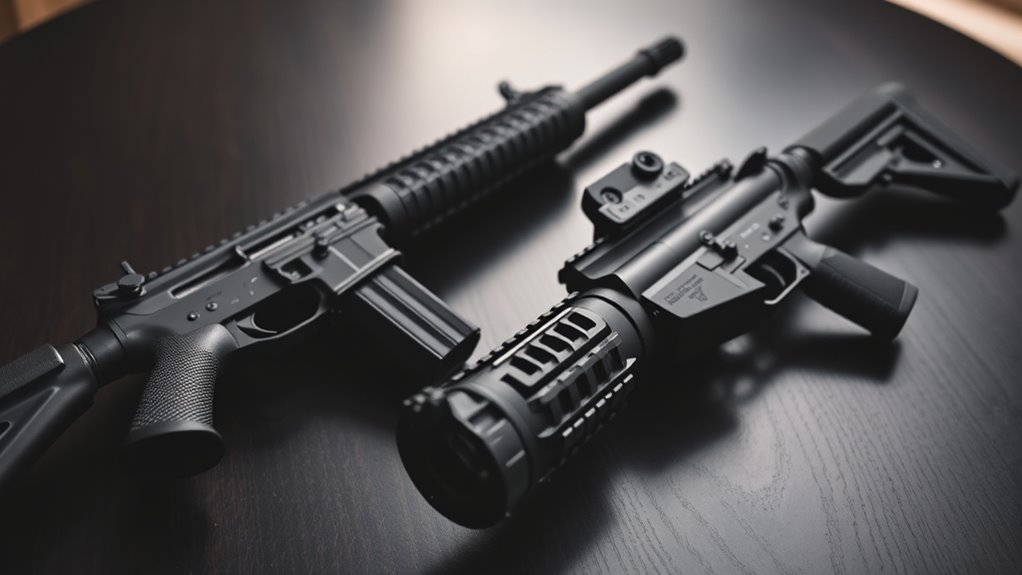
Although both semi-automatic and fully automatic AR-15s share similar external designs, the key differences lie in their firing mechanisms and legal classifications. When you examine the mechanical differences, a semi-automatic AR-15 requires a trigger pull for each round fired, cycling the bolt carrier group once per shot.
In contrast, a fully automatic AR-15’s firing mechanism allows continuous firing as long as the trigger is depressed, utilizing an auto sear to release the hammer repeatedly without manual trigger resets. This distinction hinges on the fire control group’s internal components, including the selector switch and disconnector.
Understanding these mechanical differences is essential because they define the operational capabilities and compliance with legal standards, emphasizing that firing mechanisms are engineered with precision to control rate of fire reliably and safely.
Why You Can’t Legally Make an AR-15 Fully Automatic
Because fully automatic firearms are strictly regulated under federal law, you can’t legally convert a standard AR-15 into a fully automatic weapon without proper licensing and registration. Attempting such modification carries serious legal implications due to stringent firearm regulations.
Here’s why:
- The National Firearms Act (NFA) classifies fully automatic weapons as Title II firearms, requiring extensive vetting.
- Modifying a semi-automatic AR-15 to fully automatic without approval is illegal and punishable by law.
- Manufacturing or possessing unregistered machine guns exposes you to felony charges.
- Federal authorities actively enforce these regulations to prevent unauthorized automatic weapon creation.
Understanding these points clarifies why legal barriers exist, emphasizing compliance with firearm regulations to avoid severe penalties.
Legal Requirements to Own a Fully Automatic AR-15
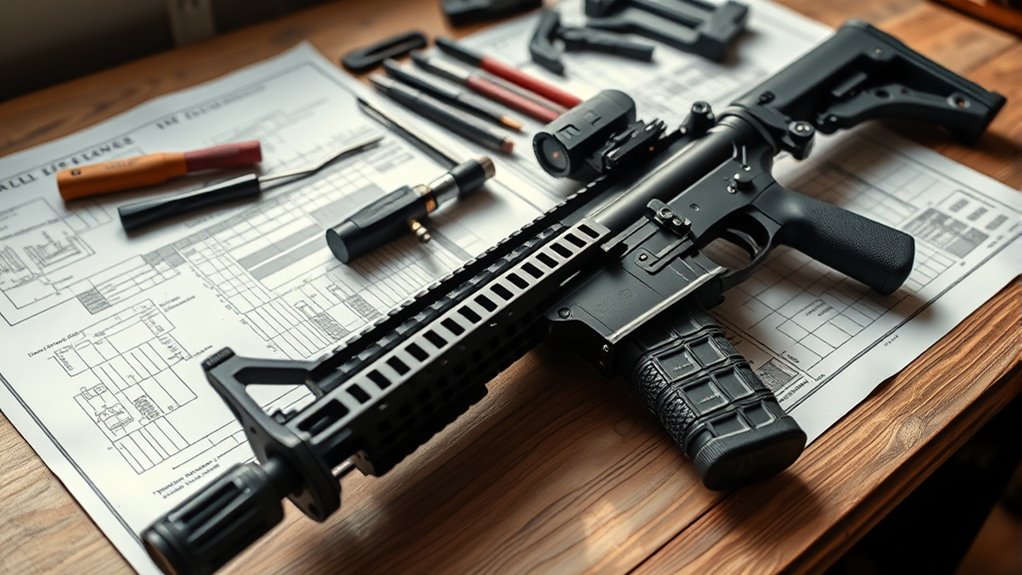
If you want to legally own a fully automatic AR-15, you must comply with specific federal regulations outlined by the National Firearms Act (NFA) and the Bureau of Alcohol, Tobacco, Firearms and Explosives (ATF).
Legal ownership requires that the firearm be registered with the ATF, and you must complete ATF Form 4, undergo a thorough background check, and pay a $200 tax stamp. Additionally, your local jurisdiction must permit possession of fully automatic weapons.
To legally own a fully automatic AR-15, register with the ATF, complete Form 4, pass a background check, and pay the $200 tax stamp.
Transfers of such firearms are strictly regulated and can only occur between licensed entities or individuals who meet all legal criteria. Failure to adhere to these federal regulations can result in severe criminal penalties.
Make sure you consult official ATF resources and legal counsel to verify compliance before pursuing ownership.
Parts Needed to Convert an AR-15 to Full Auto
When considering the parts needed to convert an AR-15 to full automatic, you must understand that the process involves specific components designed to alter the firearm’s firing mechanism. Conversion kits are often marketed to exploit legal loopholes, but they require precise installation and carry significant legal risks.
The essential parts include:
- Auto sear – Enables continuous firing by controlling hammer release.
- Full-auto bolt carrier group – Modified to work with the auto sear.
- Selector switch – Allows switching between semi-auto and full-auto modes.
- Disconnector – Adjusted or replaced to guarantee proper cycling in full-auto mode.
Each component must be compatible and installed with exacting standards, as improper assembly can cause malfunctions or legal consequences. Proceed with caution and thorough understanding.
Myths About Converting AR-15s to Full Auto
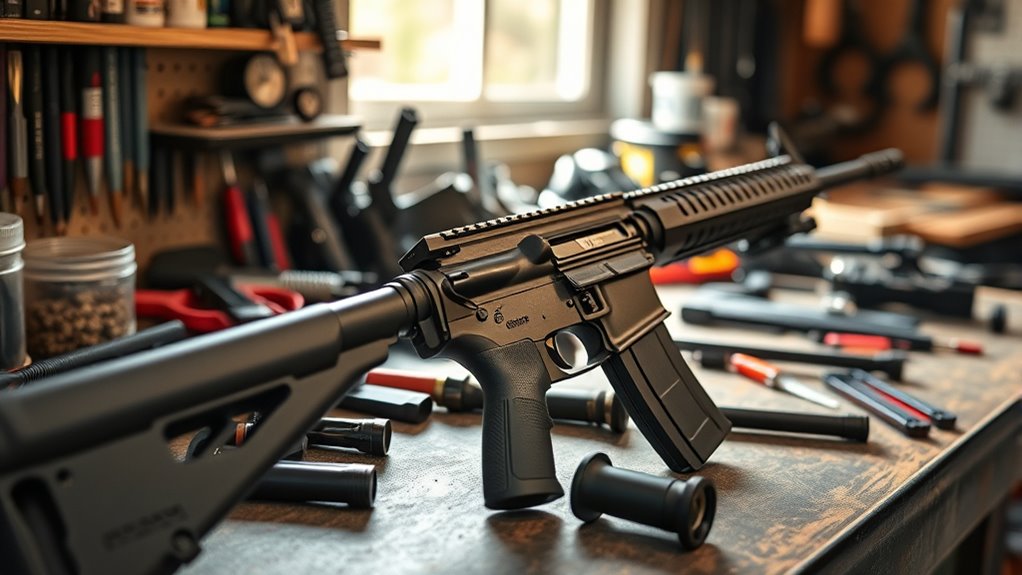
Understanding the specific parts involved in converting an AR-15 to full automatic sheds light on many common misconceptions surrounding the process. Myth debunking is essential because many assume it’s as simple as swapping a few parts, ignoring precise mechanical and legal complexities.
Legal misconceptions often lead to dangerous assumptions about the ease and legality of such conversions.
| Myth | Reality | Legal Aspect |
|---|---|---|
| Any AR-15 can be easily converted | Requires specialized parts and expertise | Conversion without authorization is illegal |
| Full auto conversion is reversible | Conversion often permanently alters firearm | Possession of converted weapons is heavily regulated |
| Conversion parts are widely available | Parts are restricted and controlled | Unauthorized possession can result in severe penalties |
You must approach these topics with caution and full awareness of legal constraints.
Risks and Consequences of Illegal AR-15 Conversion
Although the technical challenges of converting an AR-15 to fully automatic are significant, the legal and personal risks far outweigh any perceived benefits. You need to understand the gravity of illegal AR-15 conversion before proceeding.
- Legal penalties: Unauthorized conversion violates federal law, potentially leading to severe fines and prison time.
- Safety risks: Modifying firing mechanisms without expertise can cause malfunctions, risking injury or death.
- Reliability issues: Improper conversions often result in jamming or catastrophic failure, compromising firearm performance.
- Ethical and social consequences: Possession of illegal firearms damages your reputation and may attract law enforcement scrutiny.
You must weigh these factors carefully. The risks extend beyond mere legal trouble — they affect your safety and long-term well-being.
Proceeding without authorization is both technically unwise and legally dangerous.
Why Only Licensed Dealers Can Sell Fully Automatic AR-15s
Because fully automatic AR-15s are regulated under the National Firearms Act (NFA), only licensed dealers with proper federal authorization can legally sell them. You should understand that this restriction exists due to significant regulatory challenges associated with automatic weapons, including stringent background checks, registration requirements, and tax stamp procedures.
Licensed dealers bear critical responsibilities, such as maintaining accurate records, guaranteeing compliance with the Bureau of Alcohol, Tobacco, Firearms and Explosives (ATF) regulations, and verifying the legality of each transaction.
If you’re considering acquiring a fully automatic AR-15, purchasing through an authorized dealer guarantees adherence to federal laws, mitigating potential legal risks. Unauthorized sales bypass these controls, exposing both seller and buyer to severe penalties.
Consequently, dealer responsibilities and regulatory frameworks together safeguard lawful ownership and distribution of these firearms.
Safe and Legal AR-15 Alternatives to Fully Automatic Rifles
When seeking an AR-15 experience without the complexities of fully automatic firearms, you can consider semi-automatic models or specialized trigger kits designed to simulate rapid fire within legal limits. To guarantee safety and compliance, focus on these legal semi automatic options:
- Purchase factory-built semi-automatic AR-15 rifles from licensed dealers.
- Use authorized trigger kits that enhance firing rate without converting the rifle to fully automatic.
- Engage in thorough firearm safety education to understand operational and legal responsibilities.
- Explore competitive shooting platforms designed for semi-automatic rifles to practice controlled rapid fire.
How to Modify an AR-15 Within Legal Limits
Before making any modifications to your AR-15, you need to fully understand the legal restrictions imposed by federal and state laws. It’s essential to use safe modification techniques that do not convert your firearm into a prohibited weapon.
Always guarantee your changes comply with the National Firearms Act and relevant regulations to avoid serious legal consequences.
Understanding Legal Restrictions
Although modifying an AR-15 might seem straightforward, you need to carefully navigate complex federal and state laws that strictly regulate automatic firearm conversions. Understanding legal definitions related to fully automatic weapons is critical for responsible gun ownership. Here are key points to take into account:
- The National Firearms Act (NFA) defines and regulates machine guns, requiring registration and tax stamps.
- The Gun Control Act prohibits unregistered automatic firearm possession.
- State laws may impose additional restrictions or outright bans on modifications.
- Violating these laws can lead to severe penalties, including fines and imprisonment.
You must verify compliance with both federal and local statutes before attempting any modifications. Always make sure your actions align with legal frameworks to avoid inadvertently committing a serious offense.
Safe Modification Techniques
Maneuvering through legal restrictions is only part of responsibly modifying your AR-15. To guarantee safe modification, focus on enhancements that improve function without compromising legality. Consider installing upgraded triggers, adjustable gas blocks, or enhanced barrels—these legal alternatives optimize performance while maintaining semiautomatic operation.
Avoid any alterations that convert the firearm to fully automatic, as these are federally regulated and typically prohibited. Use only manufacturer-approved parts and tools designed for your specific model to prevent mechanical failures. Document each modification and verify compliance with your jurisdiction’s statutes.
Consulting with a qualified gunsmith can provide technical guidance, guaranteeing modifications remain within legal boundaries. Prioritize safety and legality over experimental alterations; this approach safeguards you and preserves responsible firearm ownership.
Compliance With Federal Laws
When modifying your AR-15, you need to strictly adhere to federal laws that govern firearm alterations, especially those related to rate of fire and component changes. Violating federal regulations can result in severe legal penalties, including fines and imprisonment.
To guarantee compliance, follow these guidelines:
- Verify if the desired modification is permitted under the National Firearms Act (NFA).
- Avoid installing or manufacturing parts classified as machine guns without proper authorization.
- File necessary paperwork with the Bureau of Alcohol, Tobacco, Firearms and Explosives (ATF) and obtain approval before modification.
- Keep detailed records of all modifications and approvals for inspection.
Resources for Learning More About AR-15 Laws and Safety
Because federal and state regulations regarding AR-15 ownership and modification vary greatly, you’ll need to consult authoritative sources to guarantee compliance. Start by reviewing official legal resources such as the Bureau of Alcohol, Tobacco, Firearms and Explosives (ATF) website, which provides up-to-date statutes and rulings. State government sites also offer relevant local laws.
For safety guidelines, rely on established organizations like the National Rifle Association (NRA) and certified firearms training programs. These sources provide detailed instructions on safe handling, storage, and operation. Additionally, consider consulting legal professionals specializing in firearms law to clarify complex issues related to fully automatic modifications.
Staying informed and cautious is critical, as noncompliance can result in severe legal consequences and safety risks. Always prioritize legal adherence and responsible use.
Frequently Asked Questions
What Is the History of the AR-15 Rifle?
You’ll find the AR 15 evolution began in the 1950s with Armalite; it caught military adoption interest due to its lightweight design and modular features.
This design influenced modern rifles while remaining primarily semi-automatic for civilian use.
How Does Recoil Affect Shooting Accuracy?
You might not realize it, but recoil directly impacts shooting accuracy by disrupting shooting stability.
Mastering recoil management is essential; without it, your shots scatter unpredictably, reducing precision and consistency in every firing sequence.
What Are Common Maintenance Tips for AR-15S?
You should regularly disassemble your AR-15, apply proper cleaning techniques like brushing and solvent use, then follow precise lubrication practices on moving parts.
Ensure cautious reassembly to maintain reliability and prevent malfunctions during operation.
How Do AR-15S Compare to Other Rifles in Performance?
You’ll find AR 15 advantages include modularity, lightweight design, and accuracy.
However, AR 15 limitations involve lower effective range and stopping power compared to larger calibers, so assess your needs carefully before choosing.
What Are the Most Popular AR-15 Accessories?
You’ll find the most popular AR-15 accessories include optics, grips, and rail systems, offering extensive customization options. Tactical gear like lights and suppressors enhance performance, but always verify compatibility and legality before adding any modifications.
Conclusion
While it might seem tempting to convert your AR-15 to fully automatic, remember that the law is clear and strict—there’s no cutting corners here. Only licensed dealers can legally handle such firearms, and attempting otherwise could land you in hot water.
Stick to modifications within legal limits and prioritize safety. Understanding the rules isn’t just playing it safe; it’s the key to keeping everything above board and protecting yourself from serious consequences.
In conclusion, knowing how to make an AR-15 fully automatic is important, but following the law is even more crucial to avoid legal trouble and ensure responsible firearm ownership.