To use your AR-15 safely, first always guarantee it’s unloaded and pointed in a safe direction.
Keep your finger off the trigger until you’re ready to shoot. Load the correct ammunition matching your rifle’s caliber, insert the magazine, and chamber a round by pulling the charging handle.
Adjust your sights or optics for accuracy, then maintain control and aim carefully before firing.
Proper cleaning and responsible handling help guarantee reliability.
Keep going to master detailed operation, customization, and maintenance tips.
Key Takeaways
- Always ensure the AR-15 is unloaded and safety is engaged before handling or operating the firearm.
- Load the magazine, insert it into the magwell, then pull back and release the charging handle to chamber a round.
- Keep the muzzle pointed in a safe direction and your finger off the trigger until ready to shoot.
- Choose compatible ammunition matching the AR-15’s caliber and intended use, such as FMJ for practice or hollow points for defense.
- Regularly maintain, clean, and inspect the AR-15 to ensure reliable operation and safely clear any malfunctions if they occur.
Safely Handle Your AR-15
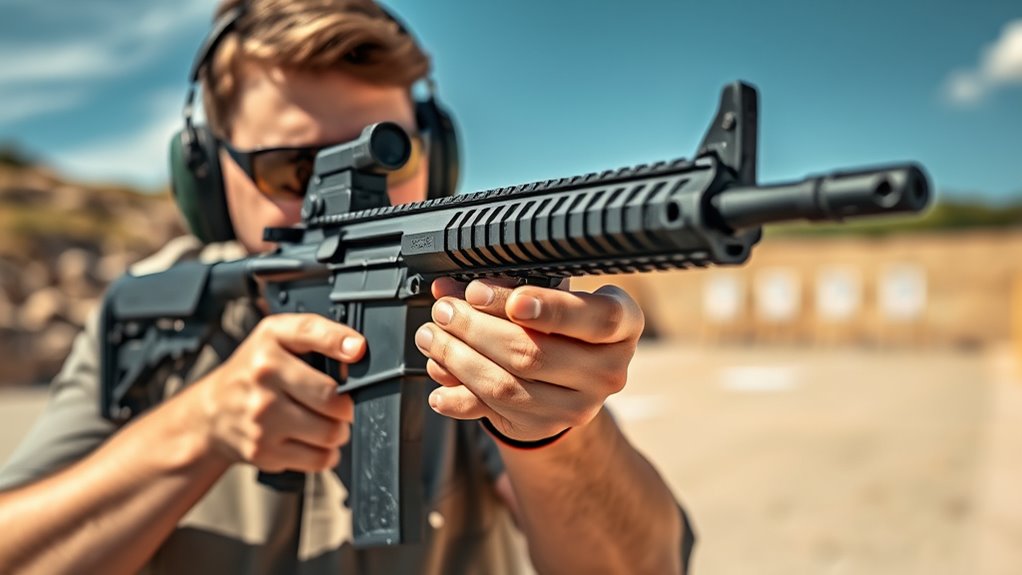
Before you pick up your AR-15, make sure you’ve checked that it’s unloaded and the safety is engaged. Following essential safety protocols is vital to prevent accidents. Always treat the firearm as if it’s loaded, keeping your finger off the trigger until you’re ready to shoot.
When gripping your AR-15, use the proper grip: firmly hold the pistol grip with your dominant hand, ensuring your trigger finger rests alongside the frame. Support the handguard with your non-dominant hand to maintain control and stability. Keep the muzzle pointed in a safe direction at all times.
Load and Unload Your AR-15 Correctly
Handling your AR-15 safely sets the foundation for proper loading and unloading techniques. To load your AR-15, first verify the safety is on and the magazine is clear. Insert the magazine firmly into the magwell until it clicks.
Use proper load techniques by pulling back the charging handle fully, then releasing it to chamber a round. Always keep your finger off the trigger during this process.
To unload, engage the safety, remove the magazine by pressing the magazine release, and pull back the charging handle to eject any chambered round. Inspect the chamber visually and physically to confirm it’s empty.
Mastering these load techniques and unload techniques guarantees your AR-15 remains safe and ready for use, preventing accidents and maintaining control at all times.
Choose the Right Ammunition for Your AR-15
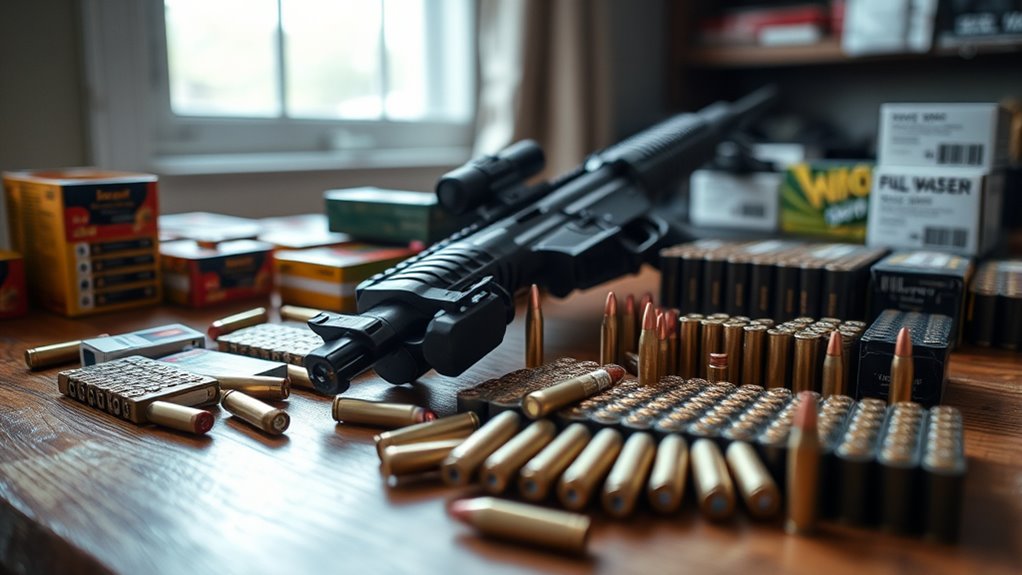
You need to select ammunition that matches your AR-15’s caliber to guarantee safe and reliable performance. Understanding the different bullet types, like FMJ, hollow point, and soft point, will help you choose the right round for your intended use.
Always check your firearm’s specifications before loading any ammunition.
Caliber Compatibility
Choosing the right caliber for your AR-15 is essential to guarantee peak performance and safety. Your rifle is designed to handle specific caliber variations, so using incompatible ammunition types can cause malfunctions or damage.
Most AR-15s are chambered for 5.56 NATO or .223 Remington, but other calibers like .300 Blackout or 6.5 Grendel exist. Always check your firearm’s markings to confirm which caliber it supports. Using the correct caliber assures reliable cycling, accuracy, and manageable recoil.
Avoid mixing calibers, even if they appear similar, as slight dimensional differences affect pressure levels and firearm integrity. By matching your AR-15 with the proper ammunition types, you maintain its longevity and make sure every shot performs as intended.
Bullet Types Overview
Although selecting the right caliber is essential, understanding the different bullet types available for your AR-15 is just as important to optimize performance and meet your shooting goals. You’ll encounter various bullet material types, such as full metal jacket (FMJ), hollow point (HP), and soft point (SP). Each offers distinct advantages depending on your use—FMJ is ideal for target practice due to penetration, while HP expands on impact, better for self-defense.
Conducting a bullet performance comparison helps you evaluate factors like accuracy, expansion, and penetration. Don’t overlook specialty rounds like tracer or armor-piercing, but make certain they’re legal in your jurisdiction. By selecting the correct bullet type tailored to your intended application, you’ll maximize your AR-15’s effectiveness and reliability.
Always verify compatibility with your rifle’s specifications before purchasing ammunition.
Adjust the Sights and Optics on Your AR-15
Before firing your AR-15, it’s vital to adjust the sights and optics to guarantee accuracy. Start by securely mounting your optics using reliable optics mounting tips, ensuring they’re firmly attached to prevent shifting. Once mounted, use sight adjustment techniques to zero your rifle.
Begin at a close range, about 25 yards, and shoot a group to observe point of impact. Adjust the windage and elevation knobs on your sights or optics accordingly, moving the point of impact toward the center of the target. Repeat this process until your shots consistently hit the bullseye.
Aim and Fire Your AR-15 Accurately
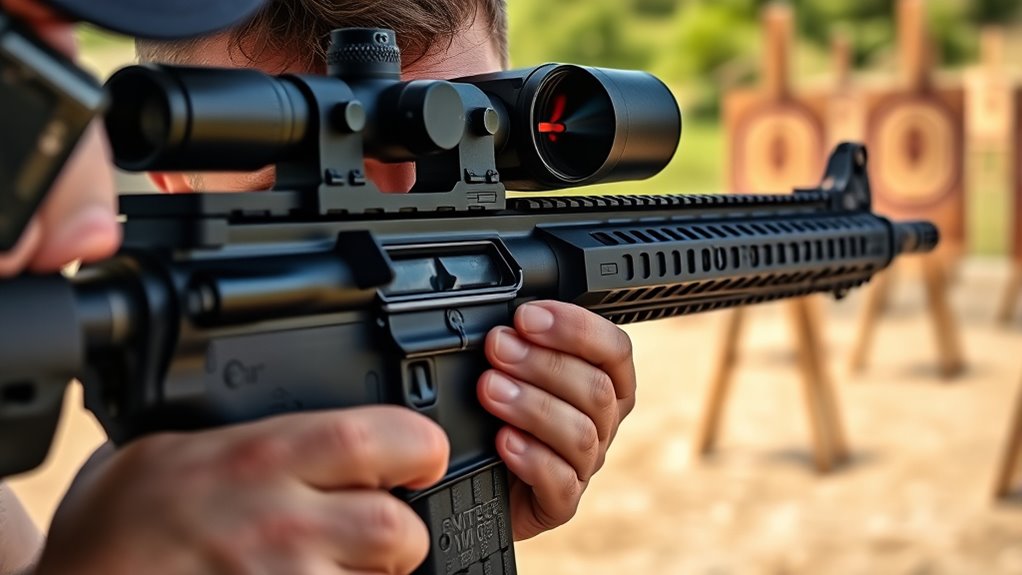
Anyone aiming to fire an AR-15 accurately needs to focus on proper stance, grip, and breath control. Start by adopting a stable, balanced stance with your feet shoulder-width apart. Firmly grip the rifle, keeping your support hand on the handguard and your firing hand on the pistol grip.
Use sighting techniques by aligning your front sight post with the rear sight aperture or your optic reticle, ensuring a clear and consistent sight picture. Before squeezing the trigger, practice breathing control: inhale deeply, exhale halfway, and hold your breath briefly to minimize movement.
Slowly and steadily press the trigger straight back without jerking. Combining these fundamentals will improve your precision and consistency when firing your AR-15.
Clear Common Malfunctions and Jams on Your AR-15
When your AR-15 jams, the first step is recognizing the type of malfunction you’re facing, such as failure to feed or eject. You need to stay calm and follow precise clearing techniques to safely resolve the issue.
Mastering these steps guarantees your rifle stays reliable and ready for action.
Identifying Common Jam Types
Although malfunctions can be frustrating, understanding the common jam types in your AR-15 is essential for quickly diagnosing and clearing them. The most frequent jams include failure to feed, failure to eject, double feed, and stovepipe. Each presents distinct signs: failure to feed usually sticks a round in the chamber, while failure to eject leaves a spent casing inside.
Double feed causes two rounds to stack in the chamber area, and stovepipe occurs when a casing protrudes from the ejection port. Recognizing these helps streamline malfunction diagnosis and apply effective jam prevention techniques.
Regular cleaning, proper lubrication, and using quality ammunition reduce the chance of these jams. Knowing how to identify your AR-15’s specific jam type sets the foundation for safe, efficient clearing.
Step-by-Step Clearing Techniques
Mastering four key clearing techniques will have you confidently addressing common AR-15 malfunctions. Always follow safety protocols before attempting any clearance.
Regularly adhering to a maintenance schedule minimizes jams, but knowing these steps guarantees readiness.
| Malfunction Type | Clearing Step 1 | Clearing Step 2 |
|---|---|---|
| Failure to Feed | Lock bolt to rear | Inspect magazine and reload |
| Failure to Eject | Lock bolt to rear | Remove spent casing |
| Double Feed | Remove magazine | Clear chamber manually |
| Stove Pipe | Pull charging handle back | Tap ejection port and reload |
Stay calm, follow these steps methodically, and maintain your AR-15 regularly for reliable performance.
Clean and Maintain Your AR-15 for Reliability
Regular cleaning and maintenance are essential to keep your AR-15 functioning reliably and safely. Start by assembling the right cleaning supplies: a bore brush, cleaning rod, patches, solvent, lubricant, and a quality cleaning mat. Follow a maintenance schedule based on usage—clean after every shooting session or at least once a month if stored.
Begin by confirming the rifle is unloaded, then disassemble the upper receiver, bolt carrier group, and charging handle. Use solvent and brushes to remove carbon buildup, paying close attention to the barrel and bolt. After cleaning, apply lubricant to moving parts to prevent wear and corrosion.
Finally, reassemble your AR-15 and perform a function check. Sticking to this routine guarantees your rifle remains dependable and extends its lifespan.
Customize Your AR-15 for Your Needs
To make your AR-15 truly yours, start by selecting the barrel length that fits your shooting style and purpose. Then, choose the right optics to enhance your accuracy and target acquisition.
Finally, consider upgrading the trigger system for improved control and responsiveness.
Select Barrel Length
Choosing the right barrel length is essential when customizing your AR-15, as it directly affects accuracy, velocity, and maneuverability. You’ll want to contemplate the typical barrel materials—usually steel alloys—that influence weight and durability.
For close-quarters or tactical use, shorter barrels around 10.5 to 14.5 inches offer superior maneuverability but may sacrifice some accuracy and bullet velocity. On the other hand, longer barrels, typically 16 to 20 inches, provide ideal lengths for accuracy and higher muzzle velocity, making them perfect for precision shooting and longer ranges.
When selecting, balance your intended use with legal restrictions in your area. Ultimately, pick a barrel length that matches your shooting style and environment to maximize performance without compromising control or compliance.
Choose Optics Type
Once you’ve settled on the barrel length that suits your shooting style, the next step is to select the right optics to enhance your AR-15’s effectiveness. Start by evaluating optics options such as red dot sights for quick target acquisition, holographic sights for enhanced clarity, or magnified scopes for precision shooting at longer ranges. Consider your typical shooting distances and environments to choose accordingly.
Next, focus on mounting techniques—ensure you pick mounts compatible with your rail system, whether it’s Picatinny or M-LOK. Properly secure your optic to avoid shifting during recoil, which can affect accuracy. By carefully choosing optics options and using reliable mounting techniques, you’ll customize your AR-15 to match your specific needs, improving both speed and precision in the field.
Upgrade Trigger System
Enhance your AR-15’s performance by upgrading its trigger system to better suit your shooting needs. A quality trigger can improve accuracy by offering a lighter, crisper trigger pull and a shorter trigger reset. This means you can fire follow-up shots faster and with better control.
When selecting a trigger upgrade, consider your shooting style—whether tactical, competition, or casual plinking.
| Trigger Type | Benefits |
|---|---|
| Single-Stage | Consistent pull, simple feel |
| Two-Stage | Initial take-up, then crisp |
| Drop-In | Easy installation, reliable |
| Adjustable | Customize pull weight/reset |
Upgrading your trigger system guarantees a more responsive firearm, letting you maximize your AR-15’s potential.
Transport and Store Your AR-15 Safely
Although transporting and storing your AR-15 might seem straightforward, it requires careful attention to safety and legal requirements. When choosing transportation methods, always unload the rifle, remove any magazines, and secure it in a locked case. This prevents accidental discharge and complies with most state laws.
Transport your AR-15 unloaded, with magazines removed, securely locked to ensure safety and legal compliance.
Avoid leaving your AR-15 unattended in a vehicle where theft or misuse could occur.
For storage solutions, invest in a quality gun safe or lockbox. Store your AR-15 unloaded, with ammunition stored separately. Use trigger locks or cable locks as an added safety measure.
Keep your storage area cool and dry to prevent rust and damage. Following these guidelines guarantees your AR-15 remains secure, safe, and ready for use when needed.
Practice Responsible AR-15 Shooting
Keeping your AR-15 secure and well-maintained sets the foundation for responsible shooting. To practice responsible AR-15 shooting, start by completing thorough safety training to understand firearm operation, handling, and emergency procedures. Always follow shooting etiquette: respect others’ space at the range, communicate clearly, and handle your firearm with care.
Before shooting, double-check your target and surroundings to prevent accidents. Maintain control of your muzzle direction and keep your finger off the trigger until ready to fire. Regularly inspect and clean your AR-15 to guarantee reliable performance.
Frequently Asked Questions
What Is the History and Origin of the AR-15?
You’ll find the AR-15’s history rooted in design evolution by Eugene Stoner in the 1950s, later adapted for military use as the M16.
This showcases significant military adaptation that transformed its role and capabilities over time.
How Does the AR-15 Compare to Other Rifles?
You’ll find the AR 15 stands out for its modularity and customization with numerous AR 15 accessories. Regular AR 15 maintenance guarantees reliability, making it versatile and user-friendly compared to many other rifles on the market.
Can the AR-15 Be Used for Hunting Specific Game?
Imagine precision as your ally; yes, you can use the AR-15 for hunting specific game, but you must always follow hunting regulations and consider game selection carefully.
This approach guarantees ethical, legal, and effective hunting experiences every time.
What Legal Restrictions Apply to AR-15 Ownership?
You must follow federal regulations and state laws when owning an AR-15. These rules vary by location, so check background checks, age limits, and restrictions on modifications to guarantee you’re compliant and avoid legal issues.
What Are the Most Popular AR-15 Brands and Models?
You’ll find popular brands like Smith & Wesson, Daniel Defense, and Colt leading the market. Top models include the M&P15, DDM4, and Colt LE6920, known for reliability, precision, and customization options you’ll appreciate.
Conclusion
By following proper handling, loading, and maintenance techniques, you’ll guarantee your AR-15 operates safely and reliably. Did you know that nearly 70% of AR-15 malfunctions result from user error, often avoidable with correct care? Taking the time to customize and practice responsible shooting not only improves your accuracy but also your safety.
Stay informed, stay prepared, and always prioritize safety when using your AR-15. Your responsible use makes all the difference in ensuring a safe and effective shooting experience with your AR-15.