The forward assist on your AR-15 is a crucial feature that lets you manually guarantee the bolt is fully seated and locked in the chamber.
This is especially important if debris or fouling prevents the bolt from closing completely.
By pressing the forward assist, you apply extra pressure to the bolt carrier group.
This action helps reduce feeding errors and failures to fire during critical moments.
It acts as a reliability backup mechanism, designed based on early combat feedback.
Explore further to understand its operation, benefits, and possible alternatives.
Key Takeaways
- The forward assist manually ensures the AR-15 bolt is fully seated in the chamber for reliable firing. It engages when the bolt carrier group fails to close completely due to dirt, fouling, or weak ammunition.
- Pressing the forward assist button pushes the bolt forward to guarantee it locks without disassembling the rifle. It was added to improve reliability and reduce stoppages during adverse conditions or combat scenarios.
- Alternatives include proper maintenance, quality ammo, and upgraded components to avoid dependency on the forward assist.
What Is the Forward Assist on an AR-15?
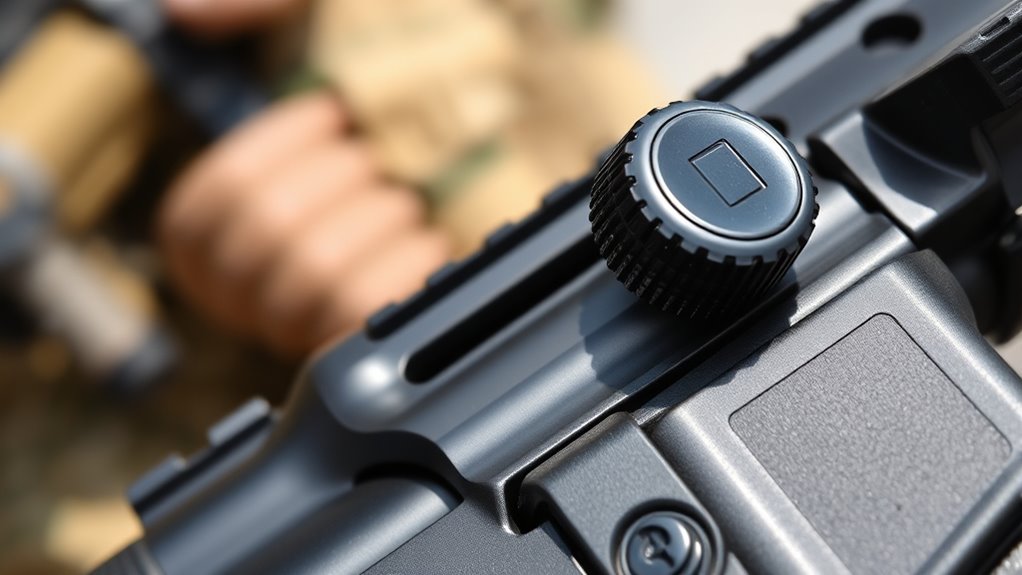
The forward assist on an AR-15 is a small, spring-loaded button located on the right side of the rifle’s upper receiver. Its primary function is to manually guarantee the bolt is fully seated into the chamber when the bolt carrier group doesn’t completely close under normal cycling.
If you’re considering forward assist installation, it’s essential to align the mechanism precisely with the bolt carrier to maintain reliability and avoid malfunctions. While many AR-15 models come with a factory-installed forward assist, some shooters opt for forward assist alternatives, such as enhanced charging handles or bolt release techniques, to address bolt seating issues without adding extra components.
Understanding these options helps you make an informed decision tailored to your operational needs and maintenance preferences.
How the Forward Assist Works
You use the forward assist to guarantee the bolt fully locks into the chamber when it doesn’t seat properly on its own. By pressing the forward assist button, you manually push the bolt carrier group forward through a ratcheting mechanism.
This feature is especially useful in situations where debris or fouling prevents the bolt from closing completely.
Purpose of Forward Assist
Forward assist serves a critical role in guaranteeing the AR-15’s bolt fully locks into battery, especially under adverse conditions. When you’re engaged in tactical training or real-world scenarios, debris, grime, or imperfect ammunition can cause the bolt to stall just short of full lock. This creates reliability concerns, potentially leading to malfunctions.
By using the forward assist, you manually push the bolt carrier group forward, overcoming minor obstructions and confirming the bolt is properly seated. This confirms the firearm is ready to fire without hesitation. The feature is particularly valuable when immediate functionality is necessary, and clearing the chamber by cycling the action repeatedly isn’t ideal.
Understanding this purpose helps you appreciate the forward assist as an essential tool for maintaining consistent performance in demanding situations.
Mechanism Operation Steps
Ensuring the bolt is fully locked involves a specific sequence when using the forward assist. The mechanism design relies on a ratcheting pawl engaging the bolt carrier’s serrations. When you press the forward assist button, the operation principles translate your force into a push that drives the bolt forward, ensuring it locks completely into the barrel extension.
| Step | Action | Result |
|---|---|---|
| 1 | Identify bolt not fully locked | Bolt carrier partially forward |
| 2 | Press forward assist button | Pawl engages bolt serrations |
| 3 | Apply pressure forward | Bolt driven fully into battery |
| 4 | Confirm bolt locked | Ready for firing |
Understanding this sequence highlights the forward assist’s role in reliable firearm function.
When to Use
A critical moment for engaging the forward assist arises when the bolt fails to fully chamber a round due to debris, fouling, or other obstructions. In these instances, you use the forward assist to manually push the bolt carrier forward, ensuring the round seats properly in the chamber. This prevents a failure to feed that could disrupt your shooting sequence.
Regular forward assist maintenance is essential to keep this mechanism functioning smoothly, especially after exposure to dirt or carbon buildup. While some shooters rely on forward assist alternatives like charging handle manipulation or immediate action drills, these methods may not always guarantee bolt lock.
Understanding when and how to use the forward assist enhances your firearm’s reliability in critical situations.
Why the AR-15 Has a Forward Assist
You’ll find the forward assist on the AR-15 serves to manually guarantee the bolt is fully locked when it doesn’t chamber a round completely. This feature was added during the rifle’s development to address reliability issues under combat conditions.
Understanding its functional benefits highlights how it enhances operational readiness and reduces stoppages.
Purpose Of Forward Assist
Although the AR-15’s direct impingement system is generally reliable, the forward assist serves as a manual backup to help you fully seat the bolt if it fails to lock into place under normal operation. This feature enhances the mechanical design by providing a fail-safe method to guarantee operational efficiency during critical moments.
When debris, fouling, or other factors prevent the bolt from fully closing, the forward assist lets you apply extra force manually, securing the bolt carrier group without cycling the action again. This improves reliability without compromising the rifle’s function.
| Feature | Function | Benefit |
|---|---|---|
| Manual Operation | Engages bolt manually | Guarantees bolt lock |
| Mechanical Design | Integrated with bolt carrier | Simple, robust mechanism |
| Operational Efficiency | Prevents stoppages | Maintains firing readiness |
| Reliability | Backup for direct impingement | Reduces malfunction risk |
| User Control | Allows immediate intervention | Enhances tactical response |
Historical Development Reasons
Understanding why the AR-15 includes a forward assist requires examining the rifle’s development history and the challenges faced during its initial deployment. The forward assist emerged from the AR-15’s military origins, addressing reliability concerns under combat conditions.
As the design evolved, engineers identified scenarios where the bolt might not fully lock due to fouling or debris, risking malfunctions. The forward assist was incorporated to provide soldiers a manual method to guarantee the bolt was securely seated without disassembling the weapon.
Key historical factors include:
- Early combat feedback highlighting bolt engagement issues
- Need for quick bolt closure in adverse environments
- Influence of military testing protocols on design
- Desire to maintain weapon reliability under stress
- Evolution from prototype to standardized issue rifle
This design evolution guaranteed the AR-15 met rigorous military operational demands.
Functional Benefits Explained
The forward assist on the AR-15 serves a critical function by allowing you to manually verify the bolt is fully locked into battery when it doesn’t seat properly on its own. This guarantees reliable chambering, especially under adverse conditions.
When practicing shooting techniques or performing field maintenance, the forward assist helps prevent malfunctions by securing the bolt without cycling the charging handle.
| Benefit | Explanation |
|---|---|
| Enhanced Reliability | Assures complete bolt lock for consistent firing |
| Quick Malfunction Fix | Enables immediate correction without disassembly |
| Maintenance Aid | Assists in confirming bolt position during cleaning |
Incorporating the forward assist into your routine supports consistent performance and reduces stoppages, reinforcing both your shooting efficiency and maintenance regimen.
When and Why to Use the Forward Assist
Even if your AR-15 chamber seems to close smoothly most of the time, there are moments when the bolt might not fully seat due to dirt, fouling, or a weak round. In such cases, knowing when and why to use the forward assist is vital.
The forward assist benefits include ensuring the bolt locks completely, preventing misfeeds or failures to fire, which can be significant during operation. It’s especially useful when immediate AR 15 maintenance isn’t possible.
The forward assist ensures complete bolt lock, preventing misfeeds and failures when quick AR-15 maintenance isn’t an option.
Use the forward assist when:
- The bolt doesn’t fully close on a chambered round
- You feel resistance closing the bolt manually
- Dirt or fouling hinders bolt movement
- You encounter weak or underpowered ammunition
- Immediate clearing is essential without disassembling
This tool helps maintain reliability under adverse conditions.
Common Scenarios for Forward Assist Use
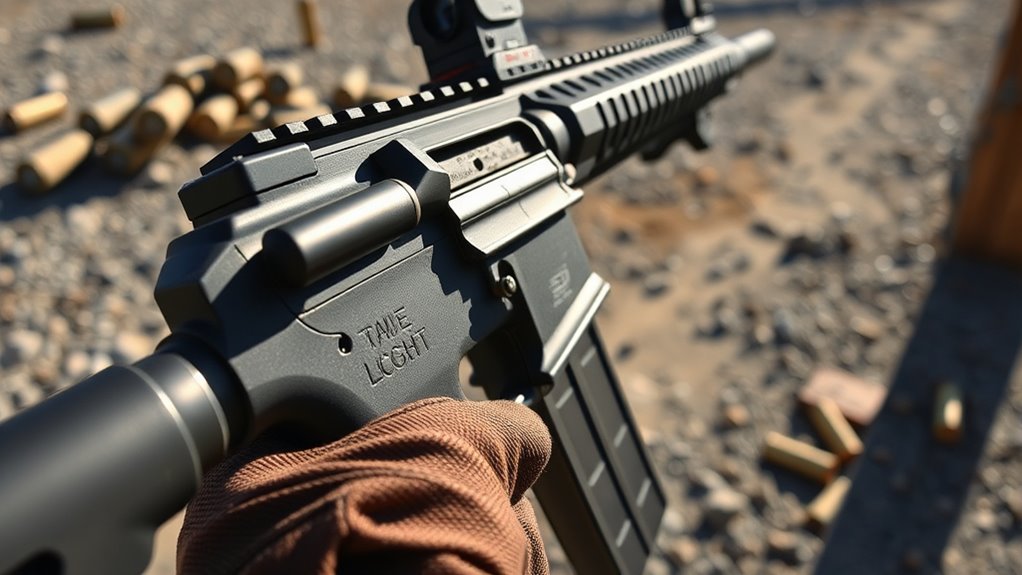
When your AR-15 encounters debris or inconsistent ammunition, you’ll often find the forward assist invaluable for guaranteeing the bolt fully locks. This mechanism maintains operational effectiveness by manually pushing the bolt carrier group forward when it doesn’t fully chamber a round.
You’ll typically use the forward assist in situations where reliability is critical.
| Scenario | Forward Assist Application |
|---|---|
| Dirty or fouled chamber | Guarantees bolt locks despite debris |
| Low-quality ammunition | Compensates for inconsistent cartridge seating |
| Rapid fire or combat stress | Maintains bolt engagement quickly |
| Malfunction clearing | Assists in chambering after immediate action |
Understanding these scenarios helps you maintain consistent function and maximize your AR-15’s performance under varied conditions.
Pros and Cons of the Forward Assist
Three main advantages and drawbacks define the forward assist’s utility on your AR-15. Historically, it was introduced to address jamming issues in military rifles, influencing its mechanical design to allow manual bolt closure. However, its necessity remains debated among users.
- Enhances bolt closure in adverse conditions
- Provides manual control when chambering rounds
- Adds slight complexity and potential failure points
- May encourage reliance on manual force instead of proper maintenance
- Historical context reveals its role in early M16 reliability issues
While the forward assist offers a mechanical solution for stubborn rounds, it also introduces potential drawbacks in simplicity and user technique. Understanding these pros and cons helps you decide if the forward assist suits your AR-15 setup and operational needs.
How the Forward Assist Affects Reliability
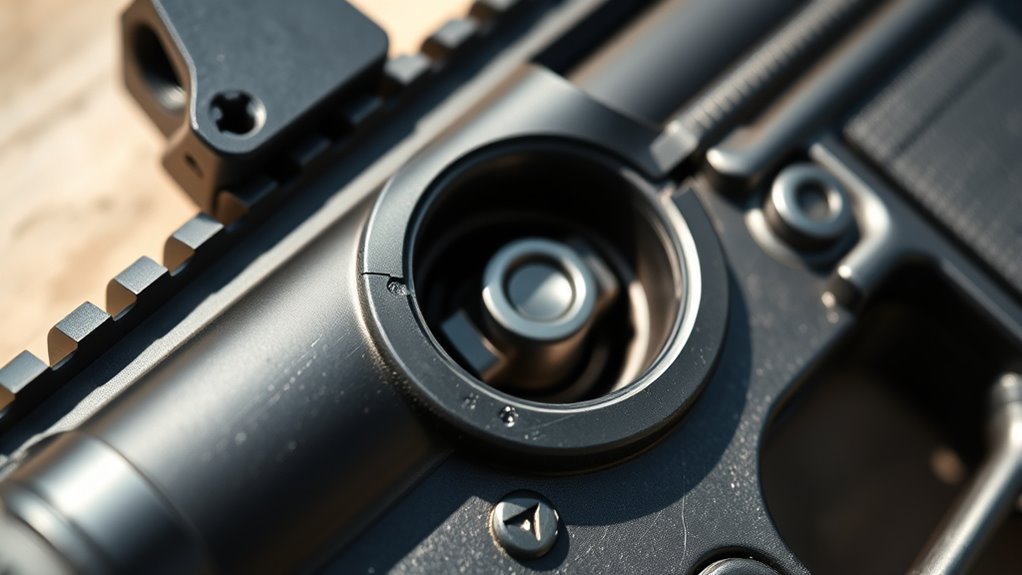
Understanding the forward assist’s impact on your AR-15’s reliability requires examining how it interacts with the rifle’s cycling process under various conditions. The forward assist provides a mechanical means to guarantee the bolt fully locks into battery when the bolt carrier group doesn’t seat completely on its own.
This feature can enhance forward assist reliability by allowing you to manually correct incomplete chambering, especially in adverse environments where dirt or fouling might impede cycling. While the AR 15 performance typically relies on proper gas system function, the forward assist acts as a backup, reducing the chance of stoppages during critical moments.
However, overreliance can mask underlying issues. Overall, the forward assist can improve reliability by enabling you to maintain consistent bolt lock-up, directly impacting your rifle’s dependable operation.
Alternatives to Using the Forward Assist
If you find yourself hesitant to rely on the forward assist, there are several effective alternatives to guarantee your AR-15’s bolt fully chambers without manual intervention. These alternative techniques can reduce dependence on the forward assist while maintaining reliability.
One common method is proper maintenance, confirming the chamber and bolt are clean and lubricated to prevent malfunctions. Another is improving your manual cycling technique, using smooth, deliberate bolt manipulation to confirm proper seating. Additionally, using high-quality, reliable ammunition reduces feeding issues.
Ensure reliable bolt seating with proper maintenance, smooth cycling, and premium ammunition to prevent malfunctions and feeding issues.
Upgrading the extractor or buffer spring can also enhance bolt engagement. Finally, training to recognize and address feeding issues proactively helps you avoid situations where forward assist use might be necessary.
- Thorough cleaning and lubrication
- Controlled manual cycling
- Using premium ammunition
- Upgrading extractor or buffer spring
- Regular function drills and training
Should You Remove or Modify Your Forward Assist?
While alternatives to using the forward assist can improve your AR-15’s reliability, you might still wonder whether removing or modifying this component is advisable. Forward assist removal can streamline your rifle and reduce weight slightly, but it eliminates a manual method to guarantee the bolt fully locks in adverse conditions.
Conversely, forward assist modification, such as reshaping or polishing, can enhance its function without sacrificing reliability. However, if your AR-15 cycles and chambers rounds consistently, forward assist removal might be unnecessary.
Before deciding, evaluate your firearm’s performance and intended use. For tactical or competition shooting, where every second counts, maintaining or modifying the forward assist could be beneficial. In contrast, for clean, well-maintained environments, removal poses minimal risk but limits manual bolt engagement options.
Frequently Asked Questions
Can the Forward Assist Damage the Bolt or Chamber?
You won’t typically damage the bolt or chamber using the forward assist, but forcing it repeatedly can impair bolt function.
It’s designed to guarantee full bolt seating, so use it cautiously to avoid undue stress or wear.
Is the Forward Assist Necessary for Competitive Shooting?
You don’t necessarily need a forward assist for competitive advantages; it depends on shooter preferences and reliability concerns. Some shooters value it for ensuring full bolt closure under stress, while others rely on consistent ammunition and maintenance.
Ultimately, its necessity varies based on individual shooting style and the specific conditions of use. Many competitive shooters find success without using the forward assist at all.
Does the Forward Assist Affect the Ar-15’s Accuracy?
You might be surprised—forward assist mechanics don’t directly influence accuracy factors on an AR-15. It guarantees full bolt closure under tough conditions, but precision depends more on barrel quality, ammunition, and shooter skill than the forward assist itself.
How Often Should the Forward Assist Be Cleaned or Maintained?
You should clean the forward assist during regular AR-15 maintenance, typically every 500-1000 rounds. Maintenance tips include inspecting for debris, lubricating moving parts, and ensuring proper function.
This helps prevent malfunctions and prolongs firearm reliability. Regular attention to the forward assist ensures the AR-15 operates smoothly and safely.
Are There Legal Restrictions on Forward Assists in Certain States?
About 15% of states impose specific regulations on firearm modifications like forward assists. You’ll need to check state regulations carefully, as some jurisdictions restrict or ban certain modifications to guarantee compliance with local firearm laws.
Conclusion
In understanding the forward assist on your AR-15, you see it’s designed to guarantee the bolt fully locks if it doesn’t chamber a round properly. While often unnecessary during normal use, it can be vital in adverse conditions or with dirty ammo. Visualize it as a manual nudge guaranteeing reliability.
However, relying on it too much might mask underlying issues. So, weigh its benefits carefully before deciding to modify or remove it from your rifle. In conclusion, the forward assist on an AR-15 serves as an important feature to ensure consistent weapon function when needed.