If you’re trying to identify what an AR-15 looks like, start by noticing its straight-line stock and a slim barrel, often topped with a flash suppressor.
This rifle features modular upper and lower receivers—the upper containing the bolt carrier and barrel connection.
The lower receiver houses the trigger and magazine well. Directly below the receiver is the pistol grip, and the magazine is curved, typically holding 20-30 rounds of .223 or 5.56 NATO ammunition.
Exploring further reveals even more distinct features and customization options that make the AR-15 unique and versatile.
Key Takeaways
- The AR-15 features a straight-line stock and pistol grip directly below the receiver for better recoil control and handling. It has a distinctive carrying handle or flat-top upper receiver with forward assist and ejection port cover.
- The barrel is long and slim, often with a flash suppressor and available in various profiles like lightweight or heavy.
- The detachable curved magazine typically holds 20-30 rounds of .223 Remington or 5.56x45mm NATO cartridges.
- Handguards vary from traditional round to free-floating rails, supporting modular attachments like M-LOK or Picatinny systems.
Key Visual Features of an AR-15
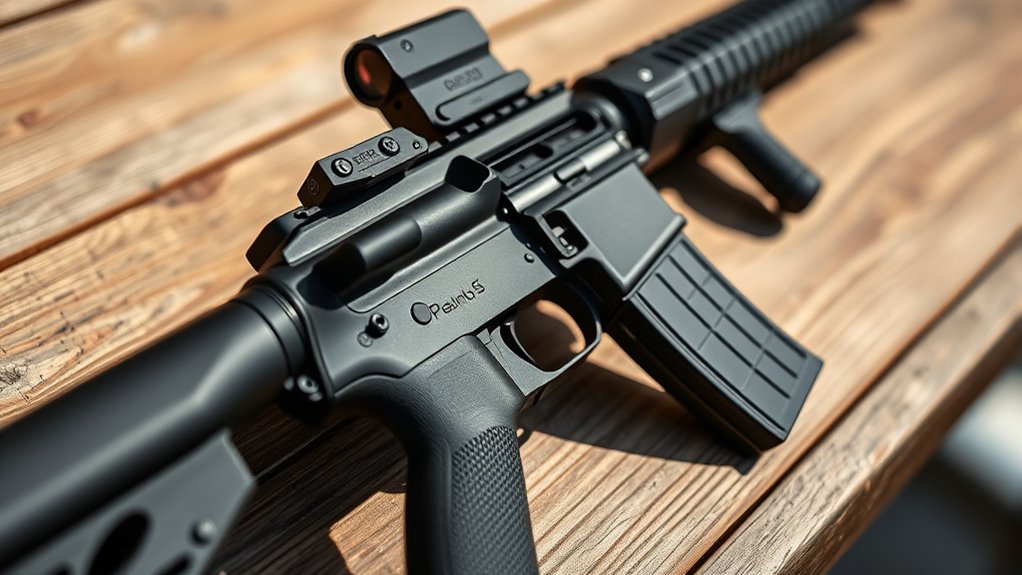
Although the AR-15’s appearance can vary slightly depending on the manufacturer and customizations, you’ll recognize it by several key visual features: a distinctive carrying handle or flat-top upper receiver, a straight-line stock design, a pistol grip situated directly below the receiver, and a long, slim barrel often equipped with a flash suppressor.
The AR 15 history traces back to its original design by Eugene Stoner in the late 1950s, emphasizing modularity and lightweight construction. This design ethos allows you to easily add AR 15 accessories like adjustable stocks, optics, and handguards without altering core components.
The straight-line stock design aligns recoil for better control, while the pistol grip enhances handling precision. These features collectively define the AR-15’s recognizable silhouette and functional versatility.
What the AR-15’s Upper and Lower Receivers Look Like
The upper and lower receivers form the core framework of the AR-15, housing critical components and defining much of its functionality. When examining AR 15 features, you’ll notice the two main receiver types: the upper receiver, which contains the bolt carrier group and interfaces with the barrel, and the lower receiver, which holds the trigger assembly and magazine well.
Both receivers are typically made from aluminum alloy for durability and weight reduction.
Key visual aspects include:
- The upper receiver’s forward assist and ejection port cover
- The lower receiver’s magazine well and trigger guard
- The takedown and pivot pin locations connecting both receivers
- Markings indicating manufacturer, model, and caliber stamped on the lower receiver
Understanding these receiver types is essential for recognizing the AR-15’s modular design and operational layout.
Recognizing the AR-15’s Barrel and Handguard Styles
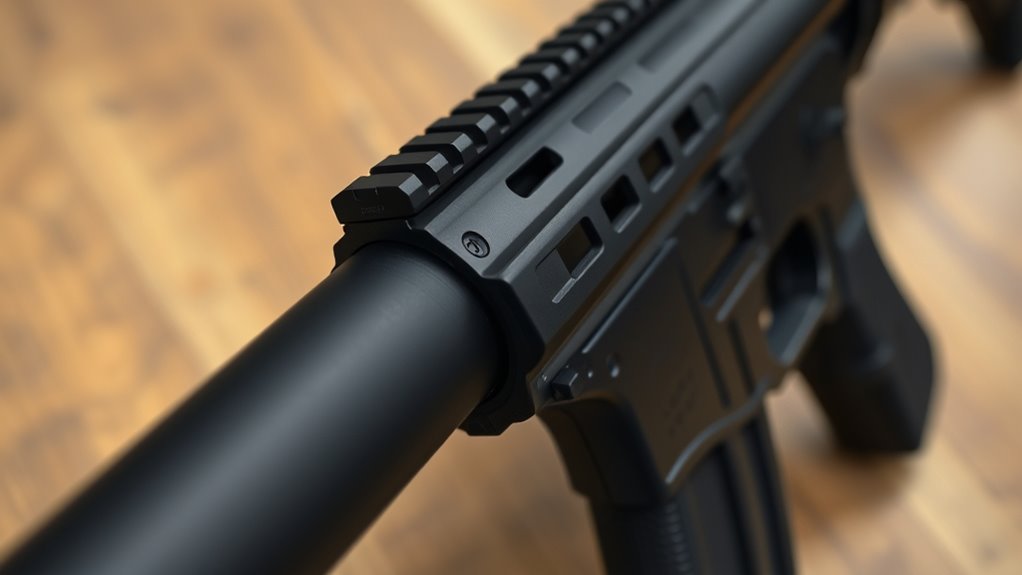
You’ll notice the AR-15 barrels come in various profiles, including lightweight, government, and heavy barrels, each affecting weight and heat dissipation.
The handguard styles also vary, ranging from traditional round designs to free-floating rails with M-LOK or KeyMod attachment systems.
Understanding these differences helps you identify the rifle’s configuration and intended use.
Barrel Types Overview
When identifying an AR-15’s barrel and handguard, you’ll notice distinct variations that affect both performance and handling. Barrels differ primarily in materials and finishes, influencing durability and heat dissipation. Common barrel materials include chrome-moly steel and stainless steel, each offering unique advantages in corrosion resistance and rigidity.
Finishes such as phosphate, nitride, and chrome lining improve wear resistance and ease maintenance. Barrel profiles also vary, impacting weight and accuracy.
Key barrel types you’ll encounter:
- Lightweight (pencil) barrels: slim, enhancing maneuverability but less heat tolerance
- Government profile barrels: moderate weight, balanced for durability and accuracy
- Heavy barrels: thicker for sustained firing and heat management
- Bull barrels: maximal thickness for precision shooting and stability
Understanding these distinctions helps you choose the barrel that best suits your shooting needs.
Handguard Design Variations
Although barrel types markedly influence an AR-15’s performance, handguard designs play an equally crucial role in handling, heat management, and accessory compatibility. You’ll find handguards constructed from various materials like aluminum, carbon fiber, and polymer, each offering distinct weight, durability, and heat dissipation characteristics.
Aluminum handguards excel in rigidity and heat conduction but add weight, while carbon fiber reduces weight and heat transfer. Polymer variants prioritize cost and corrosion resistance but may sacrifice structural stiffness. Design-wise, free-floating handguards enhance accuracy by eliminating barrel contact, whereas drop-in models prioritize simplicity.
Handguard accessories mount via M-LOK, KeyMod, or Picatinny rails integrated into the design, allowing you to customize grips, lights, and optics efficiently. Selecting the appropriate handguard material and style directly affects your AR-15’s ergonomics and modularity, so consider your intended use carefully.
Identifying the AR-15’s Stock and Grip
The stock and grip are essential components that define the AR-15’s ergonomics and handling characteristics. When identifying the AR-15, you’ll notice various stock types like fixed, collapsible, and adjustable, each influencing length of pull and comfort.
Grip materials range from polymer to rubberized coatings, affecting tactile feedback and control. The design often incorporates texturing patterns for enhanced grip stability under recoil.
Pay attention to:
- Collapsible stocks with multiple positions for user customization
- Fixed stocks offering rigidity and simplicity
- Pistol grips molded from durable polymer or rubber for improved handling
- Textured surfaces on grips designed to reduce slippage in adverse conditions
Understanding these elements helps you accurately recognize the AR-15’s distinctive profile and tailor your handling experience.
How to Recognize the AR-15 by Its Magazine and Caliber
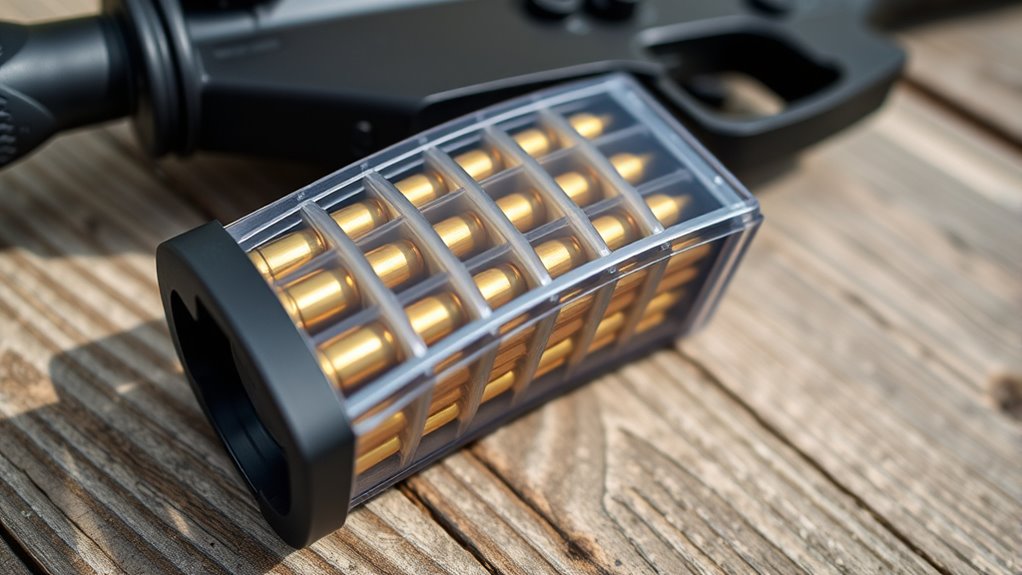
Beyond the stock and grip, the magazine and caliber offer key visual and functional cues to identify an AR-15. Magazine identification is essential: the AR-15 typically uses a detachable box magazine with a curved profile designed for .223 Remington or 5.56x45mm NATO rounds.
Caliber comparison further aids recognition, as the AR-15’s chambering differs from other rifles.
| Feature | AR-15 Standard | Common Alternatives | Notes |
|---|---|---|---|
| Magazine Capacity | 20-30 rounds | 10-40 rounds | Standard 30-round is most common |
| Caliber | .223 Rem / 5.56mm | .308 Winchester, 7.62mm | AR-15 rarely uses larger calibers |
| Magazine Shape | Curved, polymer | Straight, metal | Curved design accommodates cartridge taper |
Understanding these factors streamlines accurate AR-15 identification through magazine identification and caliber comparison.
Key Visual Differences Between the AR-15 and Military Rifles
When you’re comparing an AR-15 to military rifles, you’ll notice distinct visual cues that set them apart, primarily in their design features and build specifications. The AR-15 is often lighter and features modular construction, accommodating various AR 15 accessories. Military rifle differences include heavier barrels and integrated suppressors or grenade launchers.
The AR-15 is lighter and modular, while military rifles feature heavier barrels and integrated attachments.
Key visual distinctions include:
- Receiver markings: AR-15s display civilian manufacturer logos; military rifles have government proof marks.
- Stock design: AR-15 stocks are adjustable; military rifles often have fixed or robust folding stocks.
- Sights: Military rifles typically use iron or optical sights optimized for combat; AR-15s may have simpler or customizable setups.
- Barrel profile: Military barrels are thicker for sustained fire, contrasting with the AR-15’s thinner, lighter barrel.
These differences reflect their distinct roles and regulatory classifications.
Common Customizations That Change the AR-15’s Appearance
When customizing your AR-15, you’ll notice barrel lengths can range from compact 7.5 inches to extended 24 inches, considerably affecting the rifle’s profile and handling. Stock options vary from fixed to adjustable designs, altering both the silhouette and ergonomics.
Additionally, handguards come in multiple materials and styles, such as free-floating or quad rails, further redefining the rifle’s external appearance.
Barrel Length Variations
Several barrel length options exist for the AR-15, each affecting its handling, weight, and overall profile. When you’re choosing barrel lengths, you’ll notice differences in maneuverability and ballistic performance. Shorter barrels, typically 10.5 to 14.5 inches, enhance compactness but reduce velocity and effective range.
Longer barrels, around 16 to 20 inches, improve accuracy and muzzle velocity but add weight. Barrel profiles also vary, from lightweight pencil barrels to heavy target profiles, impacting heat dissipation and rigidity.
- 10.5-inch barrels: highly maneuverable, ideal for close quarters
- 16-inch barrels: standard compromise between portability and performance
- Heavy barrel profiles: increased stability during rapid fire
- Lightweight barrels: reduce overall rifle weight for easier carry
Understanding these variations helps you customize the AR-15 to your specific needs.
Stock Style Options
Adjusting the barrel length impacts not only the AR-15’s handling but also its overall silhouette, and the stock style you choose further refines the rifle’s ergonomics and appearance. Adjustable stocks offer you versatility, allowing length-of-pull customization to fit various shooting positions or body sizes. Collapsible stocks, a subset of adjustable types, enable rapid length adjustments and often contribute a tactical, compact look.
Fixed stocks provide a rigid, stable platform, enhancing accuracy but limiting adaptability. Minimalist stocks prioritize weight reduction and streamlined profiles, often constructed from lightweight materials to improve maneuverability without sacrificing structural integrity. Selecting the right stock style directly influences your AR-15’s balance, recoil management, and visual profile, so consider your intended use carefully when customizing this critical component.
Handguard Custom Designs
Although the handguard may seem like a straightforward component, its custom design greatly affects both the AR-15’s functionality and aesthetic profile. When you select from various custom handguard styles, you’re influencing heat dissipation, weight distribution, and accessory mounting options.
Unique design elements such as material choice, rail integration, and contouring define the rifle’s handling and visual impact. Consider these common customizations:
- Free-floating handguards enhance accuracy by eliminating barrel contact.
- M-LOK or KeyMod slots offer modular attachment points for lights, grips, and lasers.
- Carbon fiber or aluminum constructions reduce weight while maintaining rigidity.
- Sleek, streamlined profiles improve ergonomics and modernize the rifle’s look.
Where to Find Clear Images and Diagrams of an AR-15
Where can you locate clear, detailed images and diagrams of an AR-15 to enhance your understanding of its components? Start with reputable firearms manuals and manufacturer websites, which often provide exploded views and technical schematics. Websites specializing in firearm parts and upgrades also offer high-resolution images that showcase AR 15 accessories and their integration with various AR 15 variants.
Online forums and enthusiast communities frequently share annotated diagrams and user-submitted photos that highlight differences between models and custom configurations. Additionally, technical publications and training materials deliver precise breakdowns of internal mechanisms. When researching, verify the sources clearly distinguish between standard components and aftermarket parts, helping you accurately identify parts and modifications.
This approach guarantees an all-encompassing, technical grasp of the AR-15’s design and functionality.
Frequently Asked Questions
What Is the Historical Origin of the AR-15 Design?
You’ll find the AR-15’s design originated from military influence, evolving from the Armalite AR-10. Its design evolution focused on lightweight materials and modularity, shaping modern tactical rifles with precision-engineered components.
These components enhanced performance and reliability, making the AR-15 a versatile and widely adopted firearm in both civilian and military contexts.
How Does the AR-15 Function Mechanically?
You know what they say, “the devil’s in the details.” When you fire, the gas system redirects gas to cycle the bolt carrier. This action extracts and ejects spent casings, then chambers a new round.
This process ensures semi-automatic function with precision and reliability.
What Are the Legal Restrictions on Owning an AR-15?
You’ll face varied legal ownership restrictions on AR-15s depending on state regulations, including mandatory background checks, waiting periods, magazine capacity limits, and assault weapon bans.
Always verify your state’s specific laws before purchasing or possessing one.
How Do AR-15 Safety Features Operate?
You’d think AR-15 safety mechanisms could stop a runaway train, but they precisely block trigger operation by isolating the sear, ensuring the hammer won’t fall unless you intentionally disengage the safety.
This design prevents accidental discharge reliably, giving shooters confidence in their firearm’s safety features. The mechanism’s simplicity and effectiveness make it a trusted component in firearm safety.
What Are Common Uses for the AR-15 Rifle?
You’ll find the AR-15 commonly used for hunting applications due to its modularity and accuracy, plus home defense because of its manageable recoil, customizable optics, and quick follow-up shot capability, enhancing tactical versatility.
Its lightweight design and ease of customization also make it popular among sport shooters. Additionally, many use the AR-15 for competitive shooting events, where precision and speed are crucial.
The rifle’s adaptability allows users to configure it for different calibers and purposes, making it a versatile choice for various shooting activities.
Conclusion
Now that you’ve navigated the nuanced nuances of the AR-15’s anatomy, you can confidently distinguish its distinct design details—from the sleek stock to the sturdy steel barrel. Whether spotting subtle shifts in the silhouette or scanning for signature shapes in the stock and sights, your sharp sight will swiftly separate the standard AR-15 from similar styles.
Keep studying specifications and scrutinizing schematics to sharpen your skills and solidify your savvy sighting. Understanding what do a AR 15 look like is essential for enthusiasts and professionals alike, helping you identify this iconic firearm with ease and accuracy.