Your AR-15 is most commonly chambered in 5.56x45mm NATO, the standard caliber offering ideal performance and reliability.
This caliber is widely used by military and civilian shooters alike, making it a popular choice for the AR-15 platform.
It also chambers .223 Remington, which is dimensionally similar but operates at lower pressure.
Because of this difference, be cautious about mixing ammo to ensure safety and proper function.
Other calibers like .300 Blackout and 6.5 Grendel exist for specialized uses, each requiring specific modifications to the rifle.
Understanding these differences helps you choose the right caliber for your needs and guarantees safe, efficient use of your rifle.
More details follow.
Key Takeaways
- The most common caliber for an AR-15 is 5.56x45mm NATO, designed for standard military and civilian use.
- AR-15 rifles are often chambered in .223 Remington, a similar caliber with slightly lower pressure specifications.
- Other popular AR-15 calibers include .300 Blackout and 6.5 Grendel for specialized hunting and tactical needs.
- The 5.56 NATO caliber offers higher pressure and better terminal ballistics than .223 Remington.
- Choosing an AR-15 caliber depends on intended use, recoil tolerance, ammunition availability, and desired range.
Standard AR-15 Calibers Explained
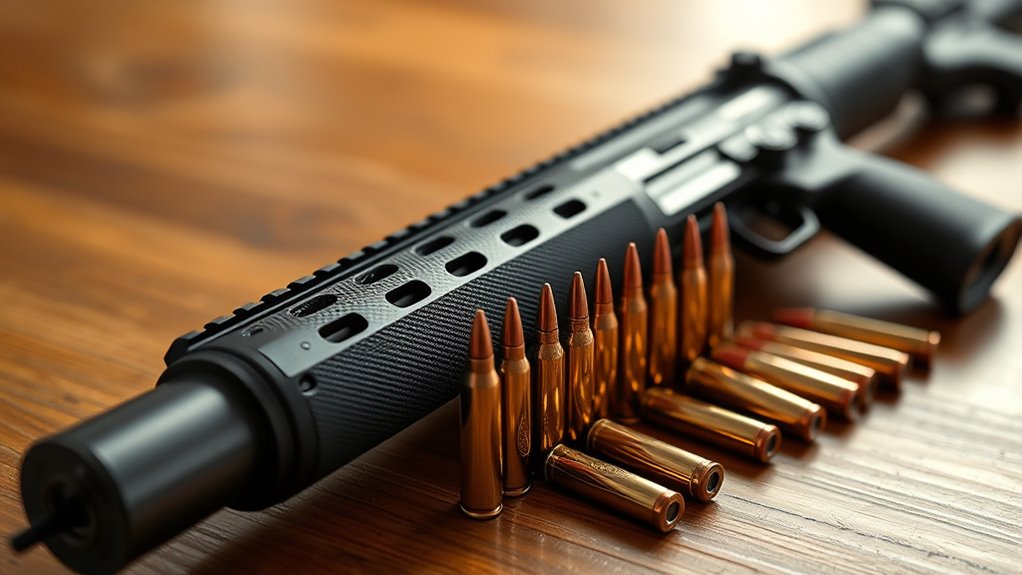
When discussing standard AR-15 calibers, you’ll find that the most common chambering is the 5.56x45mm NATO. This caliber’s history dates back to the 1960s when it was adopted by NATO forces for its balance of velocity, range, and manageable recoil. The AR-15 platform was initially designed around this cartridge, ensuring ideal caliber compatibility.
Besides 5.56x45mm NATO, many AR-15s also accommodate other calibers like .223 Remington, which shares dimensions but differs in pressure specifications. The caliber history of the AR-15 includes adaptations to various rounds, but the 5.56x45mm remains the benchmark for performance and reliability.
Understanding caliber compatibility is essential for safe and effective firearm operation, ensuring you select ammunition that matches your AR-15’s chamber specifications precisely.
Differences Between .223 Remington and 5.56 NATO
Although the .223 Remington and 5.56x45mm NATO cartridges look nearly identical, their differences in chamber pressure and throat dimensions greatly affect their interchangeability and performance. When considering .223 vs 5.56, you should note that 5.56 NATO rounds are loaded to higher pressures, typically around 58,000 psi, compared to approximately 55,000 psi for .223 Remington.
Additionally, 5.56 chambers have a longer leade or throat, allowing the bullet to travel slightly before engaging the rifling, which helps manage pressure. In contrast, .223 chambers have tighter chamber specifications with a shorter leade, resulting in higher pressures if 5.56 ammo is fired in a .223 chamber.
Consequently, you can safely shoot .223 in a 5.56 chambered AR-15, but firing 5.56 NATO in a .223 chamber may not be advisable due to potential overpressure and accuracy issues.
Pros and Cons of Common AR-15 Calibers
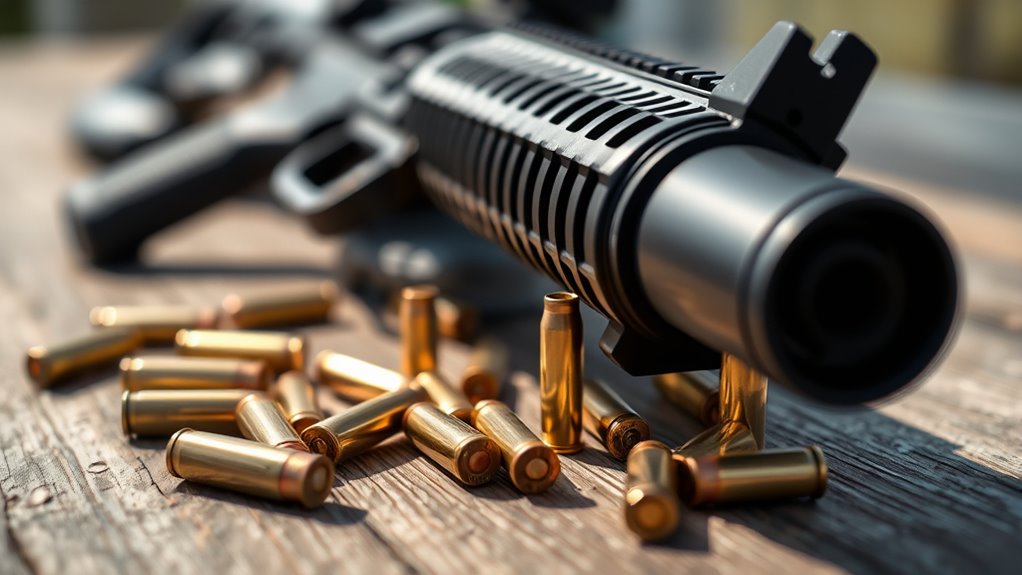
Understanding the differences between .223 Remington and 5.56 NATO highlights how caliber choice impacts an AR-15’s performance and safety. Your caliber selection affects recoil, range, and ammunition types compatibility. Here are pros and cons of common AR-15 calibers:
- .223 Remington: Low recoil and widely available ammo, but less effective at longer ranges compared to 5.56 NATO.
- 5.56 NATO: Higher pressure and velocity improve terminal ballistics, but requires a rifle rated for 5.56 to guarantee safety.
- .300 Blackout: Excellent for short-range and suppressed shooting; however, it has limited effective range and less ammo availability.
- 6.5 Grendel: Superior long-range performance and energy retention, yet ammunition is pricier and less common.
Each caliber offers trade-offs; understanding them helps optimize your AR-15 for your needs.
How to Choose the Best AR-15 Caliber for You
How do you determine the best AR-15 caliber for your specific needs? Caliber selection hinges on your shooting preferences, intended use, recoil tolerance, and ammunition availability.
To optimize your choice, evaluate factors like range, stopping power, and cost per round.
| Factor | Consideration |
|---|---|
| Intended Use | Target shooting, self-defense |
| Recoil Level | Manageable vs. heavy |
| Ammunition Cost | Budget constraints |
| Accuracy | Precision at desired distance |
| Availability | Local and online supply |
Popular AR-15 Caliber Options for Hunting and Defense
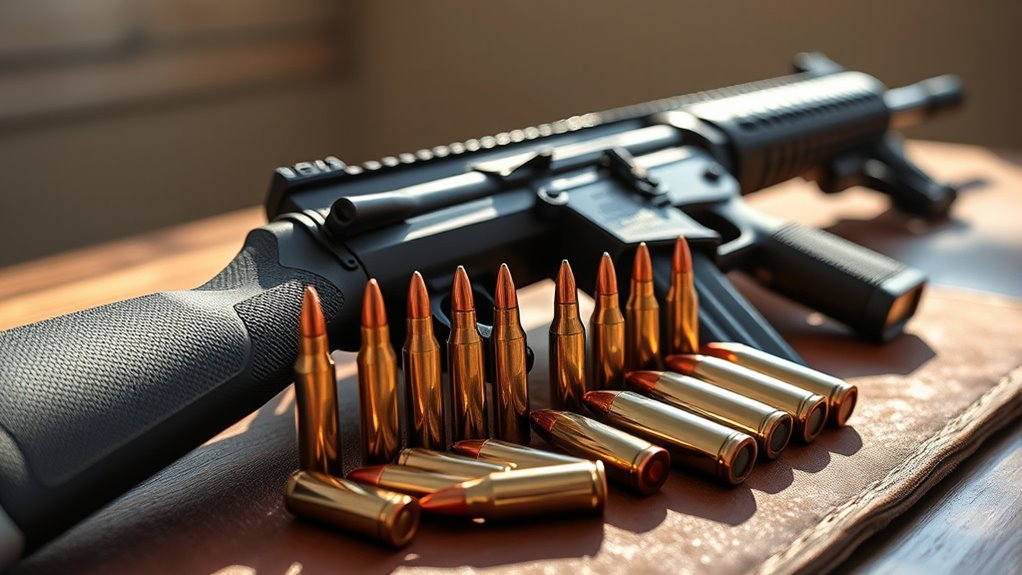
When selecting an AR-15 caliber for hunting, you’ll often encounter options like .223 Remington and 6.5 Grendel, which balance range and terminal performance.
For defense, calibers such as .300 Blackout offer advantages in stopping power and versatility in various environments. Understanding these options helps you optimize your rifle’s effectiveness for both hunting and self-defense scenarios.
Common Hunting Calibers
Three calibers dominate the AR-15 platform for hunting and defense: .223 Remington/5.56 NATO, .300 AAC Blackout, and 6.5 Grendel. When considering caliber selection, you must account for hunting regulations, which often dictate minimum calibers and bullet weights.
- .223 Remington/5.56 NATO – Suitable for small to medium game; widespread availability and moderate recoil.
- .300 AAC Blackout – Offers better terminal performance on medium game at shorter ranges, compatible with standard AR-15 magazines.
- 6.5 Grendel – Provides superior long-range accuracy and energy, ideal for larger game within 500 yards.
- .224 Valkyrie – Emerging option for extended-range hunting with flat trajectory and manageable recoil.
Selecting the right caliber guarantees compliance with regulations and optimizes ethical, effective hunting.
Defense-Caliber Advantages
Although hunting calibers focus on game-specific performance, defense calibers prioritize stopping power, reliability, and controllability under stress. When considering caliber selection for an AR-15 intended for defense, you’ll want to balance recoil management with terminal performance.
The 5.56 NATO is popular due to its manageable recoil and proven track record, offering reliable defensive effectiveness in close- to mid-range encounters. Alternatively, calibers like the .300 Blackout enhance stopping power, especially in suppressed configurations, without sacrificing controllability.
Your choice should account for ammunition availability and compatibility with your AR-15 platform. Ultimately, selecting a defense caliber means optimizing for rapid, accurate follow-up shots and consistent performance under pressure, ensuring your AR-15 serves as a dependable tool for personal protection scenarios.
Versatility and Performance
Because the AR-15 platform supports a variety of calibers, you can tailor your rifle’s versatility and performance to suit both hunting and defensive needs. When evaluating caliber comparisons and performance metrics, consider these popular options:
- .223 Remington/5.56 NATO – Offers high velocity and low recoil, ideal for small to medium game and home defense.
- .300 AAC Blackout – Excels in suppressed shooting with superior terminal performance in short barrels.
- 6.5 Grendel – Provides enhanced long-range accuracy and energy retention, suitable for larger game.
- .450 Bushmaster – Delivers significant stopping power for big game and close-quarters defense.
Modifications Needed to Change AR-15 Calibers
When you decide to change the caliber of your AR-15, several key modifications are required to guarantee proper function and safety. The most common method involves caliber conversions, which typically necessitate swapping the upper receiver or performing upper replacements tailored to the new caliber specifications. You’ll need to install a barrel chambered for the desired caliber and make sure the bolt carrier group matches the cartridge dimensions.
Additionally, magazines compatible with the new caliber must be used to maintain reliable feeding. Depending on the caliber, adjustments to the gas system may be essential to make sure proper cycling. Proper headspace verification and function testing are vital after modifications.
Frequently Asked Questions
What Is the History Behind the AR-15 Design?
You’ll find the AR-15’s design evolution started with military origins in the 1950s, developed by Eugene Stoner to create a lightweight, reliable rifle.
This design influenced modern firearms through modularity and advanced materials for enhanced performance.
How Does Barrel Length Affect AR-15 Performance?
You’ll notice barrel length affects velocity and maneuverability; shorter barrels reduce range but enhance handling.
Matching barrel twist rates optimizes bullet stabilization, balancing accuracy trade offs depending on your intended shooting distance and ammunition type.
Are There Legal Restrictions on AR-15 Calibers?
Yes, you’ll find caliber regulations vary by jurisdiction, affecting AR-15 calibers you can legally possess.
Stay informed on local firearm legislation to guarantee compliance with restrictions on specific calibers or ammunition types before purchasing or modifying.
What Are the Maintenance Requirements for Different Calibers?
Maintenance frequency varies with caliber due to fouling rates; larger calibers often require more frequent cleaning.
In your caliber comparison, consider that higher-pressure rounds demand stricter upkeep to guarantee reliability and longevity of your AR-15.
How Does Caliber Impact AR-15 Recoil and Accuracy?
Think of caliber selection as tuning a violin; smaller calibers offer gentler recoil management, enhancing precision, while larger ones produce more kick, challenging your stability but potentially increasing stopping power.
This directly impacts your AR-15’s accuracy and control.
Conclusion
Whether you’re aiming for precision with .223 Remington, power with 5.56 NATO, versatility with .300 Blackout, or affordability with 9mm, each AR-15 caliber offers distinct advantages. You’ll balance range, recoil, cost, and application. You’ll modify barrels, bolts, and magazines to suit your choice.
By understanding these factors, you’ll select the perfect caliber tailored to your needs—whether for target shooting, hunting, or defense. This ensures your AR-15 performs reliably and efficiently every time. Knowing what caliber is an AR-15 chambered in will help you make the best decision for your firearm.