An AR-15 typically measures between 32 and 39 inches overall, depending mainly on barrel length and stock configuration.
A 16-inch barrel carbine setup is around 32.5 inches, while a 20-inch rifle-length barrel can reach 36 inches or more.
Adjustable stocks can add or subtract about an inch or so, affecting the rifle’s length and handling.
Understanding these variations helps you choose the ideal size for your purpose.
Exploring these details further reveals how length impacts performance and use.
Key Takeaways
- The standard AR-15 length is about 39 inches from muzzle to buttstock when fully extended.
- Typical barrel lengths range from 16 to 20 inches, affecting the rifle’s total length and use case.
- Carbine models usually measure around 32.5 to 33 inches for better maneuverability.
- Adjustable stocks can change overall length by 1 to 1.5 inches for improved comfort and control.
- Longer barrels improve accuracy and velocity but increase rifle length and weight.
What Is the Standard Length of an AR-15 Rifle?
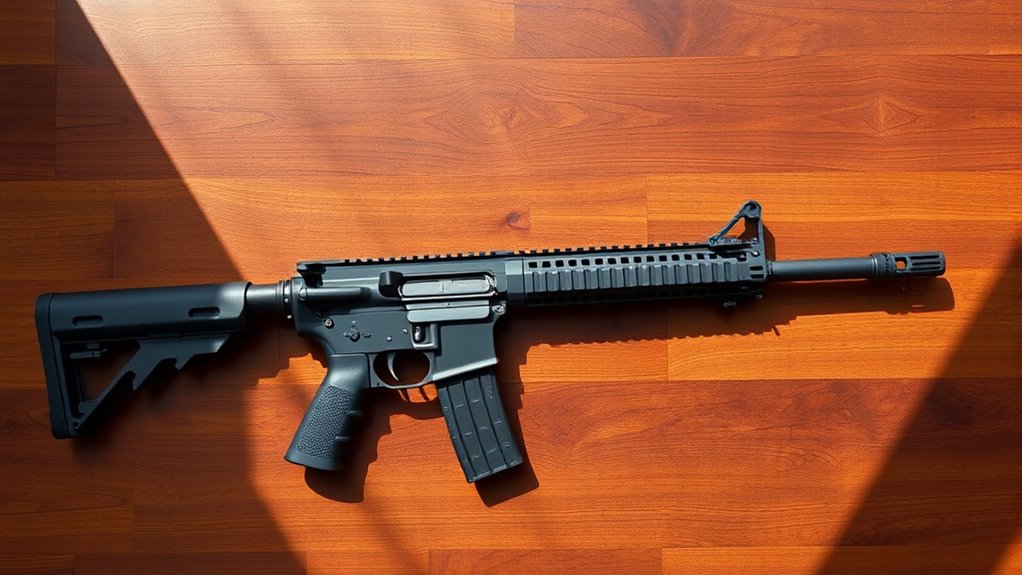
While the AR-15 platform can vary, the standard length of an AR-15 rifle is typically around 39 inches from the muzzle to the buttstock when fully extended. This measurement applies to the most common standard configurations, which usually feature a 16-inch barrel and a six-position adjustable stock.
You should know that length variations occur depending on barrel length, stock type, and handguard design. For example, carbines with shorter barrels and collapsible stocks can measure closer to 33 inches, while rifles with longer barrels and fixed stocks may exceed 40 inches.
Understanding these length variations helps you select an AR-15 suited to your needs, whether for maneuverability or accuracy. Standard configurations balance size and functionality, making 39 inches a practical benchmark for general use.
How Barrel Length Affects AR-15 Overall Size
Barrel length plays a significant role in determining the overall size of an AR-15, directly impacting both its length and handling characteristics. When you consider the barrel length, you must understand how it influences the rifle’s overall dimensions:
Barrel length crucially affects an AR-15’s size and handling, shaping its overall dimensions and balance.
- Total length: Longer barrels extend the rifle’s physical length, affecting maneuverability.
- Weight distribution: Increasing barrel length shifts weight forward, impacting balance.
- Accessory compatibility: Barrel length dictates handguard size and sight placement, influencing customization options.
Carbine vs. Mid-Length vs. Rifle: Which AR-15 Length Is Right?
How do you choose between carbine, mid-length, and rifle AR-15 configurations? Understanding their functional differences helps. Carbine-length gas systems, typically 7.5 inches, offer carbine advantages like reduced weight and enhanced maneuverability, ideal for close-quarters or rapid target acquisition.
Mid-length systems extend the gas port to about 9 inches, balancing recoil impulse and reliability, offering smoother cycling compared to carbines. Rifle-length gas systems, around 12 inches, provide a longer dwell time, which can improve barrel life and reduce wear but incur rifle drawbacks such as increased weight and a heavier recoil impulse.
Your choice depends on your intended use—if you prioritize compactness and speed, carbine suits you; for balanced performance, mid-length is most effective; if durability and reduced recoil matter most, rifle length fits best.
How Adjustable Stocks Affect AR-15 Length
You’ll find that adjustable stocks greatly influence the AR-15’s overall length by allowing the buffer tube to extend or retract. This variability lets you customize the length of pull to fit different shooting positions or user preferences.
Understanding how stock position alters the rifle’s length is essential for optimizing handling and storage.
Stock Position Variability
Although the overall length of an AR-15 is influenced by multiple factors, the stock position plays a critical role in its variability. When you perform stock adjustment, you directly affect the weapon’s length variation, changing how it handles and fits your body. Adjustable stocks typically offer several positions, allowing you to customize length of pull.
Here’s how stock position variability impacts your AR-15:
- Range of Adjustment: Most adjustable stocks provide 6 to 7 positions, altering overall length by 1 to 1.5 inches.
- Ergonomics: Proper stock positioning improves shooting comfort and control.
- Compatibility: Some stocks feature proprietary buffers affecting length variation.
Understanding stock position variability is essential for optimizing your AR-15’s fit and function without altering other components.
Impact on Overall Length
Adjusting the stock on your AR-15 directly alters its overall length, impacting both handling and storage. Adjustable stocks provide significant length variations, allowing you to fine-tune the rifle’s length of pull to fit your body size and shooting stance. This customization option enhances ergonomics and control, especially in dynamic shooting environments.
When fully extended, the AR-15 can increase in length by several inches, improving stability during aimed fire. Conversely, collapsing the stock compacts the rifle for easier maneuverability in confined spaces or transport. Understanding these length variations is essential when selecting stocks, as they influence balance, recoil management, and compatibility with gear like slings or body armor.
Ultimately, adjustable stocks offer practical versatility, optimizing your AR-15’s overall length for diverse operational needs.
Measuring Your AR-15’s Length Accurately
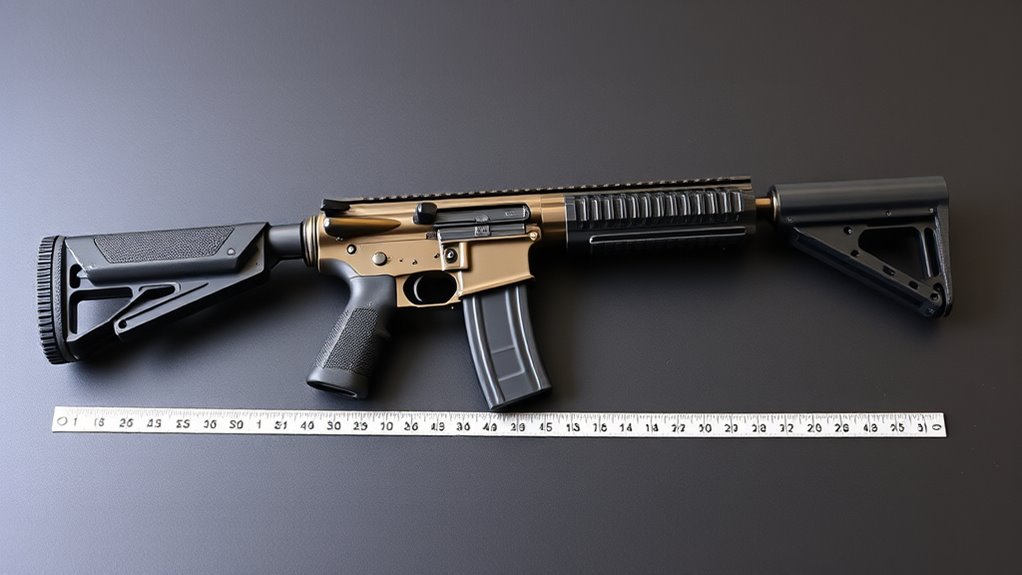
When measuring your AR-15’s length accurately, it’s essential to use the proper reference points to confirm consistency. Start by measuring from the tip of the barrel—taking into account the barrel material, since some coatings or attachments may slightly extend length—to the end of the stock.
Since stock types vary widely (fixed, collapsible, or folding), make sure you measure to the stock’s furthest point in its current configuration.
Always measure to the stock’s furthest point, considering whether it’s fixed, collapsible, or folding.
Follow these steps for precision:
- Align the rifle horizontally on a flat surface.
- Use a rigid measuring tape or caliper for exact length.
- Measure from the barrel’s muzzle to the rearmost point of the stock.
This method accounts for variations in barrel material and stock types, providing an accurate overall length measurement.
Why AR-15 Length Matters for Handling and Maneuverability
You’ll notice that the length of your AR-15 directly impacts its balance, affecting how effortlessly you can control the weapon. In tight, close-quarters environments, a shorter length enhances maneuverability, allowing quicker target acquisition.
Conversely, a longer barrel can improve precision shooting by providing a more stable platform and increased velocity.
Impact On Weapon Balance
Although the overall length of an AR-15 might seem like a simple measurement, it plays a critical role in the weapon’s balance, directly affecting handling and maneuverability. The length influences weight distribution, which in turn impacts handling comfort and control. When you consider modifying or selecting an AR-15, keep these points in mind:
- Shorter lengths shift the center of gravity closer to you, enhancing quick target acquisition but potentially increasing muzzle rise.
- Longer lengths distribute weight more evenly, improving stability during sustained fire but possibly reducing agility.
- The barrel and handguard length contribute to perceived balance, affecting how comfortably you can maneuver the rifle in various shooting positions.
Understanding this balance helps you optimize your AR-15 for your specific handling preferences and operational needs.
Effect On Close Quarters
Because close quarters demand rapid movement and tight maneuvering, the length of an AR-15 becomes a decisive factor in handling efficiency. A shorter barrel and compact overall length enhance your ability to navigate confined spaces, reducing the risk of snagging or obstruction. This streamlined profile offers a distinct tactical advantage by allowing quicker target acquisition and smoother shifts between angles.
Conversely, longer configurations may impede swift handling, limiting your responsiveness in dynamic environments. Choosing the right AR-15 length directly impacts your control, speed, and comfort during close quarters engagements. Ultimately, optimizing your rifle’s dimensions guarantees superior maneuverability, giving you the tactical advantage needed to operate effectively in tight, unpredictable scenarios.
Influence On Precision Shooting
While shorter AR-15 configurations excel in tight spaces, precision shooting often benefits from different considerations regarding rifle length. When you’re focusing on accuracy at varied shooting distances, the length of your AR-15 critically influences key precision factors.
A longer barrel generally improves bullet velocity and stability, enhancing accuracy. However, increased length can affect handling and maneuverability, especially in dynamic shooting scenarios. Consider these points:
- Barrel Length: Longer barrels provide higher muzzle velocity, improving ballistic performance at extended ranges.
- Sight Radius: A longer sight radius enhances your ability to align sights precisely, reducing aiming errors.
- Weight Distribution: Length influences balance, affecting your steadiness and recoil management during precise shots.
Balancing these factors guarantees your AR-15 maximizes precision without compromising handling tailored to your shooting distances.
Common AR-15 Configurations and Their Typical Lengths
Several common AR-15 configurations exist, each designed with specific barrel lengths and overall dimensions to suit different applications.
When customizing your AR-15, understanding these typical setups helps in selecting appropriate AR 15 accessories and planning custom configurations.
| Configuration | Barrel Length (inches) | Overall Length (inches) |
|---|---|---|
| Carbine | 16 | 32.5 |
| Mid-Length | 18 | 34 |
| Rifle | 20 | 36 |
Carbine models prioritize maneuverability, making them popular for close quarters. Mid-length barrels offer a balance of velocity and control.
Rifle-length barrels enhance accuracy and velocity but add weight and length. Your choice influences handling and accessory compatibility.
How AR-15 Length Impacts Shooting Accuracy and Handling
Although longer barrels generally improve bullet velocity and accuracy at distance, they also affect how you handle the AR-15 in practical scenarios. Barrel materials like chrome-moly steel or stainless steel influence weight and heat dissipation, impacting your control during rapid fire. Your shooting stances must adapt to barrel length to maintain stability and minimize fatigue.
Longer barrels boost velocity and accuracy but require stance adjustments for better control and reduced fatigue.
Consider these factors:
- Maneuverability: Shorter barrels enhance handling in close quarters but may sacrifice long-range precision.
- Recoil Management: Heavier barrels reduce muzzle rise, aiding follow-up shots.
- Balance: Barrel length shifts the rifle’s center of gravity, affecting your ability to maintain steady shooting stances.
Understanding these dynamics helps you optimize accuracy and handling based on your AR-15’s length and intended use.
Tips to Choose the Best AR-15 Length for Your Use Case
Choosing the right AR-15 length depends heavily on how you plan to use the rifle and the trade-offs you’re willing to accept between maneuverability, accuracy, and recoil control. For close-quarters or home defense, shorter barrels—often in custom lengths—offer enhanced maneuverability but may sacrifice velocity and long-range precision.
Conversely, longer barrels improve accuracy and ballistic performance, ideal for target shooting or hunting. When selecting barrel materials, consider stainless steel for corrosion resistance and precision or chrome-moly for durability and cost efficiency.
Custom lengths allow you to tailor the rifle to your specific application, balancing weight and handling characteristics. Ultimately, you should evaluate your primary use case, preferred barrel materials, and whether a custom length can optimize performance without compromising reliability or comfort.
Frequently Asked Questions
What Materials Are Commonly Used to Manufacture AR-15 Barrels?
You’ll find AR-15 barrel materials typically include chrome-moly steel and stainless steel, chosen for durability and heat resistance.
Manufacturing processes involve precision forging, rifling, and chrome lining to enhance accuracy, corrosion resistance, and longevity.
How Often Should You Clean an AR-15 for Optimal Performance?
Like clockwork gears, you should clean your AR-15 after every 200-300 rounds for peak performance. Regular cleaning frequency and maintenance tips, such as lubricating and inspecting parts, guarantee reliability and prevent malfunctions in all conditions.
Can You Legally Modify the Length of an AR-15 Barrel?
You can legally modify your AR-15 barrel length, but must comply with barrel regulations, including minimum length requirements and ATF rules.
Always verify legal modifications to confirm they meet federal and state firearm laws precisely.
What Accessories Are Compatible With Different AR-15 Lengths?
Like a chameleon, your AR-15 adapts with barrel lengths and stock options. Short barrels suit compact handguards and suppressors, while longer barrels handle precision optics. Adjustable stocks fit various lengths for ergonomic shooting comfort.
How Does AR-15 Length Affect Recoil and Muzzle Flash?
You’ll notice shorter AR-15s increase recoil management challenges and produce more muzzle flash due to reduced barrel length, while longer models offer smoother recoil and less visible flash, enhancing shooting control and accuracy.
Conclusion
Choosing the right AR-15 length isn’t just about numbers—it’s about tailoring your tool to your mission. Like the perfect gear shifting smoothly through terrain, your rifle’s dimensions affect every shot and movement.
Whether you favor compact agility or extended precision, understanding barrel lengths, adjustable stocks, and configurations lets you wield control with surgical accuracy. So measure wisely, and let your AR-15 become an extension of your intent, balancing power and maneuverability flawlessly.
Ultimately, knowing how long is an AR 15 helps you select the ideal setup for your needs, ensuring optimal performance in every scenario.