You’ll find a crossbow uniquely defined by its horizontal bow mounted on a stock combined with a mechanical trigger, unlike the hand-drawn vertical limbs of traditional bows.
This distinct design sets a crossbow apart from other bows and contributes to its unique functionality.
Its higher draw weight and compact bolt design deliver greater power and penetration.
Crossbows also include advanced safety features like automatic trigger locks and anti-dry fire mechanisms, reflecting centuries of refinement.
Understanding these distinctions reveals why crossbows changed archery’s landscape, especially in warfare and sport.
This sets the stage for a deeper comparison between crossbows and other types of bows.
Key Takeaways
- Crossbows have a horizontal bow mounted on a stock with a trigger system, unlike traditional bows with vertical, hand-drawn limbs.
- They use shorter, heavier bolts for greater stability and penetration compared to longer, lighter arrows of traditional bows.
- Crossbows generate higher draw weights and kinetic energy, offering more power and penetration than most traditional bows.
- Their trigger release and cocking mechanism reduce physical strain, making them more accessible and easier to shoot for beginners.
- Unique safety features like automatic trigger locks and anti-dry fire mechanisms distinguish crossbows from other types of bows.
What Makes Crossbows Different From Traditional Bows
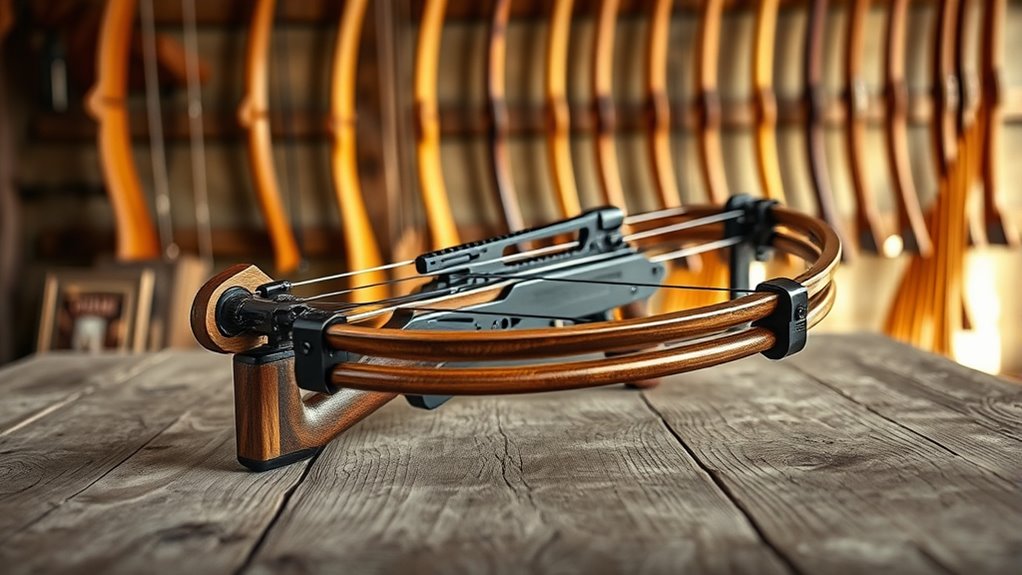
Although both crossbows and traditional bows serve the same fundamental purpose of launching projectiles, their mechanical designs and operational principles differ considerably. When you examine crossbow mechanisms, you’ll notice they incorporate a horizontal bow mounted on a stock, combined with a trigger system that holds and releases the string.
This contrasts with the vertical, hand-drawn limbs of traditional bows, where the archer manually draws and releases the string. Crossbows utilize shorter, heavier bolts as projectile types, optimized for stability and penetration, whereas traditional bows fire longer, lighter arrows designed for varied trajectories.
Historically, crossbows emerged in medieval Europe as powerful siege and hunting weapons, leveraging mechanical advantage for higher draw weights. Understanding these distinctions clarifies why crossbows and traditional bows operate within different technical and tactical frameworks.
Why Crossbows Are Easier to Use for Beginners
Understanding the mechanical differences between crossbows and traditional bows explains why crossbows are generally more accessible for beginners. Crossbows feature user friendly mechanics such as a horizontal stock and a trigger release system, which eliminate the need for continuous draw strength and complex finger placement required by longbows or recurves.
This beginner friendly design allows you to cock the crossbow once, lock it in place, and focus solely on aiming before firing, reducing physical strain and technique errors. Historically, this design evolved to make archery more approachable for novices and hunters alike, enabling consistent shooting without extensive training.
Consequently, if you’re starting out, a crossbow’s simplified mechanics provide a more forgiving and intuitive experience compared to mastering traditional bow techniques.
Comparing Power and Range: Crossbows vs Longbows and Recurve Bows
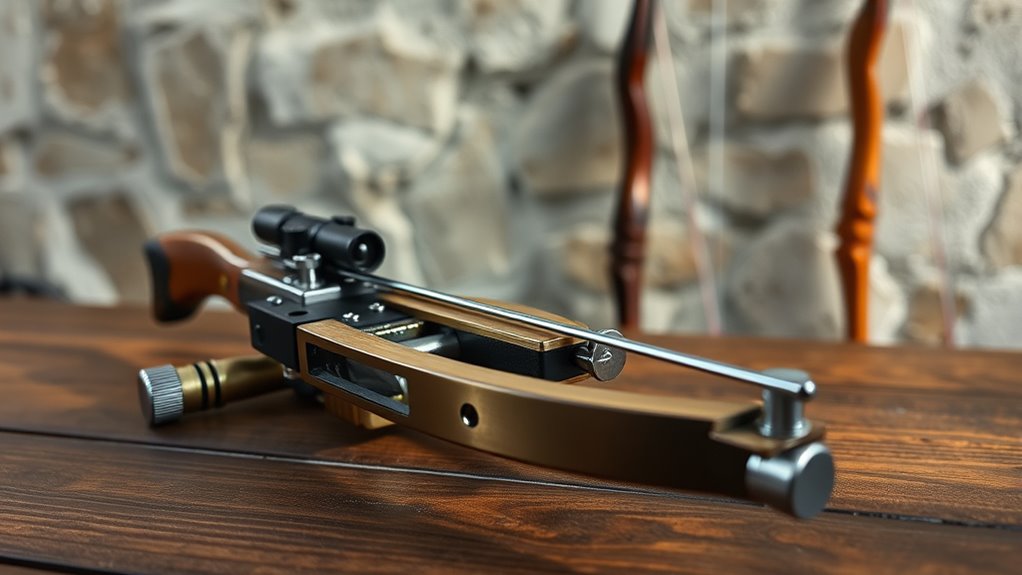
When evaluating projectile weapons, it’s essential to take into account the distinct power outputs and effective ranges of crossbows compared to longbows and recurve bows. In this power comparison and range differences analysis, crossbows typically generate higher draw weights—often exceeding 150 lbs—resulting in greater kinetic energy and bolt penetration.
Conversely, longbows and recurve bows, with their traditional curved limbs, offer smoother energy transfer but generally lower power.
Key distinctions include:
- Power Comparison: Crossbows deliver more consistent force due to mechanical advantage.
- Range Differences: Longbows can achieve longer effective ranges (up to 250 yards) owing to lighter arrows and faster limb recovery.
- Historical Context: Crossbows revolutionized medieval warfare by combining power with ease of use, unlike the skill-dependent longbows and recurves.
How Crossbow Design Influences Accuracy and Shooting
Since crossbow design directly affects factors like bolt flight stability and shooter control, it plays a critical role in accuracy and shooting performance. You’ll find that the high string tension generated by a crossbow’s shorter limbs stores considerable energy, delivering bolts with consistent velocity. This consistent force reduces oscillations during release, enhancing projectile stability.
Additionally, the rigid stock and integrated trigger mechanism minimize shooter-induced movement, unlike traditional bows that rely heavily on hand and arm steadiness. Historically, advancements such as the introduction of the prod and precise string grooves have refined alignment, further improving shot precision.
When you handle a modern crossbow, its ergonomic design and precise string tension calibration work together, giving you a steadier aim and tighter groupings compared to longbows or recurves, which depend more on raw skill and physical control.
Safety Features Unique to Crossbows
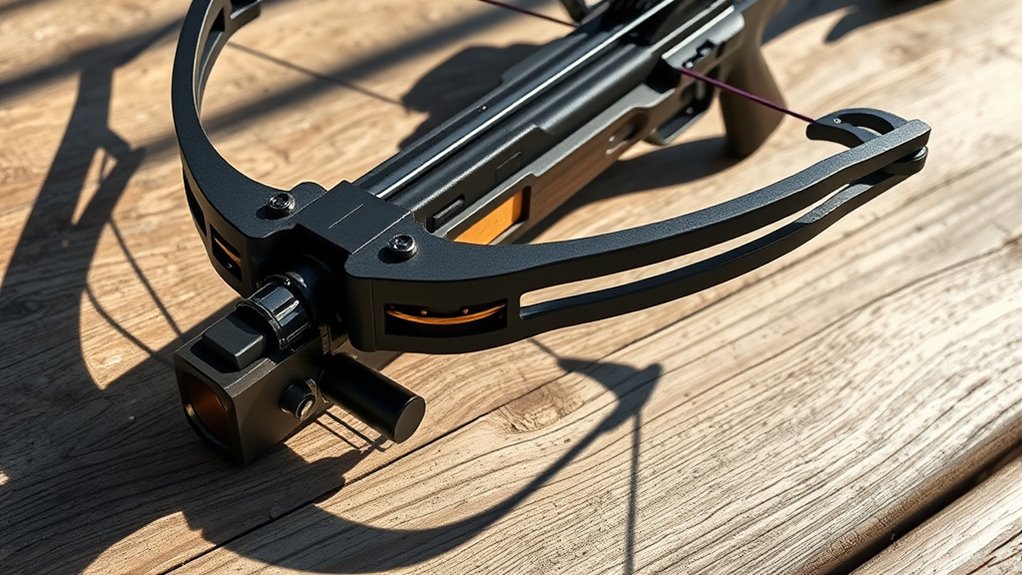
Although crossbows share some safety principles with traditional bows, their unique mechanical components demand specialized safety features to prevent accidental discharge and injury. Unlike longbows or recurves, crossbows incorporate intricate safety mechanisms tailored to their trigger systems and cocking processes.
Crossbows require unique safety features to prevent accidental discharge due to their complex mechanical triggers and cocking systems.
As you handle a crossbow, you’ll notice distinct user safeguards such as:
- Automatic Safety Engagement: This feature locks the trigger immediately after cocking, preventing premature firing.
- Anti-Dry Fire Mechanism: It stops the crossbow from releasing the string without a bolt, protecting both you and the weapon.
- Finger Guards and Safety Wings: These protect your hands from string slap during release, a hazard uncommon in other bows.
These specialized safety mechanisms reflect centuries of refinement, ensuring your shooting is not only precise but also secure.
Choosing Crossbows vs Longbows and Recurve Bows
Mastering the safety features unique to crossbows lays a solid foundation for selecting the right bow type for your needs. When choosing between crossbow types, longbows, and recurve bows, consider mechanical complexity and draw weight. Crossbows utilize a trigger mechanism and stock, offering mechanical advantage and allowing you to hold the drawn position safely.
In contrast, longbows and recurve bows depend on continuous muscle engagement and traditional bow materials like yew or laminated fiberglass. Historically, crossbows emerged for ease of use and power, while longbows and recurves favored speed and agility. Your decision hinges on intended use, physical capability, and preference for bow materials’ flexibility and strength.
Understanding these variables guarantees you pick a bow that aligns with your technical and ergonomic requirements.
Modern Hunting and Sport Uses for Crossbows
When you explore modern hunting and sport applications, crossbows offer distinct advantages in accuracy, power, and ease of use compared to traditional bows. Their mechanical cocking systems reduce physical strain, allowing for steadier shots and extended aiming time, which is critical in regulated hunting environments. Crossbows have adapted to comply with evolving hunting regulations, making them a preferred choice for many hunters.
Crossbows combine accuracy, power, and ease, easing physical strain for steadier shots in hunting and sport.
In sport competitions, their consistency and precision have elevated their status. Key features include:
- High draw weights and mechanical triggers enhance shot power and reliability.
- Compact designs improve maneuverability in dense terrain.
- Advanced sights and scopes facilitate precise targeting at varied distances.
Frequently Asked Questions
How Do Crossbow Maintenance Requirements Differ From Other Bows?
You’ll need stringent inspections of your crossbow’s trigger mechanism and string integrity, unlike other bows.
Plus, regular lubrication of the rail and cams prevents wear, ensuring precise performance rooted in centuries of mechanical evolution.
What Materials Are Commonly Used in Manufacturing Crossbows?
You’ll find crossbow materials like high-tensile steel, carbon fiber, and laminated wood used in manufacturing processes, blending traditional craftsmanship with modern composites for durability, precision, and optimized performance in historical and contemporary designs.
Are Crossbows Legal for Hunting in All States or Countries?
You’ll find crossbow legality varies widely due to hunting regulations; some states and countries permit them year-round, while others restrict use seasonally or prohibit them entirely.
This variation reflects evolving historical perspectives on archery weaponry.
How Do Crossbow Bolts Differ From Traditional Arrows?
Like a sleek dagger, crossbow bolts feature shorter, thicker shafts with specialized fletching, contrasting traditional arrows’ longer, slender design.
This bolt design enhances stability and power, reflecting centuries of evolution in projectile weaponry.
What Historical Events Influenced the Development of Crossbows?
You’ll find medieval warfare and technological advancements greatly influenced crossbow development, as engineers optimized mechanical leverage and trigger mechanisms to enhance projectile velocity, accuracy, and armor penetration during sieges and battlefield confrontations.
These improvements were driven by the need to counter increasingly effective armor and fortifications. The crossbow’s evolution reflects a continuous arms race between offensive and defensive military technologies.
As a result, it became a pivotal weapon in European and Asian warfare, shaping battle tactics and fortification designs over centuries.
Conclusion
When weighing weapons, you’ll find crossbows combine compact construction with calculated control, creating consistent accuracy compared to classic longbows or recurve bows. Their mechanical mechanism minimizes muscle memory mastery, making them more manageable for novices.
Whether hunting or honing marksmanship, understanding these unique utilities reveals unmatched user experience.
So, select your shooting system smartly—balancing ballistic benefits, historical heritage, and handling ease—to harness the power and precision that only crossbows proficiently provide. In conclusion, what sets a crossbow apart from other bows is its blend of ease of use and reliable accuracy.