You might wonder if a crossbow is a firearm, but legally, it doesn’t count as one.
Firearms use explosive combustion to propel bullets, while crossbows launch bolts through stored mechanical energy without any explosion.
Federal law specifically excludes crossbows from firearm definitions, resulting in different regulations and safety requirements.
Understanding these distinctions is essential if you want to navigate legal responsibilities and usage rules properly.
There’s more to explore about how these differences impact laws and safe handling.
Key Takeaways
- A crossbow uses mechanical energy to launch bolts, unlike firearms that use explosive combustion to propel bullets.
- Federal law does not classify crossbows as firearms, as they lack explosive action to expel projectiles.
- Crossbows are regulated under state and local laws, separate from firearm regulations.
- Firearm laws require licensing and background checks, while crossbow laws generally do not.
- Understanding these differences helps ensure proper legal compliance and safety practices for each device.
What Defines a Firearm: And How It Differs From a Crossbow
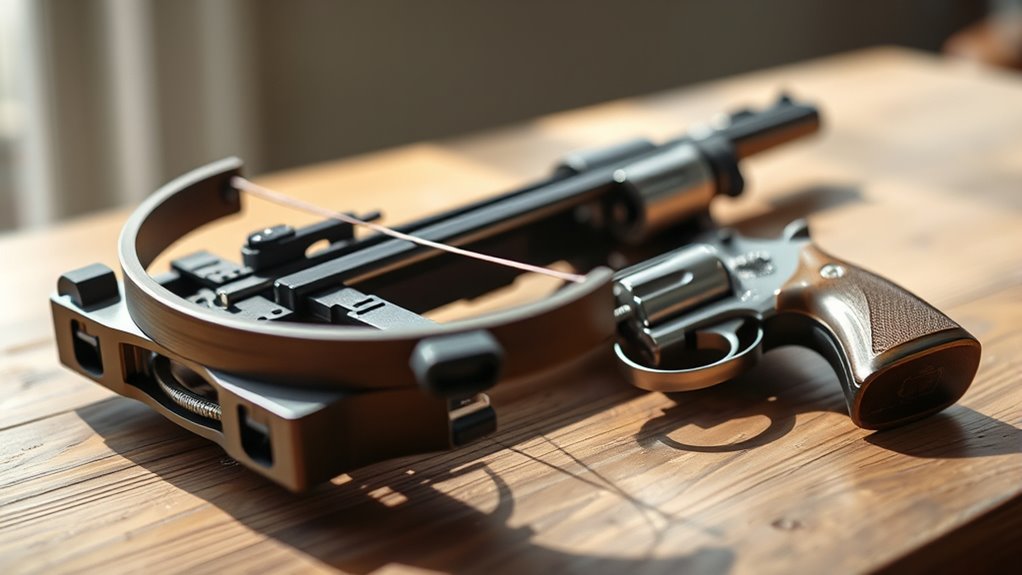
Understanding what legally and technically defines a firearm is essential when distinguishing it from a crossbow. Firearm definitions universally emphasize the use of explosive combustion or expanding gases to propel a projectile. Specifically, a firearm discharges a bullet or similar projectile by igniting a chemical propellant within a chamber.
In contrast, crossbow mechanics rely solely on stored mechanical energy in the drawn bowstring, released to launch a bolt without any combustion or explosive force. This fundamental difference places crossbows outside typical firearm classifications, as they do not involve chemical propellants or ignition systems.
Therefore, when evaluating legal or technical contexts, you must focus on the presence of explosive propulsion in firearm definitions, which crossbows lack, differentiating them categorically despite both being projectile weapons.
How Crossbows Work Compared to Firearms
While firearms rely on burning gunpowder to generate high-pressure gases that propel a bullet through a barrel, crossbows operate through purely mechanical means. You’ll find that the mechanical design of a crossbow uses tension stored in a drawn bowstring, held by a locking mechanism until released. This stored potential energy converts to kinetic energy, driving the bolt forward.
With respect to projectile mechanics, firearms utilize rapid combustion to accelerate a projectile at extreme velocities in a short barrel, whereas crossbows depend on the elastic potential of limbs and a trigger release system. Understanding these fundamental differences clarifies that crossbows function through mechanical energy transfer, contrasting with the chemical energy conversion seen in firearms, which directly affects their operation, performance, and classification.
US Legal Definitions: Firearms vs. Crossbows
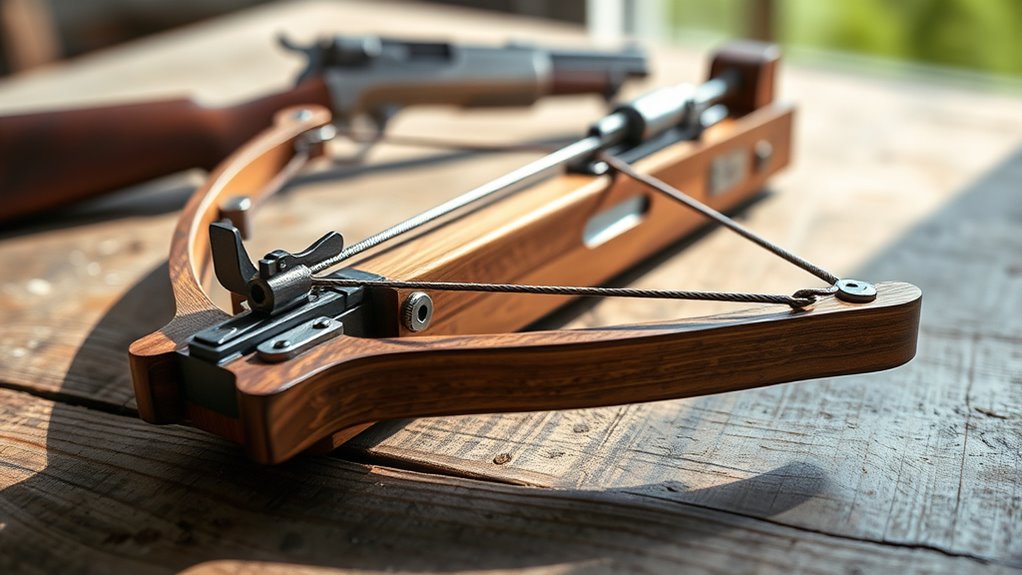
You need to understand that federal firearm regulations specifically exclude crossbows from the legal definition of firearms. This distinction affects how crossbows are classified and regulated under US law.
Knowing these differences is essential for compliance and proper handling.
Federal Firearm Regulations
Because federal firearm regulations hinge on specific legal definitions, it is vital to recognize that crossbows do not meet the criteria established for firearms under U.S. law. Federal definitions, as outlined by regulatory agencies such as the Bureau of Alcohol, Tobacco, Firearms and Explosives (ATF), categorize firearms based on their ability to expel a projectile through explosive action.
Crossbows, which use mechanical energy stored in limbs and launched bolts without combustion, fall outside these parameters. As a result, crossbows are exempt from federal firearm regulations, including background checks and licensing requirements.
Understanding this distinction is significant when interpreting laws enforced by regulatory agencies, ensuring you comply only with applicable statutes governing firearms, not crossbows, which are regulated separately under different legal frameworks.
Crossbow Legal Classification
Federal firearm regulations clearly exclude crossbows due to their mechanical operation rather than explosive propulsion. Under US legal terminology, a firearm is defined by its use of gunpowder or similar explosive propellants to discharge a projectile. Crossbow regulations, thus, fall outside federal firearm statutes and are typically governed by state and local laws instead.
When dealing with crossbow legal classification, you must understand that these weapons are categorized differently because they rely on stored mechanical energy, not combustion, to launch bolts. This distinction affects licensing, possession, and transportation rules.
Crossbow Laws Compared to Firearm Regulations
Although crossbows and firearms both serve as projectile weapons, the legal frameworks governing them differ markedly. You’ll find that crossbow safety regulations tend to be less stringent, while firearm laws often mandate extensive background checks and licensing. Hunting permits may be required for both but vary considerably in scope and enforcement.
Understanding these distinctions is essential for compliance and responsible use.
| Aspect | Crossbow Laws | Firearm Regulations |
|---|---|---|
| Licensing | Often no license needed | Mandatory licenses |
| Age Restrictions | Usually lower or none | Strict age limits |
| Safety Training | Recommended but not required | Often mandatory |
| Hunting Permits | Required in many states | Required and strictly enforced |
| Carry Regulations | Less restrictive | Highly regulated |
This table highlights critical emotional and legal contrasts you must grasp.
When and Where You Can Legally Use a Crossbow
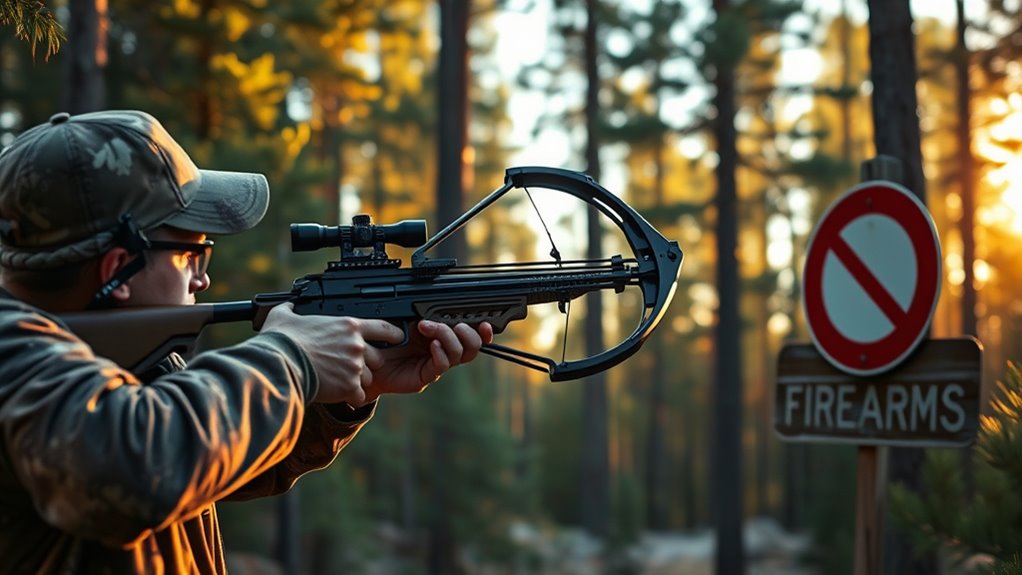
You need to meet specific legal age requirements before using a crossbow, which vary by jurisdiction. Additionally, hunting regulations dictate the seasons and species for which crossbows are permitted.
Public use restrictions typically prohibit discharge in populated or restricted areas, so understanding local laws is essential.
Legal Age Requirements
When considering the legal age requirements for using a crossbow, it is essential to recognize that regulations vary considerably depending on jurisdiction. You must verify the specific legal age mandated by local or state law, as some areas set a minimum age distinct from other weaponry.
Often, the legal age for crossbow use aligns with the hunting age established for archery or firearms, but this is not universal. In many states, individuals under 18 require adult supervision or special permits to operate a crossbow.
Additionally, some jurisdictions impose stricter age limits during hunting seasons. To guarantee compliance, always consult relevant state wildlife or firearms authorities to confirm the legal age and any associated restrictions before possessing or using a crossbow.
Hunting Regulations
Understanding the legal age for crossbow use is only part of the regulatory framework governing these weapons. When it comes to hunting regulations, you need to be aware that crossbow use is strictly controlled by specified hunting seasons dictated by state and local wildlife management agencies. These seasons are designed to balance hunter access with sustainable wildlife populations.
You can typically use a crossbow during archery seasons, but in some jurisdictions, crossbows are permitted only during certain portions of the hunting season or under specific conditions, such as for hunters with disabilities. It’s vital you consult the official hunting regulations for your area to confirm when and where crossbow hunting is authorized. Compliance guarantees you contribute to responsible wildlife management and avoid legal penalties.
Public Use Restrictions
Although crossbows are legal to own in many areas, public use restrictions often limit where and when you can discharge them. Due to varying public perception and usage statistics, regulatory bodies impose specific constraints to guarantee safety and minimize misuse. You must understand these to comply with local laws and avoid penalties.
Common public use restrictions include:
- Prohibition of crossbow discharge within city limits or densely populated zones
- Restrictions in public parks and recreational areas
- Designated hunting seasons and zones where crossbow use is permitted
- Limitations during specific hours to reduce noise complaints and accidents
- Mandatory permits or licenses for public discharge in certain jurisdictions
Staying informed about these regulations helps you legally and responsibly use your crossbow while respecting public safety concerns.
Common Misconceptions About Crossbows and Firearms
Why do many people confuse crossbows with firearms? This misconception often arises because both devices launch projectiles using stored energy and can cause serious injury. However, myths debunked reveal significant differences: firearms use explosive propellants to discharge bullets, whereas crossbows rely on mechanical tension.
Understanding these distinctions is vital given the safety concerns you must consider when handling either device. Crossbows, lacking combustion, pose different risks and require distinct safety protocols. Yet, because both can be lethal, confusion persists in public perception and legal frameworks.
You need to recognize that categorizing crossbows as firearms oversimplifies their operation and regulatory status. Clarifying these differences helps prevent misunderstandings and guarantees you approach each device with appropriate caution and compliance.
Why Crossbow and Firearm Classifications Matter for Safety and Compliance
Because crossbows and firearms are governed by different regulations, knowing their classifications is essential for ensuring legal compliance and maintaining safety standards. If you misunderstand these classifications, you risk violating laws and facing compliance issues that could lead to penalties. Proper classification helps you adhere to specific safety standards tailored to each type of weapon, reducing the risk of accidents.
You should consider the following:
- Distinct licensing requirements for firearms vs. crossbows
- Variations in age restrictions and usage permissions
- Differing storage and transportation regulations
- Specific safety training mandates
- Regulatory inspections and enforcement protocols
Frequently Asked Questions
Can Crossbows Be Used for Hunting the Same Game as Firearms?
You can use crossbows to hunt the same game as firearms, but you must adhere to hunting regulations and ethical considerations.
Ensure you are hunting the proper species during the designated seasons. It is also important to follow equipment standards to maintain fair chase and conservation principles.
Are There Special Licenses Required to Own a Crossbow?
You’ll find crossbow regulations vary by jurisdiction; some require specific ownership requirements or licenses, while others don’t.
Check local laws carefully to guarantee you comply with all necessary permits and restrictions for legal crossbow ownership.
How Loud Is a Crossbow Compared to a Firearm?
You’ll find crossbow noise markedly quieter than a firearm; sound comparison shows crossbows produce about 100 decibels less, making them stealthier for hunting or target shooting where minimal noise is essential.
Can Crossbows Be Modified Like Firearms?
You can perform crossbow modifications, but they’re limited compared to firearms. Firearm regulations strictly control alterations, while crossbows face fewer legal constraints, allowing more flexibility in customizing components like limbs, strings, and triggers.
What Is the Typical Effective Range of a Crossbow?
Think of a crossbow as a sniper’s arrow; its typical effective distance ranges between 30 to 50 yards. Within this span, shooting accuracy remains ideal, allowing you precise, controlled shots for hunting or target practice.
Conclusion
You might think a crossbow and a firearm are one and the same, but their mechanisms and legal definitions sharply diverge. While firearms rely on explosive force to propel a bullet, crossbows use mechanical tension to launch bolts. This distinction matters—not just in how you handle them, but in where and when you can legally use them.
Understanding these differences guarantees you stay compliant and safe, maneuvering the fine line between two powerful tools. In conclusion, a crossbow is not a firearm, and recognizing this is crucial for proper use and legal adherence.