A crossbow is a ranged weapon that lets you shoot bolts with mechanical precision.
Unlike traditional vertical bows, it features a horizontal assembly with a stock and a trigger mechanism. This design means you don’t have to hold the draw manually, making aiming easier and more stable.
It’s powered by limbs and a string that store and release energy efficiently.
If you want to understand its parts, uses, and how it compares to other bows, there’s much more to explore.
Key Takeaways
- A crossbow is a ranged weapon that uses a horizontal bow mounted on a stock to shoot bolts with a trigger mechanism.
- It combines bow mechanics with a trigger to allow easier aiming and shooting without continuous muscle tension.
- Crossbows have shorter, thicker limbs and a mechanical trigger, differing from traditional vertical bows that require manual string release.
- Types include recurve, compound, and pistol crossbows, each varying in design, power, and usage.
- Common uses are hunting, target shooting, wildlife management, and historical reenactments due to its precision and ease of use.
What Is a Crossbow and How Does It Work
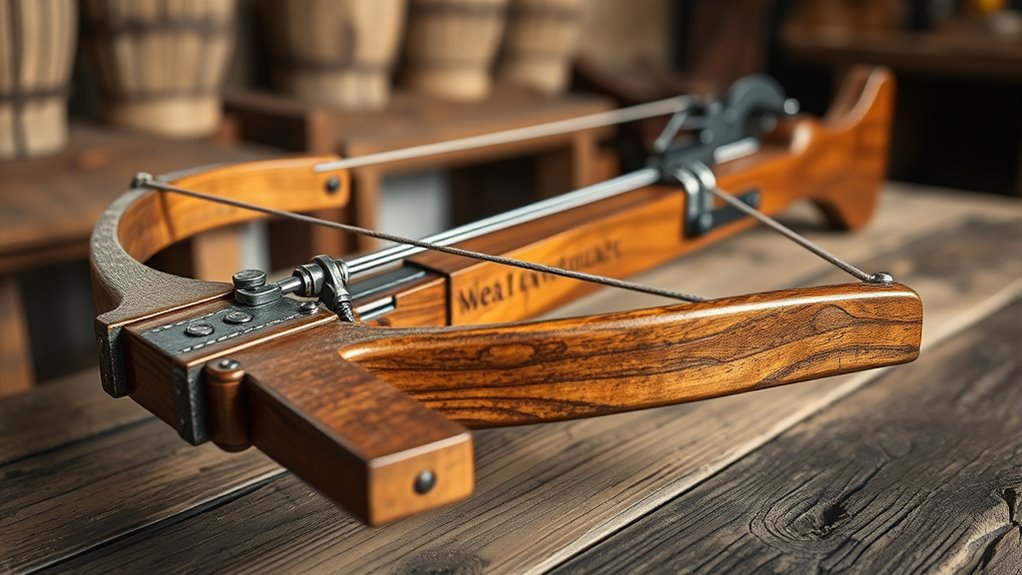
A crossbow is a ranged weapon that combines the mechanics of a bow with a trigger mechanism, allowing you to shoot projectiles called bolts with greater ease and accuracy. Understanding crossbow terminology helps you grasp its function—terms like “prod” (the bow part), “stock” (the body), and “trigger” clarify how the weapon operates.
Crossbow types vary, including recurve, compound, and pistol styles, each differing in design and power delivery. Recurve crossbows rely on a simple, curved prod, while compound crossbows use pulleys to reduce draw weight, making them easier to cock. Pistol crossbows are smaller for close-range use.
The Main Parts of a Crossbow You Should Know
To fully understand how a crossbow functions, you need to recognize its key mechanical components, like the prod, string, and trigger mechanism. Each essential functional part plays a specific role in storing and releasing energy efficiently.
Key Mechanical Components
Although crossbows might seem straightforward at first glance, understanding their key mechanical components reveals a complex interplay of parts designed for precision and power. The string design directly affects energy transfer, while limb types—recurve or compound—dictate draw weight and speed. These components work in tandem to optimize performance.
| Component | Function |
|---|---|
| String | Transfers energy to the bolt |
| Limbs | Store and release energy |
| Trigger System | Controls release mechanism |
| Stock | Provides structural support |
Each part’s design influences accuracy and force. For example, recurve limbs offer simplicity and reliability, whereas compound limbs incorporate cams for increased power. Understanding these mechanics helps you appreciate the engineering behind every shot.
Essential Functional Parts
When you’re handling a crossbow, understanding its essential functional parts is critical for both effective use and maintenance. The crossbow anatomy centers on several key components: the stock, which provides stability; the prod or bow, responsible for storing energy; and the string, which transfers this energy to the bolt.
You’ll also find the trigger mechanism, important for releasing the string precisely. The safety catch prevents accidental firing, while the stirrup aids in cocking the bow. Each part interacts systematically, ensuring the crossbow functions efficiently.
Knowing these essential components helps you diagnose issues and perform upkeep accurately. By grasping this anatomy, you not only enhance your handling skills but also extend the lifespan of your crossbow, optimizing performance in every use.
Differences Between Crossbows and Traditional Bows
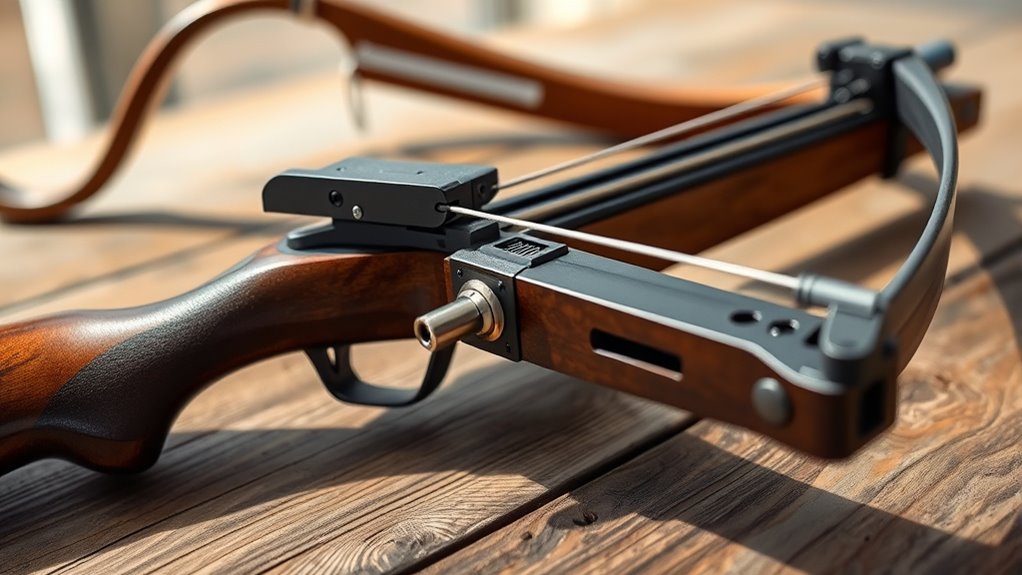
When comparing crossbows to traditional bows, you’ll notice key differences in their mechanism and design that affect how you use and handle them. The way each stores and releases energy changes the power output and accuracy you can achieve.
Understanding these distinctions helps you choose the right tool for your specific shooting needs.
Mechanism And Design
Because crossbows and traditional bows serve similar purposes, understanding their distinct mechanisms and designs is essential to appreciating how each functions. Crossbows use a horizontal assembly where crossbow limbs are mounted on a stock, while traditional bows have a vertical, curved limb design.
The key difference lies in the crossbow triggers, which mechanically hold and release the string, allowing you to maintain a drawn position without physical effort. Traditional bows require continuous draw tension from your muscles.
Key distinctions include:
- Crossbow limbs are shorter, thicker, and mounted horizontally.
- Crossbow triggers enable mechanical string release.
- Traditional bows rely on continuous muscle tension.
- Crossbows typically have a stock for aiming stability.
These design choices affect power delivery and user experience.
Usage And Handling
Although both crossbows and traditional bows require skill, their usage and handling differ markedly, influencing how you approach aiming, drawing, and shooting. With crossbows, you often deal with a mechanical trigger system, which lets you hold steady aim without continuous muscle strain, unlike traditional bows that demand sustained physical effort to draw and hold.
Crossbow handling involves managing the cocking mechanism and guaranteeing safe trigger control, which requires specific training. Additionally, crossbow maintenance is more intricate, involving regular lubrication and inspection of the string and trigger assembly to guarantee reliability.
In contrast, traditional bows need frequent tuning and string care but are simpler mechanically. Understanding these distinctions helps you optimize performance and safety tailored to each weapon’s unique demands.
Power And Accuracy
While both crossbows and traditional bows can deliver impressive power, their mechanisms create distinct differences in accuracy and force that you’ll want to understand. Crossbows utilize a mechanical lock and trigger system, providing consistent power delivery with less physical strain, which often enhances accuracy. Conversely, traditional bows rely heavily on the archer’s skill, affecting shot consistency.
Key accuracy factors and power delivery differences include:
- Crossbows maintain a fixed draw length, reducing variability in shot power.
- Traditional bows allow dynamic aiming adjustments, offering more control but requiring skill.
- Crossbows tend to have higher initial velocity, increasing penetration.
- Traditional bows’ accuracy depends on the archer’s form, release, and muscle strength.
Understanding these nuances helps you choose the right tool for your shooting needs.
Crossbow History: Evolution Through the Ages
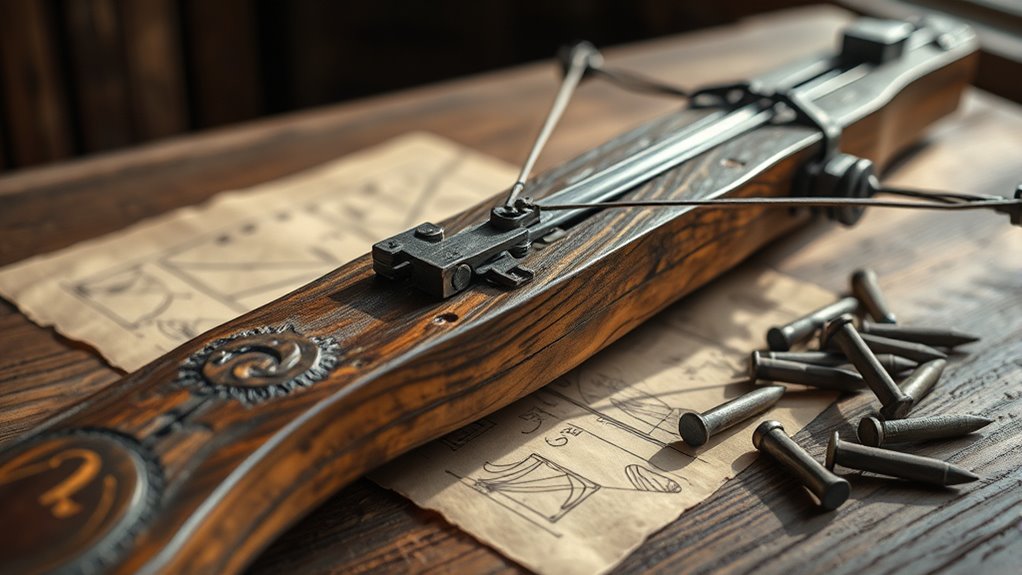
When you trace the origins of the crossbow, you’ll find its development deeply intertwined with advancements in military technology and shifting warfare tactics throughout history. Ancient designs, like those from China and medieval Europe, emphasized mechanical advantage to increase range and power, transforming battlefield strategies.
Over centuries, improvements in materials and engineering enhanced durability and precision. You’ll notice that these early models laid the groundwork for modern innovations, which integrate advanced composites and ergonomic features, boosting both performance and ease of use.
Understanding this evolution reveals how the crossbow adapted to changing demands—from siege warfare to precision hunting—reflecting broader technological progress. By examining its historical trajectory, you gain insight into how the crossbow remains a remarkable blend of tradition and innovation, shaped continuously by human ingenuity.
Common Uses of Crossbows Today
Crossbows today serve a range of purposes that extend far beyond their historical military roots. If you’re exploring their modern relevance, you’ll find several practical and recreational contexts where crossbows excel. Their precision and power make them ideal for hunting applications, allowing hunters to approach game silently and effectively.
Crossbows combine precision and power, excelling in hunting and various modern recreational uses.
Additionally, many enthusiasts engage in recreational shooting, enjoying the skill and focus the crossbow demands. Other notable uses include:
- Competitive target shooting, where accuracy and consistency are tested.
- Wildlife management, assisting in population control ethically.
- Historical reenactments, preserving traditional skills and techniques.
- Survival scenarios, offering a reliable hunting tool when needed.
Understanding these uses helps you appreciate how the crossbow remains a versatile and valued tool in diverse contemporary settings.
How to Choose the Right Crossbow for Hunting or Target Shooting
Because selecting the right crossbow involves balancing power, accuracy, and ease of use, you’ll need to evaluate factors like draw weight, velocity, and size based on whether your focus is hunting or target shooting. Different crossbow types—recurve, compound, and pistol—offer distinct advantages: recurve models are simpler and quieter, while compound crossbows deliver higher power and precision, ideal for hunting.
Consider hunting regulations in your area, as they often dictate minimum draw weights and permissible crossbow types. For target shooting, prioritize accuracy and comfortable handling over raw power. Size and weight also matter; a lighter crossbow improves maneuverability but may sacrifice some velocity.
Ultimately, your choice should reflect intended use, compliance with local laws, and personal comfort to guarantee effective and responsible crossbow use.
Safety Tips for Using a Crossbow
Choosing the right crossbow for your needs is only part of the equation; understanding how to use it safely guarantees both your well-being and that of others around you. Crossbow safety hinges on disciplined, consistent safe handling practices to prevent accidents. Always treat your crossbow as if it’s loaded, maintaining muzzle awareness and never pointing it at anything you don’t intend to shoot.
Key safety tips include:
- Always engage the safety mechanism before handling or cocking.
- Use appropriate bolts designed for your specific crossbow model.
- Never dry fire your crossbow; it can cause severe damage.
- Inspect the crossbow regularly for signs of wear or damage.
Crossbow Accessories and Upgrades You’ll Love
Upgrading your crossbow can greatly enhance both performance and comfort, tailoring the experience to suit your specific needs. When selecting must have accessories, consider a quality scope for improved accuracy and a quiver for convenient arrow storage. Adding a cocking device reduces physical strain, making repeated shots easier.
Don’t overlook crossbow maintenance tips: regular lubrication and string inspection prevent malfunctions and prolong lifespan. Upgrading to quieter limbs or installing vibration dampeners can also improve stealth and shooting comfort. A sling provides better carry options during long hunts.
Each upgrade should align with how you use your crossbow, whether for target practice or hunting, ensuring you invest in accessories that genuinely elevate your shooting efficiency and safety. This analytical approach helps you make informed, practical enhancements.
Frequently Asked Questions
Are Crossbows Legal to Use for Hunting in All States?
No, you can’t use crossbows for hunting in all states since crossbow regulations vary widely.
You’ll need to check specific state laws carefully, as some allow them during archery seasons while others restrict or prohibit their use entirely.
How Long Does It Take to Reload a Crossbow?
You know what they say, “Practice makes perfect.” Crossbow loading times vary, but with proper reloading techniques, you can reload in about 10-20 seconds.
Efficiency depends on your familiarity and the specific crossbow model used.
Can Children Safely Use a Crossbow?
You shouldn’t let children use a crossbow without strict safety measures and adult supervision, as age restrictions vary.
Proper training and protective gear are essential to minimize risks and guarantee responsible, safe handling by young users.
What Maintenance Is Required for a Crossbow?
You’ll need to focus on regular string maintenance by inspecting for wear and applying lubricant, plus timely string replacement to guarantee safety and performance.
Also, check bolts, tighten screws, and clean the rail after each use for peak function.
How Loud Is a Crossbow When Fired?
When you fire a crossbow, the crossbow noise is relatively low, similar to a loud clap or a distant gunshot.
Compared to firearms, its sound is quieter, making it ideal for stealth hunting or tactical situations.
Conclusion
Think of a crossbow like a finely tuned watch—each part working in precise harmony to deliver power and accuracy. Just as a watchmaker adjusts gears for perfect timing, you’ll need to understand its mechanics, history, and safety to master it fully.
Whether hunting or shooting targets, knowing these details guarantees you’re not just pulling a string but engaging with centuries of innovation. With the right knowledge, you’re set to unseal your crossbow’s true potential.
Understanding what is a crossbow is key to unlocking its power and precision.