You’ll find that the AR-15 was invented in 1956 by Eugene Stoner, who aimed to create a lightweight, reliable rifle suited for varied combat roles.
His design incorporated innovative materials like aluminum and a novel direct impingement gas system, focusing on modularity and ease of maintenance.
This prototype underwent refinements through the early 1960s, addressing military demands for increased efficiency.
If you look deeper, you’ll uncover how this firearm’s evolution and adoption shaped modern weaponry.
Key Takeaways
- The AR-15 was invented in 1956 by Eugene Stoner while working at Armalite.
- Stoner’s design was groundbreaking for its lightweight aluminum and composite materials.
- The rifle was developed to meet military needs for a reliable, lightweight infantry weapon.
- Early prototypes and refinements occurred throughout the late 1950s and early 1960s.
- The AR-15 was adopted by the U.S. military in the late 1950s, marking its official debut.
Who Invented the AR-15 and When?
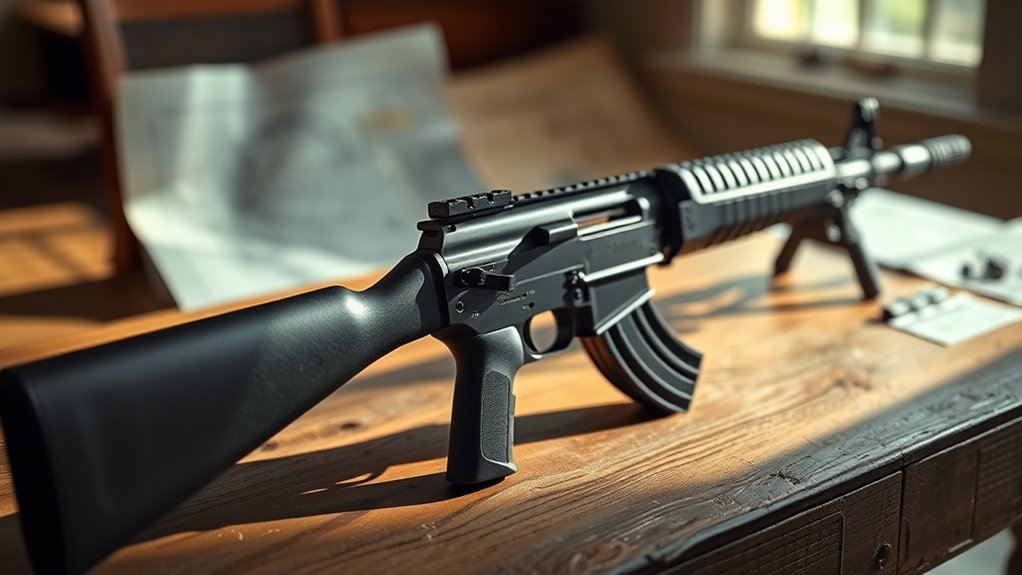
Three key figures are often credited with the invention of the AR-15, but the primary inventor was Eugene Stoner, who designed the rifle in 1956. When you examine the design origins, you see Stoner’s work at Armalite was pivotal for firearm innovation, combining lightweight materials with a novel gas-operated mechanism. His approach departed from traditional designs, focusing on modularity and ease of manufacture.
While others contributed to refining the rifle, Stoner’s blueprint laid the foundation. Understanding this context helps you appreciate how the AR-15’s invention wasn’t a singular event but a culmination of deliberate engineering choices aimed at enhancing performance and reliability. This clarity on the inventor and timing helps you grasp the AR-15’s place in the evolution of modern firearms.
What Inspired the AR-15’s Original Design?
You’ll find that the AR-15’s design was heavily shaped by military requirements for a lightweight, reliable rifle suitable for rapid fire. Eugene Stoner’s vision prioritized innovative materials like aluminum and composites, which reduced weight without sacrificing durability.
Understanding these influences helps explain why the AR-15 stood out compared to earlier firearms.
Military Needs Influence
Although the AR-15 is often viewed as a civilian firearm today, its original design was deeply shaped by specific military requirements during the Cold War era. You’d find that military efficiency was paramount; the U.S. military needed a lightweight, reliable rifle that could perform under diverse combat conditions.
Tactical adaptability was equally vital, as the weapon had to suit various combat roles—from close quarters to long-range engagements. This meant the design prioritized modular components that allowed soldiers to customize the rifle quickly.
The focus on reduced recoil and improved accuracy also reflected military priorities to enhance soldier effectiveness. In short, the AR-15’s development was a direct response to evolving battlefield demands, balancing firepower, maneuverability, and versatility to meet the complex challenges faced by armed forces at the time.
Eugene Stoner’s Vision
Innovation drove Eugene Stoner’s vision for the AR-15, blending cutting-edge materials and engineering principles to meet the demands of modern warfare. You’ll notice Stoner’s philosophy emphasized simplicity, reliability, and modularity, setting the foundation for what became a revolutionary rifle.
His innovative engineering approach focused on reducing complexity while enhancing performance, anticipating the evolving needs of soldiers in varied combat scenarios. By rethinking traditional firearm mechanisms, Stoner introduced features that increased accuracy and ease of maintenance.
Understanding his vision helps you appreciate how the AR-15 wasn’t just a product of technical advancements but a strategic response to shifting military tactics. This philosophy laid the groundwork for the rifle’s enduring adaptability and widespread adoption across multiple forces.
Lightweight Materials Use
Stoner’s emphasis on simplicity and performance naturally led him to explore materials that could reduce the rifle’s weight without sacrificing durability. He incorporated lightweight composites, which were revolutionary compared to traditional steel.
This use of advanced materials not only enhanced portability but also influenced modern applications in firearms design, where weight and strength balance is essential.
| Material | Benefit |
|---|---|
| Aluminum alloy | Light, corrosion-resistant |
| High-strength steel | Durable, reliable |
| Fiberglass | Lightweight, strong |
| Polymer composites | Resistant to impact, lightweight |
| Titanium | Strong, lightweight |
How Did the AR-15 Design Evolve in the 1960s?
You’ll notice that the AR-15’s early prototypes in the 1960s underwent significant refinements to improve reliability and ease of use. Key design modifications, such as changes to the gas system and materials, addressed practical challenges faced during testing.
Understanding these adjustments helps clarify how the rifle evolved into a more effective and adaptable firearm.
Early Prototype Development
Although the AR-15 is often associated with its final design, its development throughout the 1960s involved multiple iterations and refinements that responded to military requirements and technological advancements. You’d notice early design considerations focused heavily on weight reduction, ease of maintenance, and modularity. These priorities influenced the choice of materials like aluminum for the receiver, which was unconventional at the time.
Prototype features included a direct impingement gas system, which aimed to improve reliability and reduce recoil compared to traditional piston systems. As you examine these prototypes, you see the balance sought between innovative mechanisms and practical battlefield needs. Each refinement was a response to testing feedback and evolving combat doctrines, shaping the AR-15 into a versatile platform well-suited for modern infantry use.
Key Design Modifications
Several key design modifications throughout the 1960s markedly shaped the AR-15’s evolution from prototype to a reliable service rifle. You’ll notice that early design features, such as the direct impingement gas system, were refined to improve reliability under combat conditions.
Colt and ArmaLite engineers focused on performance enhancements like reinforced bolt carriers and improved barrel rifling, which enhanced accuracy and durability. Changes to the magazine design also increased feeding reliability, addressing earlier jamming issues.
Additionally, the incorporation of a forward assist mechanism allowed soldiers to manually close the bolt, a vital adaptation for battlefield conditions. These deliberate modifications reflected a strategic response to practical field feedback and testing, ultimately ensuring the AR-15 met rigorous military standards and set the foundation for its widespread adoption in subsequent decades.
When Was the AR-15 First Adopted by the Military?
The AR-15 was first adopted by the U.S. military in the late 1950s, marking a significant shift in infantry weaponry. You should know that this military adoption wasn’t just about acquiring a new rifle; it reflected changing combat needs and technological advancements. The lightweight, selective-fire design contrasted sharply with the heavier, traditional battle rifles of the time.
Its historical significance lies in how it influenced future military small arms development, emphasizing versatility and modularity. By adopting the AR-15, the military prioritized firepower, ease of use, and adaptability to various combat scenarios. This decision set a precedent, shaping the evolution of infantry weapons globally.
Understanding this context helps you appreciate why the AR-15’s military adoption was a pivotal moment in weapon history.
How Did Civilian Versions of the AR-15 Come About?
Following the military’s adoption of the AR-15, interest grew in adapting this innovative rifle for civilian use. You’ll find that civilian ownership of the AR-15 emerged as manufacturers recognized its popularity and versatility beyond the battlefield. However, firearm regulations played a significant role in shaping these civilian models.
To comply with laws, companies modified features like the firing mechanism and magazine capacity, ensuring legal access while maintaining performance. This balance between innovation and regulation allowed the AR-15 to enter the civilian market without replicating military configurations exactly.
As you explore this evolution, it’s clear that civilian versions grew out of both demand and the necessity to navigate complex firearm regulations, ultimately creating a widely accessible rifle tailored for sport shooting, hunting, and personal defense.
Key Design Changes That Shaped the AR-15 Over Time
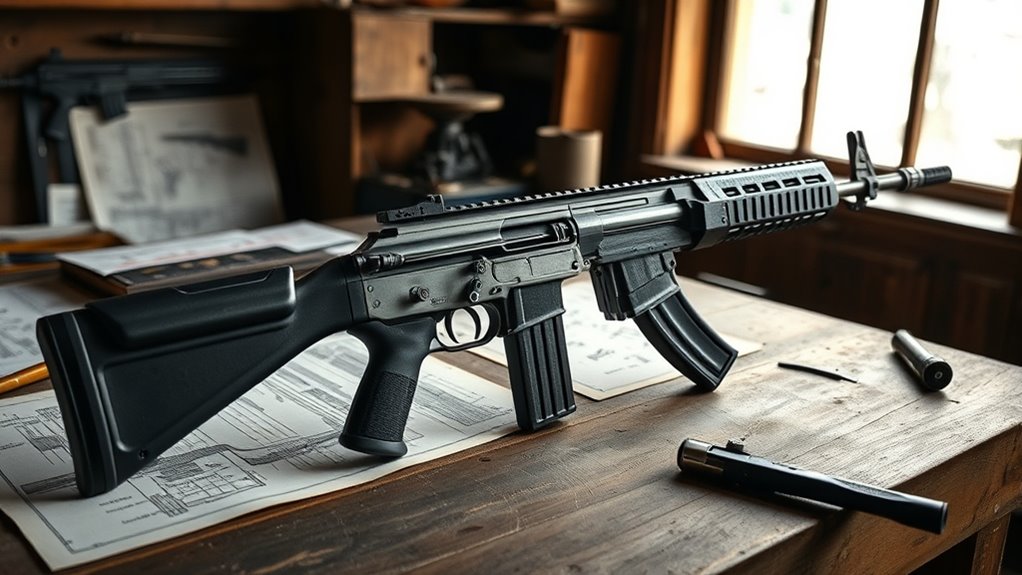
Although the AR-15’s core design has remained influential, its evolution reflects continuous refinements that address both user needs and regulatory demands. You’ll notice that key design changes stem from a focus on modularity, weight reduction, and improved reliability. Early models used heavier materials, but manufacturing advancements introduced lightweight alloys and polymers, enhancing maneuverability without sacrificing durability.
The design evolution also includes alterations to barrel lengths, handguards, and trigger mechanisms, allowing users to customize functionality. Additionally, changes in gas systems improved cycling efficiency and reduced recoil. These iterative modifications not only responded to practical considerations but also adapted to shifting legal frameworks, ensuring compliance without compromising performance.
Why Did the AR-15 Become So Popular After Its Invention?
Since its invention, the AR-15 has gained widespread popularity due to its unique blend of adaptability, ease of use, and advanced engineering. You’ll find its modular design appeals to both hobbyists and professionals, while its cultural significance has made it a symbol in various social and political contexts.
Legal implications have also shaped its accessibility, influencing public perception and ownership trends.
| Factor | Description | Impact |
|---|---|---|
| Adaptability | Modular components | Customization for diverse needs |
| Ease of Use | Lightweight and ergonomic design | Appeals to novices and experts |
| Cultural Significance | Symbol in media and politics | Drives demand and debate |
| Legal Implications | Regulations vary by region | Affects market availability |
| Engineering | Innovative mechanics | Reliable performance |
These factors collectively explain why the AR-15 remains widely popular.
How the AR-15 Still Shapes Firearms Today
Even as firearm technology advances, the AR-15’s design principles continue to influence modern weapon development. You’ll notice that its modularity and lightweight construction have set a benchmark in firearms evolution, encouraging manufacturers to prioritize adaptability and user customization.
When you examine contemporary rifles, many incorporate features pioneered by the AR-15, such as direct impingement gas systems and ergonomically designed controls. Regarding modern usage, its platform versatility allows for a broad spectrum of applications—from tactical to recreational shooting—shaping industry standards and consumer expectations.
Frequently Asked Questions
What Materials Are Used to Manufacture the AR-15?
You’ll find the AR-15’s manufacturing processes use aluminum alloys and steel to balance material durability and weight. Polymer components also appear, enhancing resilience while maintaining precision essential for its reliable, long-lasting performance.
How Does the Ar-15’s Recoil Compare to Other Rifles?
You might expect harsh recoil from a rifle, but the AR-15’s recoil is surprisingly mild. Thanks to excellent recoil management and proper shooting techniques, it offers better control compared to heavier-caliber rifles, enhancing accuracy and comfort.
What Are Common Accessories for the AR-15?
You’ll find common accessories like sight upgrades—red dot, holographic, or scopes—and various magazine options, from standard 30-round to extended or drum magazines.
These enhancements boost your AR-15’s versatility for target shooting or tactical use.
Is the AR-15 Legal in All U.S. States?
You won’t find uniform AR 15 regulations, nor consistent state compliance. Some states allow AR 15s freely, others restrict features or ownership.
Understanding local laws is essential, as legal status varies widely across the U.S. jurisdictions.
How Should the AR-15 Be Properly Maintained?
You should follow strict cleaning protocols, disassembling the AR-15 carefully, removing debris, then applying proper lubrication techniques to key components.
This guarantees reliability, prevents wear, and maintains peak performance under varied conditions.
Conclusion
When you look at the AR-15, think of it as more than just a firearm—it’s a symbol of innovation and adaptability. Born from a blend of military needs and civilian demand, its evolution mirrors the shifting landscape of technology and culture.
The AR-15’s design changes act like chapters in a story about progress and controversy, reminding you how tools often reflect society’s complexities, shaping and being shaped by the times they move through. Understanding when the AR-15 was invented helps place this remarkable firearm in its proper historical context.