You might hear the AR-15 called an assault rifle, but it’s not one.
An assault rifle must have selective fire modes, letting you switch between semi-automatic and fully automatic or burst fire. The AR-15 fires semi-automatically only, meaning one trigger pull equals one shot.
Its design and function differ considerably from true military assault rifles, which meet specific criteria.
To fully grasp these distinctions and their legal and social implications, exploring the details will be enlightening.
Key Takeaways
- The AR-15 is a semi-automatic rifle, lacking the selective fire feature required for assault rifles.
- Assault rifles can switch between semi-automatic and fully automatic or burst modes; AR-15s cannot.
- AR-15s use intermediate cartridges but are designed primarily for civilian use, unlike military assault rifles.
- Legal definitions of assault weapons vary, but AR-15s generally do not meet the military assault rifle criteria.
- Public confusion arises because “assault rifle” is often misused to describe AR-15s despite key functional differences.
What Exactly Is an AR-15 Rifle?
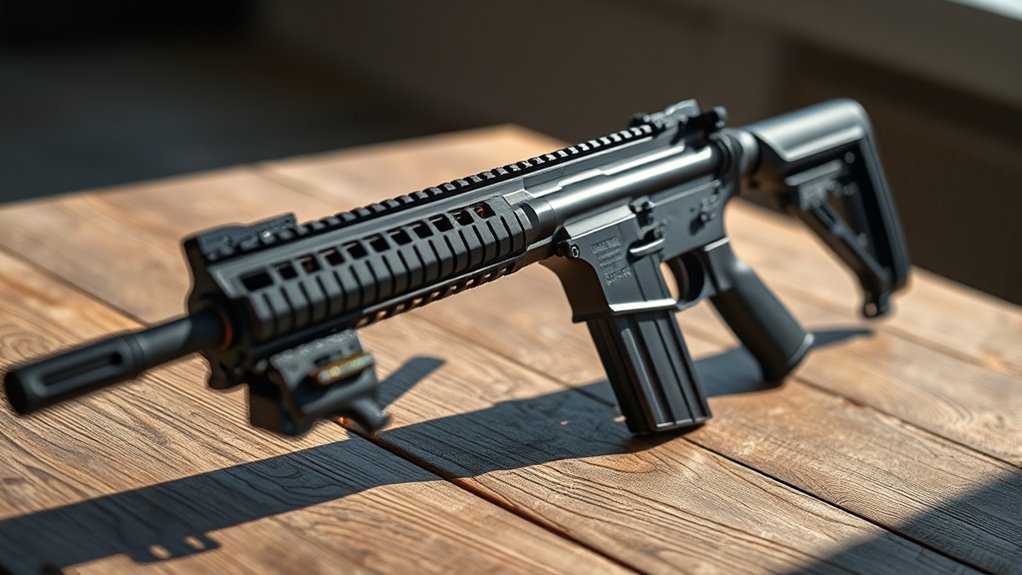
What exactly defines an AR-15 rifle? You’re looking at a semi-automatic, magazine-fed firearm originally designed by Eugene Stoner in the late 1950s. It employs a direct impingement gas system, which cycles the bolt carrier group using expanding gas from fired cartridges.
In terms of firearm manufacturing, the AR-15 is notable for its modularity—allowing you to customize parts such as barrels, stocks, and triggers with precision engineering. Ballistics analysis reveals that it typically chambers the .223 Remington or 5.56x45mm NATO round, delivering controlled recoil and effective range up to 500 meters.
Understanding these technical specifics clarifies that the AR-15 is a civilian rifle platform rather than a military automatic weapon, emphasizing semi-automatic function and modular design in its construction and performance.
What Defines an Assault Rifle?
To understand what classifies a firearm as an assault rifle, you need to examine specific military criteria, including selective fire capability. This means the weapon must be able to switch between semi-automatic and fully automatic or burst modes.
Additionally, assault rifles share key features like intermediate cartridge usage and detachable magazines that distinguish them from other rifles.
Military Criteria Explained
Although the term “assault rifle” is often used loosely, military criteria set specific standards that distinguish these weapons from other firearms. To qualify as an assault rifle, a firearm must be capable of selective fire, chamber an intermediate cartridge, and possess a detachable magazine. These standards exclude many civilian firearms, including most AR-15 variants, which are semi-automatic only.
You should note that firearm customization and hunting applications often modify rifles for precision and versatility but do not alter their fundamental classification under military definitions. The military’s emphasis is on functionality for combat scenarios, not on customization features or civilian use. Consequently, while AR-15s share design elements with assault rifles, they do not meet the strict military criteria that define the category.
Selective Fire Capability
Since selective fire capability is a defining feature of assault rifles, understanding its mechanics is essential. Selective fire allows you to switch between firing modes, adapting to varied combat situations. This capability directly influences how ammunition types are utilized, providing flexibility beyond semi-automatic fire.
Key aspects to contemplate include:
- Firing modes: Typically includes semi-automatic, burst, and fully automatic settings.
- Mechanical complexity: Requires additional components to control the firing cycle safely.
- Firearm safety: Enhanced safety protocols are necessary due to rapid fire potential.
Without selective fire, a rifle lacks the versatility characteristic of assault rifles. The AR-15, for example, operates primarily in semi-automatic mode, differentiating it from true assault rifles equipped with selective fire mechanisms.
Assault Rifle Features
When identifying an assault rifle, you’ll focus on several key features that distinguish it from other firearms. Primarily, an assault rifle must have selective fire capability, but other factors like ballistics performance and magazine capacity are equally critical. These rifles typically fire intermediate cartridges, balancing range and recoil for effective combat use.
The magazine capacity usually exceeds 20 rounds, allowing sustained fire without frequent reloads. Here’s a concise overview:
| Feature | Description | Importance |
|---|---|---|
| Selective Fire | Semi-auto and full-auto modes | Essential for versatility |
| Ballistics Performance | Intermediate cartridge effectiveness | Balances range and recoil |
| Magazine Capacity | Usually 20+ rounds | Enables sustained firing |
| Ergonomics | Compact design with adjustable stock | Enhances handling and control |
How Does an AR-15 Differ From a Military Assault Rifle?
How exactly does an AR-15 differ from a military assault rifle? While both share a common military design heritage, the AR-15 is tailored specifically for civilian use, lacking key combat features. Here’s how they differ:
- Firing Modes: The AR-15 is semi-automatic only, firing one round per trigger pull, whereas military assault rifles have selective fire capability, including fully automatic or burst modes.
- Barrel and Components: Military models often use heavier barrels and reinforced parts for sustained fire, unlike the lighter AR-15 built for general civilian shooting.
- Ammunition Compatibility: Both typically use intermediate cartridges, but military rifles may be optimized for different rounds or enhanced performance under combat conditions.
Understanding these distinctions clarifies why the AR-15 does not meet the technical definition of an assault rifle.
Why Do People Confuse AR-15S With Assault Rifles?
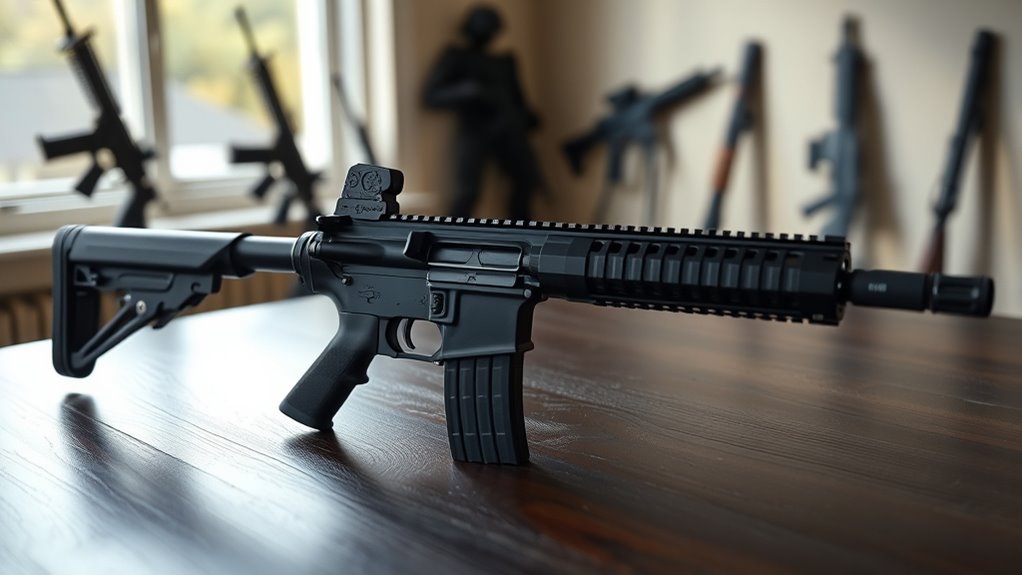
Despite the clear technical differences between the AR-15 and military assault rifles, many people still mistake the AR-15 for an assault rifle. This confusion stems primarily from misconceptions clarified when terminology explained is overlooked. The term “assault rifle” is often used colloquially to describe any rifle with a military-style appearance, which includes the AR-15’s design.
However, the AR-15 is a semi-automatic civilian firearm, lacking the selective-fire capability that defines true assault rifles. Media portrayal and political discourse frequently blur these definitions, reinforcing public misunderstanding. When you understand the precise meaning of “assault rifle” as a selective-fire weapon, you can separate fact from fiction and avoid the common confusion surrounding the AR-15’s classification.
Misconceptions clarified are essential for informed discussion.
Semi-Automatic vs. Automatic Firing: What Sets AR-15s Apart
Although both semi-automatic and automatic firearms discharge bullets, the key distinction lies in their firing mechanisms: an AR-15 operates solely in semi-automatic mode, meaning it fires one round per trigger pull without the capability for continuous fire, unlike automatic weapons that can fire multiple rounds with a single trigger engagement.
Understanding semi-automatic mechanics clarifies this difference. The AR-15’s firing modes are limited and precise. When you handle an AR-15, note:
- Each trigger pull initiates a single firing cycle, ejecting one spent cartridge
- The semi-automatic mechanism resets after each shot, requiring trigger release to fire again
- Automatic firearms use a different internal design, allowing continuous fire while the trigger remains depressed
This distinction is fundamental in defining the AR-15’s classification and performance profile.
How Do Gun Laws Treat AR-15s vs. Assault Rifles?
When comparing AR-15s and assault rifles under gun laws, you’ll find their classifications markedly influence legal treatment. AR-15s, being semi-automatic civilian rifles, generally face fewer restrictions than assault rifles, which are typically defined by their selective-fire capability. This distinction creates significant gun regulation differences, as assault rifles often fall under stricter controls due to their automatic firing modes.
Public perception also plays a role, with AR-15s frequently mischaracterized as assault rifles, affecting legislative approaches and enforcement priorities. You should understand that while AR-15s are legal in many jurisdictions with standard regulations, assault rifles may be banned or require special licensing.
Consequently, the legal framework hinges on technical definitions rather than appearance, shaping how each firearm is regulated and perceived under current laws.
Legal Criteria for Assault Weapons Under U.S. Gun Laws
You need to understand that federal law defines assault weapons based on specific features like barrel shrouds, pistol grips, and detachable magazines. However, state laws differ considerably, with some imposing stricter or broader criteria.
Knowing which characteristics influence classification is essential to grasp how an AR-15 is legally categorized across jurisdictions.
Federal Assault Weapon Definitions
Since federal law doesn’t offer a single, uniform definition of “assault weapon,” you need to understand that various statutes specify different criteria based on features like semi-automatic capability, detachable magazines, and specific design elements. Federal definitions focus on these technical characteristics, and legal interpretations often hinge on the presence or absence of certain attributes.
For example, the now-expired 1994 Federal Assault Weapons Ban outlined criteria including:
- Semi-automatic rifles with detachable magazines plus two or more military-style features (e.g., pistol grip, folding stock)
- Specific firearm models explicitly named in legislation
- Features enhancing rapid fire or concealability
Understanding these federal definitions is essential since they form the baseline for regulatory and enforcement decisions concerning assault weapons at the national level.
State-Specific Legal Variations
Federal definitions set a foundational understanding of assault weapons, but state laws often impose additional, varying criteria that can greatly affect how firearms like the AR-15 are classified and regulated. When you examine state regulations, you’ll find that legal definitions differ considerably, with some states adopting broader or narrower criteria than federal standards.
For example, California’s assault weapon laws include specific features and configurations beyond federal definitions, impacting how an AR-15 is legally categorized. Similarly, states like New York and Connecticut have their own unique regulatory frameworks, which may affect ownership, transfer, and permissible modifications.
Understanding these state-specific legal definitions is essential because they directly influence compliance requirements and enforcement. As a result, your AR-15’s legal status can vary dramatically depending on the jurisdiction.
Features Impacting Classification
Although legal definitions of assault weapons vary, certain firearm features consistently influence how an AR-15 is classified under U.S. gun laws. When you examine classification criteria, a precise features comparison is essential to understand regulatory distinctions.
Key features often scrutinized include:
- Detachable magazine capability: Enables rapid reloading, often a critical factor in classification.
- Pistol grip design: Alters handling characteristics and is frequently listed in legal definitions.
- Barrel length and muzzle device presence: Short barrels or flash suppressors can affect categorization.
How AR-15s and Assault Rifles Affect Public Debates on Gun Control
When you engage in discussions about gun control, the distinction between AR-15s and assault rifles often shapes the arguments and policy proposals presented. Public perception plays an essential role, as many people conflate the semi-automatic AR-15 with military-grade assault rifles, influencing emotional responses and legislative urgency.
Media portrayal further complicates the debate by frequently using the terms interchangeably, which can obscure technical differences and hinder informed policy-making. Understanding these nuances allows you to critically evaluate proposed regulations and the rhetoric surrounding them.
Accurately distinguishing between these firearms helps clarify the scope of legislative measures and promotes a debate grounded in factual evidence rather than misconceptions, ultimately fostering more effective and targeted gun control policies.
Common Myths About AR-15s and Assault Rifles, Debunked
Misunderstandings about AR-15s and assault rifles often stem from misinformation that clouds public discourse and policy decisions. To aid your grasp, myth debunking and terminology clarification are essential. Here are common myths you should reconsider:
Clearing up myths about AR-15s and assault rifles helps improve public understanding and informed debate.
– *Myth:* AR-15s are fully automatic assault rifles.
*Fact:* Most AR-15s are semi-automatic, firing one round per trigger pull, not automatic.
– *Myth:* All assault rifles fire military-grade ammunition.
*Fact:* Assault rifles vary in caliber; AR-15s typically use .223/5.56 rounds, standard but not exclusively military.
– *Myth:* “Assault rifle” and “assault weapon” are interchangeable terms.
*Fact:* “Assault rifle” is a technical classification requiring selective fire capability, while “assault weapon” is a legal term with varying definitions.
Understanding these distinctions sharpens your perspective on firearm discussions.
How to Talk Accurately About AR-15s and Assault Rifles
To communicate accurately about AR-15s and assault rifles, you need to distinguish technical definitions from popular usage. The AR-15 is a semi-automatic rifle designed for civilian use, with specific design considerations such as manual firing and limited rate of fire. In contrast, assault rifles are defined by their capability for selective fire, including fully automatic modes.
When discussing these firearms, you should clarify this distinction to avoid conflating them. Public perception often blurs these lines, leading to misconceptions fueled by media portrayal. To maintain precision, focus on the firearm’s mechanical properties rather than colloquial labels.
Frequently Asked Questions
What Maintenance Is Required for an AR-15 Rifle?
You need to follow strict cleaning procedures, including disassembling the bolt carrier group and barrel. Then apply proper lubrication techniques to all moving parts.
This ensures smooth operation and prevents corrosion or malfunctions during use.
Can AR-15 Rifles Be Customized With Accessories?
Think of your AR-15 as a blank canvas; its extensive customization options and accessory compatibility let you tailor performance and aesthetics precisely. From optics to grips, each addition enhances functionality, ensuring your rifle meets specific tactical needs flawlessly.
How Accurate Is the AR-15 for Target Shooting?
You’ll find the AR-15 offers excellent target precision, especially within typical shooting distances up to 300 yards.
Its inherent design and barrel quality guarantee consistent accuracy, making it a reliable choice for precision target shooting enthusiasts.
What Are the Common Calibers Used in AR-15 Rifles?
You’re stepping into a chamber of choices where popular calibers like .223 Remington and 5.56 NATO dominate. Understanding caliber differences is essential; they affect velocity, recoil, and terminal ballistics, tailoring your AR-15’s performance precisely.
Are AR-15S Suitable for Hunting Purposes?
Yes, AR-15s can be suitable for hunting if you comply with hunting regulations and consider ethical factors like shot placement and caliber selection.
These considerations help guarantee humane kills and minimize animal suffering during your hunting activities.
Conclusion
So, you’re probably ready to declare the AR-15 either a mythical assault rifle or just a fancy semi-auto, right? Not so fast. The truth is, the AR-15’s not some automatic war machine—it’s a civilian firearm with distinct legal and mechanical boundaries.
Mixing it up with assault rifles is like calling a sports car a tank. Understanding these precise differences helps you cut through the noise and debate with clarity and authority.
In conclusion, while the AR-15 shares some design features with military rifles, it does not meet the legal or functional criteria to be classified as an assault rifle.